Mercedes S-Class Coupe Renderings
Renderings of the next-generation S-Class Coupe make their way onto the web
For those of you eagerly anticipating the arrival of the new S-Class Coupe, new design sketches have been revealed showing some design insight as to what we can expect from the luxury model. There’s no word on whether they’re official Mercedes renderings, but judging from past design sketches there’s a good chance they are.
As you’ll see in the photos, the design is significantly more sporty than that of its four door counterpart, with gorgeous new sloping roof line, new tail lights, and a totally redesigned front fascia. And while design sketches typically tend to be more masculine than the final production car, from the looks of it, this may be the sportiest S-Class Coupe/CL-Class to date.
We’ll keep you posted as new details of the forthcoming S-Class Coupe are revealed in advance of its Frankfurt Motor Show debut (just a few days away); in the meantime, check out more photos of the S-Class Coupe in the gallery below.
Mercedes S-Class Coupe Spy Video and Photos
2014 Mercedes-Benz S-Class Coupe will likely make first public debut in September at Frankfurt Motor Show
The 2014 Mercedes-Benz S-Class sedan may have had its world debut back in May, but since that launch, Mercedes has been busy finishing development on additional S-Class variants. One of those variants is this, the S-Class Coupe, which we hope to see as a concept this September in Frankfurt. While we brought you spy photos a few weeks back of the upcoming model, today we have a video of the flagship Mercedes Coupe making its way around the Nürburgring.

2015 Mercedes S-Class Coupe
Covered heavily in camo, it looks conservative with gentle body lines, swept back headlamps, wrap-around taillights, dual exhausts and a single bar grille in the front.
While interior photos haven’t been shown, the cabin of the coupe will be very similar to that of the S-Class Sedan, including the gorgeous wood and attractive lighting.
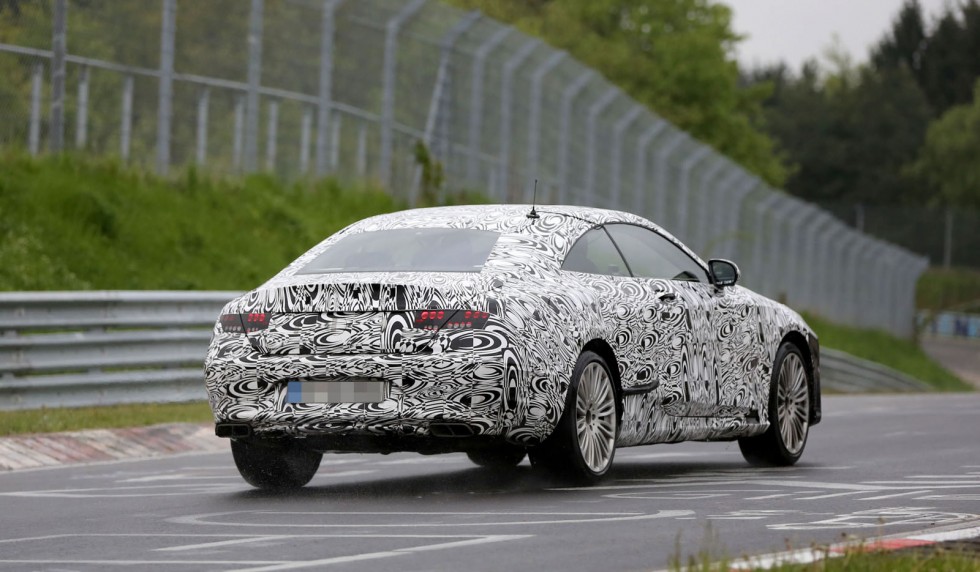
Mercedes S-Class Coupe
Under the hood of the coupe will likely be a 4.7-liter V8 that’s capable of outputting 455 HP (335 kW) and 700 Nm (516 lb-ft) of torque, with other options including a twin-turbo 3.0-liter V6, twin-turbo 5.5-liter V8 and a V12 engine option in the S65 AMG Coupe.
You can see more of the 2015 S-Class Coupe in the photo gallery below.
Mercedes S-Class Coupe Testing Spy Photos
The 2015 S-Class coupe will take several styling cues from the saloon as well as share many of the same engines
Now that some of the excitement from the 2014 S-Class world premiere has died down – who are we kidding, we’re all still dying to ride in the reclining backseat get behind the wheel of the new model. But, regardless of our new fascination, our interest have again been peaked, this time by the Coupe version of the S-Class. The latest spy photos show the 2015 Mercedes S-Class Coupe doing a little testing on the world famous Nürburgring.
The new coupe version of the S-Class will no doubt take several styling cues from the saloon as well as share many of the same engines. We can expect an S500 loaded with a 4.7-liter V8 that outputs 455 HP and 700 Nm of torque with top of the range models being paired with a V12 and a twin-turbo V8 in the S63 AMG.
From the photos, we can see the CL-Class replacing S-Class has a single bar grille with slim headlights, door mounted mirrors and a lower roofline. The overall look of the 2015 S Coupe is far sportier than the outgoing model.
We expect to see the all-new S-Class Coupe debuting early next year at either the Geneva or Shanghai Motor Show.
Photos via: GMotors.co.uk
2015 Mercedes S-Class Coupe Preparing to Replace the CL
Spied testing once again this week was the Mercedes CL replacement, the all-new 2015 Mercedes-Benz S-Class Coupe prototype
Spied testing out in the open once again this week was the Mercedes CL replacement, the all-new 2015 Mercedes-Benz S-Class Coupe prototype.
The 2015 S-Class Coupe will receive a significantly lower roofline, squared-off front-end, door-mounted mirrors and enhanced front and rear fenders.
The S-Class Coupe will be one of the five versions offered in the new S-Class lineup, three different wheelbase lengths, the coupe seen here and as a convertible. The S-Class has been confirmed for launch in Hamburg on May 15, stay tuned. Photos Via: Gmotors.co.uk
Mercedes S-Class Coupe Clearly Spied Testing in Arctic Cirlce
Check out the most recent and clearest Mercedes S-Class Coupe spy photos to date
Our good friends over at GMotors have captured the clearest spy photos to date of the next-generation Mercedes-Benz S-Class Coupe. The photogs captured the CL-Class replacement doing a bit of winter testing near the Arctic Circle in Sweden. The spy photos clearly reveal a lower roofline, door mounted mirrors, narrower rear lights and a more squared-off front.
Compared to the Mercedes CL-Class, the new S-Class Coupe is far sportier giving the coupe a younger livelier feel. The new S-Class is set to be launched on May 15 in Hamburg with the Coupe expected to follow in 2014.
Enjoy the spy photos and a big thanks to Andrus and GMotors.
Mercedes-Benz S-Class Coupe First Spy Photos
The next-gen S-Class will come in 3 wheelbase variations: standard, long and a pullman as well as a coupe and convertible
For the first time, spy photos of the next generation Mercedes-Benz S-Class Coupe have made their way onto the web. Replacing the previous large luxury coupe model, the CL-Class, the S-Class Coupe will have sportier styling than the sedan with a squared off front, lowered roofline, more noticeable front and rear fenders and door mounted mirrors.
It’s already been confirmed that the next generation S-Class will be launched in mid-2013 with three wheelbase options – standard, long and a pullman variant to replace the Maybach 57. We’ll also see the coupe and a convertible down the road.
Photos via: WCF
Mercedes-Benz S-Class To Come in Five Different Styles
According to sources, the upcoming new S-Class lineup will include five models in three different body styles
According to sources, the upcoming new S-Class (W222) lineup will include five models in three different body styles.
The sedan version will be offered in three different lengths, due to the German car maker’s recent decision to axe its Maybach brand after a decade of disappointing sales following its resurrection in 2002. Also in the family will be a coupe and cabriolet model. The S-Class Coupe is likely to be officially revealed at the Geneva Motor Show in 2014, while the convertible will be revealed six month later in Frankfurt.
All three sedans are expected to adopt the same styling, except for the length of the rear doors and windows. Standard and long wheelbase models will be unveiled this September in Frankfurt, while the Pullman version could be revealed next year at the Beijing Motor Show. Set to replace the Maybach 57, the Mercedes-Benz S-Class Pullman will probably have a 5700mm length.
Mercedes-Benz CL Grand Edition Marks 60 Year Anniversary
The CL Grand Edition includes designo paintwork, designo leather appointments and sportily elegant 20-inch wheels
Mercedes-Benz is marking the anniversary of “60 years of the S-Class Coupé” with a new “Grand Edition” model. The features of the CL‑Class “Grand Edition” include exclusive designo paintwork, high-quality designo leather appointments and sportily elegant 20-inch wheels. AMG bodystyling elements add a distinctive touch of sportiness, while a special badge indicates the exclusive nature of this anniversary edition of the luxury coupé.
The launch of the sensational 300 S in 1952 established the lineage of today’s CL-Class. The large S-Class Coupés from Stuttgart have been considered the epitome of automotive refinement ever since. These two-door luxury-class coupés combine the comfort of a prestige luxury saloon with the dynamics of a sports car in the form of an exceptionally elegant tourer. They offer stunning design, exclusive appointments and top-flight technology. For its new “Grand Edition” special edition model, Mercedes-Benz has further honed the sophisticated and unmistakable style of this design icon, adding further to its cachet and maintaining the brand’s leadership status in the luxury car segment.
In order to emphasise further the exclusive, hand-finished character of the CL‑Class, Mercedes-Benz has furnished the “Grand Edition” with some of the finest ingredients from the exquisite designo range. Customers can choose between the three designo paint finishes of platinum black metallic, mocha black metallic and the currently very voguish matt finish of magno cashmere white. A sporty note is added to the car’s look by the AMG Sports package, with powerful front and rear aprons and distinctive side sill panels. Also included here are 20-inch light-alloy wheels in a choice of five-spoke or filigree 10-spoke designs. A “Grand Edition” badge provides a discreet indication of the CL Coupé’s exclusive-edition status.
In the interior, exquisitely handcrafted, high-quality aniline leather serves to underline the luxurious nature of the “Grand Edition”. Three stunning and tasteful leather colours are available to choose from for the interior appointments: designo aniline leather armagnac, designo aniline leather deep black and the lighter designo aniline leather porcelain. The full range of CL trim finishes is available, including black ash and high-gloss burr walnut.
As with all CL models, the CL “Grand Edition” is also exceptional in technical terms. The active suspension system Active Body Control (ABC) with crosswind stabilisation, for example, sets the benchmark for driving dynamics and comfort on all rear-wheel drive CL models. Safety systems such as the drowsiness detection system ATTENTION ASSIST, PRE-SAFE® automatic emergency braking and the optional Active Blind Spot Assist, Active Lane Keeping Assist, and Adaptive Highbeam Assist systems, ensure that the CL takes pole position in the luxury coupé segment.
And the same is true of the engine range: the current V8 biturbo with a displacement of 4.6 litres and sophisticated spray-guided direct petrol injection system in the CL 500 BlueEFFICIENCY delivers 320 kW (435 hp), provides torque of 700 newton metres and opens up a whole new dimension of efficiency in the luxury coupé segment (9.5 l/100 km combined; 224 g/km CO2). The same engine is also used in the CL 500 BlueEFFICIENCY with 4MATIC all-wheel drive. The pinnacle of the engine range is provided by the CL 600 with its 380 kW (517 hp) 12-cylinder biturbo (displacement: 5.5 litres).
Irrespective of which base model is chosen, the CL “Grand Edition” is available for a package price of 4850 euros (excl. VAT). This represents a benefit to the customer of up to 38 percent. The complex designo magno paintwork is priced at an additional 1500 euros.
2010 Mercedes-Benz CL-Class Is the Epitome of Luxury
The new generation CL focuses on fuel consumption and exhaust gas emissions in the exclusive high-end segment
With a design perfected through an immaculate sense of style, highly exclusive appointments and cutting-edge technology, the extensively updated Mercedes-Benz CL underscores its claim to supremacy as the summit of automotive refinement. The entirely re-designed 320 kW (435 hp) V8 biturbo engine of the CL 500 BlueEFFICIENCY, with a combined consumption of 9.5 litres premium-grade petrol per 100 kilometres, opens a new dimension of efficiency in the luxury coupé category. Its NEDC figures show savings of around 22 percent over its predecessor model, CO2 emissions having dropped from 288 grams per kilometre to 224 grams per kilometre. This significant reduction is achieved thanks to the newly-developed BlueDIRECT technology with third-generation spray-guided direct injection, with the contribution of the specially-designed BlueEFFICIENCY package of the CL 500 BlueEFFICIENCY.
The package includes, among other things, energy-efficient control of alternator, fuel pump, air-conditioning compressor and power-assisted steering system, as well as the ECO start/stop function. It also features the use of low rolling resistance tyres and the energy-optimised Active Body Control system. In addition, the Mercedes-Benz developers equipped the CL with state-of-the-art multimedia technology, thus helping this model, produced with a high proportion of hand-finished work, to retain its position as the epitome of quality in its class.
With the new generation of the CL, the Stuttgart-based automaker focuses on fuel consumption and exhaust gas emissions in the exclusive high-end segment, too. According to Dr Dieter Zetsche, Chairman of the Board of Management of Daimler AG: “The CL is the ideal ambassador for our brand. To a special degree it integrates the things that go to make a Mercedes-Benz: fascination, perfection and responsibility. And with the new generation we raise the ante particularly in the area of efficiency. But in the realms of design, safety, comfort and performance, too, the CL shows: ahead is where Mercedes is.”
In addition, a combination of cutting-edge camera and radar-based assistance systems unique in the luxury coupé segment, including the innovation of the Active Lane Keeping Assist and the Active Blind Spot Assist, makes of the CL a “thinking” partner of the driver. The modified Active Body Control (ABC) with crosswind stabilisation system and the Direct-Steer system also contribute to enhancing safety and driving enjoyment.
Design: a muscular, self-assured presence
The exterior appearance of the new CL generation is characterised by the terse profile of the bonnet, the dynamic V-shape radiator grille and the curving headlamps – design details that discreetly but effectively emphasise the car’s elegant yet powerful lines.
The front bumper, too, presents a new design with three air intake openings and a chrome trim strip. An LED strip with chrome surround for the daytime running lamps is elegantly integrated in the side openings for the brake cooling air. With their standard-fit Intelligent Light System (ILS) and Adaptive Highbeam Assist, the headlamps offer state-of-the-art illumination technology. The latest LED technology in the turn indicators and position marker lamps rounds off the car’s advanced image. The rear of the vehicle is characterised by the newly-designed tail lights.
New V8 biturbo engine with innovative technology
The new-generation CL also assumes a pioneering role in the drive system sector. Under the bonnet of the CL 500 BlueEFFICIENCY and CL 500 4MATIC BlueEFFICIENCY a new V8 biturbo engine with BlueDIRECT technology delivers its impressive power. With its 4663 cubic centimetres displacement, the eight-cylinder engine produces 320 kW (435 hp) so that despite 0.8 litres less displacement, it is still around 12 percent more powerful than its predecessor, which had an output of 285 kW (388 hp). At the same time, torque was raised from 530 Nm to 700 Nm – an increase of 32 percent. Combined consumption in the New European Driving Cycle (NEDC), on the other hand, drops by around 22 percent to 9.5 litres of premium petrol per 100 kilometres for the rear-wheel drive version. CO2 emissions consequently sink from 288 grams per kilometre to 224 grams per kilometre. The CL 500 BlueEFFICIENCY requires a mere 4.9 seconds to accelerate from a standstill to 100 km/h (previous model: 5.4 seconds). Summing up: the CL 500 BlueEFFICIENCY is significantly more agile, torquey and thriftier than its predecessor.
The BlueDIRECT technology package of the V8 biturbo includes a series of new developments, unique in their combination. Worthy of mention among these is the third generation spray-guided direct petrol injection with piezo injectors and multi-spark ignition with up to four ignition sparks within a millisecond. Together both enable an innovative combustion process called “homogenous split”. Other factors contributing to the exemplary low fuel consumption continue to be the consistent use of friction-optimised pistons, piston rings and cylinder barrels, the on-demand control of oil pump and the new three-phase thermal management in the coolant circuit. The luxury coupé’s technology package includes the ECO start/stop function and alternator control in accordance with the handling situation and on-board voltage, including kinetic energy recuperation in overrun mode.
The CL 600, with its 380 kW (517 hp) 12-cylinder biturbo engine remains the top-of-the-line model: it accelerates the luxury coupé from a standstill to 100 km/h in impressive 4.6 seconds and now also complies with the Euro 5 emissions control standard.
A unique combination of driver-assistance systems
With state-of-the-art assistance and protection systems the new generation CL underpins its status as an automotive masterwork and technology platform of the Stuttgart-based company. The attentive assistants turnthe Mercedes model into an “intelligent” partner which is able to “see”, “feel”, respond “instinctively” to detected dangers and act “on its own initiative” in order to avoid accidents or to reduce their severity. The trailblazing driver assistance systems in the CL are based on cutting-edge radar, camera and sensor technology.
Thus, in the new-generation CL the Active Lane Keeping Assist celebrates its premiere (at the same time as in the S-Class). If the vehicle threatens to cross a broken lane marking line, the system actuates an electric motor in the steering wheel, causing it to vibrate briefly – giving the driver a discreet but effective warning hint to countersteer immediately. The active system springs into action if the Mercedes coupé unintentionally crosses a continuous lane marking line to the right or to the left. In this case, it intervenes by gently braking the wheels of the opposite side of the car, helping the driver to stay in the lane. In order to do this Active Lane Keeping Assist avails itself of the Electronic Stability Program ESP®.
Active Lane-Keeping Assist evaluates information provided by a camera mounted on the inside of the windscreen. It identifies the contrast between the road surface and the lane marking lines. In addition to this, using radar the system scans the side of the roadway for crash barriers and other roadway edge markings. This Mercedes assistance system also evaluates the driver’s actions and can thus reliably determine whether the car is departing from the lane intentionally or not. For this reason, there is no warning if the driver accelerates hard just before overtaking or when accessing a motorway, or if he brakes hard or steers into a curve.
Targeted brake actuation: Active Blind Spot Assist
A further innovation Mercedes-Benz offers for the CL is Active Blind Spot Assist, a system that makes use of a multi-stage warning concept. If it detects that a change of lane would be too dangerous, it warns the driver by displaying a red triangle in the glass of the exterior mirror. Close-range radar sensors monitor the area immediately to the side and to the rear of the car. If the driver disregards this warning and, for example, actuates the turn indicator, an audible warning also sounds. If the driver continues to ignore the warnings and comes dangerously close to a vehicle in the neighbouring lane, a novel feature of the system acts: a corrective braking intervention via ESP® on the wheels of the opposite side of the vehicle. This causes a yaw movement about the car’s vertical axis due to the unequal distribution of the braking forces. If despite this course correction an accident cannot be avoided, the Active Blind Spot Assist system can reduce the consequences of a collision through the brake actuation.
Assistants to see and be seen better
Adaptive Highbeam Assist is another standard-fit system featured by the CL. This camera-based system can recognise oncoming vehicles or vehicles ahead with their lights on, and then controls the headlamps to ensure the best possible beam range without dazzling other road users. In addition, Mercedes-Benz offers the Night View Assist Plus system for the CL, featuring a special infrared camera for pedestrian detection: as soon as the system detects pedestrians on the road ahead, these are highlighted additionally in the display, in order to catch the driver’s attention better.
The images supplied by the windscreen camera are also used by the new, optional Speed Limit Assist, which recognises speed limit signs in passing and shows the relevant speed limit in the central display and on the navigation system’s map display (standard for the CL 600).
For the new-generation CL, Mercedes-Benz has also improved the long and medium-range radar used by Brake Assist PLUS (BAS PLUS) and DISTRONIC PLUS proximity control.
An “electronic crumple zone”: the PRE-SAFE® Brake
Mercedes-Benz also offers another radar based system for the luxury coupé as a component of the Driving Assistance package Plus in the form of the PRE-SAFE® Brake. If the driver is distracted and fails to recognise the imminent danger of a rear-end collision or the warning signal of an assistance system, this system can intervene and brake the vehicle independently. If the driver fails to react even after automatic, partial braking action, this most recent development stage of the PRE-SAFE® Brake activates the maximum braking pressure around 0.6 seconds before what it now recognises as an unavoidable collision — an emergency braking action that can significantly mitigate the severity of the impact. The PRE-SAFE® Brake thus acts as a kind of “electronic crumple zone”.
Warns driver of drowsiness: ATTENTION ASSIST
Drowsiness is one of the most common causes of accidents. This is why Mercedes experts have developed the ATTENTION ASSIST system which forms part of the standard equipment of the new-generation CL. As the vehicle is being driven, the system continuously evaluates more than 70 different parameters in order to identify driver drowsiness and provide a warning before the dangerous micro-sleep phase begins. Observing the driver’s steering behaviour has proved to be a particularly strong indicator: several years of practical research by Mercedes-Benz have shown that drowsy drivers make minor steering errors which they often correct very rapidly in a characteristic way. This steering behaviour is recognised by a special steering angle sensor. Observing the driver’s eyes cannot always provide conclusive evidence of sleep since many drivers can experience micro-sleep with their eyes open.
Active Body Control reduces the effect of a crosswind
The CL also meets the highest standards in terms of driving dynamics and agility. This is in part thanks to Direct-Steer, with a steering ratio that varies with the steering angle, and modified Active Body Control (ABC) with crosswind stabilisation (standard for the CL 500 BlueEFFICIENCY and CL 600). This latest stage in active suspension development modifies the wheel load distribution via the ABC spring struts within milliseconds, depending on crosswind direction and intensity, to the extent that it can largely compensate the effects of the crosswind.
The Active Body Control suspension system with which Mercedes-Benz ushered in new dimensions of driving dynamics in the CL Coupé of the preceding C 215 model series in 1999, is unique worldwide as it not only regulates roll, but pitching and squatting movements as well, ensuring a perfect harmony of comfort and handling stability. Since the introduction of this innovative system, engineers in Sindelfingen have continuously improved on it, so that eleven years later it still marks the summit of automotive engineering. In addition to crosswind stabilisation, in its latest version the active suspension features a new energy-optimised hydraulic pump that takes part of the burden off the engine, contributing towards reducing fuel consumption.
Additional safety and agility at the physical limits is provided in the new-generation CL by the standard-fit Torque Vectoring Brake – targeted, one-sided braking intervention at the inside rear wheel when cornering. This enables the luxury coupé to turn into the bend under precise control with even greater agility.
Onboard infotainment: the most advanced multimedia technology
In line with its serene character and claim to be a technological masterwork, the CL also sets standards where onboard infotainment is concerned. Thus, the Stuttgart automotive manufacturer equips its flagship model with the new SPLITVIEW technology for the COMAND control and display system centrally located in the centre console (standard for the CL 600 in conjunction with Front Seat Entertainment package). This innovative display concept allows the driver and front passenger to view different contents simultaneously on one and the same screen. While the driver, for example, uses the map-based navigation system, the front passenger can be watching a film on DVD.
The standard COMAND control and display system with Bluetooth®, USB and SD card interfaces offers customers the possibility of exporting their stored data to other vehicles and multimedia devices. It is also possible to transfer and update navigation data. In the glove compartment Mercedes-Benz integrates as optional equipment the Media Interface – an interface for mobile audio and video devices – devices such as the iPod® and every other possible customer device.
The optional Navigation package with COMAND APS (standard for the CL 600) features a Europe-wide navigation system whose data are stored on a 40-gigabyte hard disc, enabling extremely rapid route calculation. Another factor contributing to a high level of navigation comfort is the detailed three-dimension map display including updates free of charge for three years. For musical entertainment COMAND APS provides a radio, a CD/DVD player with MP3 function, an equaliser with speed-dependent volume control and the MUSIC REGISTER with a 7.2 gigabyte hard disc which stores around 2500 digital music files in MP3, AAC or WMA format (which can be conveniently transferred to the REGISTER from PC memory cards). The system recognises music files played on CD, DVD or from the MUSIC REGISTER using its stored Gracenote® database, and shows the title, album and performer in the colour display. Another new function, Music Search, enables CL drivers and passengers to search SD memory cards, USB sticks, CDs and DVDs for specific music titles and performers.
The Navigation package also includes the latest-generation LINGUATRONIC voice-operated control system that controls the navigation, telephone and audio devices via whole-word input. Benefit: the driver no longer needs to spell out his commands but simply speaks the corresponding words as whole words when entering the destination or choosing a radio station or a music title from the MUSIC REGISTER, or when calling up a name from the phone book.
The further developed surround sound system with Discrete Logic7® technology developed by Mercedes-Benz together with audio specialists Harman Kardon® delivers an outstanding performance with three-dimensional sound as a natural 360-degree musical experience for all passengers of the CL. Mercedes-Benz offers the surround sound system together with SPLITVIEW and a six-disc DVD changer as part of the Entertainment package (standard for the CL 600).
Interior: carefully selected materials and first-class finish
In the interior, too, Mercedes-Benz developers and designers perfected the CL paying careful attention to detail. A total of four different kinds of fine wood open up the possibilities for perfectly matched material and colour concepts according to personal taste: apart from light and dark high-gloss burr walnut, there is black ash and brown high-gloss poplar (CL 600). Another particularity: in line with the central importance awarded to the concept of sustainability within the Mercedes-Benz corporate philosophy, the CL employs only European wood from renewable forestry sources. Most of the wood parts are hand-made and matched individually for colour and grain by experienced craftsmen.
The seat covers of the new CL are of the most exquisite quality. For this luxury model there are two different kinds of leather available which thanks to their low pre-tensioning and consequent wrinkle effect appear supple and comfortable from the very first glance. There is a choice of five tasteful colour combinations for the vehicle interior: black/black, savannah beige/cashmere beige, sahara beige/black, and the novel combinations alpaca grey/basalt grey and aubergine/black.
The multifunction steering wheel of the CL has also been modified by the Mercedes-Benz designers: the rim and airbag module are lined with soft nappa leather as standard. The new, flatter airbag module also lends a sporty touch to the multifunction steering wheel covered in leather sewn with sophisticated double stitching.
Apart from this, Mercedes-Benz makes more use of light as a styling element in the vehicle interior. In future customers who specify the optional ambient lighting (standard for the CL 600) have a choice between three lighting moods: solar (amber), neutral (white) and polar (ice-blue).
Tradition: an exclusive line of ancestors
The new generation CL continues the great tradition of Mercedes-Benz coupés, which reaches back to the legendary supercharged cars of the 1920s and ’30s. Since the 1950s, in particular, the brand with the three-pointed star has produced an uninterrupted series of exclusive two-door cars which combine sophisticated design with trailblazing technology – every model an automotive classic. The W 188 model series 300 S Coupé which entered series production in 1952 marked the beginning. A contemporary report called it the “measure of what it is possible to achieve in automotive engineering”.
This statement has retained its full validity for all subsequent models, right down to the current CL of model series C 216, because the luxury coupés from Mercedes-Benz featured – apart from their timeless design and the highest level of comfort – trailblazing innovations in automotive technology. Thus it was that in 1961 the 220 SE Coupé was the first series-production Mercedes-Benz to be equipped with disc brakes. In 1995 the Electronic Stability Program ESP® celebrated its world premiere in the S 600 Coupé of model series C 140, and in 1999 the Active Body Control suspension system was introduced for the first time in the CL-Class, model series C 215. With the PRE-SAFE® brake a further technological innovation made its debut in a large Mercedes-Benz coupé. In the new CL generation, two new developments, Active Lane Keeping Assist and the Active Blind Spot Assist, will help prevent accidents or reduce their severity.
The new-generation CL can already be ordered from Mercedes-Benz sales outlets and authorised dealers. The prices:
- CL 500 BlueEFFICIENCY: 118,346 euros
- CL 500 4MATIC BlueEFFICIENCY: 123,463 euros
- CL 600: 162,792 euros
(all prices include 19% VAT)
2011 Mercedes-Benz CL63 AMG and CL65 AMG General Overview
The new CL 63 AMG, High performance coupé with new drive system – Higher performance, lower consumption
New design and new high-tech drive system: the Mercedes-Benz CL 63 AMG is to feature a new cutting-edge look as well as state-of-the-art technology. The stylish visual modifications will be accompanied by a completely newly developed powertrain. The AMG 5.5-litre V8 biturbo engine with a peak output of up to 420 kW (571 hp) and a torque of up to 900 Nm, in combination with the unique AMG SPEEDSHIFT MCT 7-speed sports transmission, contributes towards a considerable increase in driving dynamics, while at the same time guaranteeing a respectable reduction in consumption and emissions. With a fuel consumption of 10.5 litres per 100 kilometres (NEDC combined), the new high-performance coupé not only undercuts its direct competitors – it is also 27 percent more economical in terms of its fuel consumption than the previous model with naturally aspirated V8 engine.
The new CL 63 AMG marks the start of a new chapter in the “AMG Performance 2015” drive strategy: Mercedes-AMG is continuing this impressive story and is meeting its promise to continuously reduce both the fuel consumption and emissions of new models with the new engine/transmission combination – while reaching new heights with the central AMG brand value of “performance”.
According to Ola Källenius, head of Mercedes-AMG GmbH: “We are heading into a new era with the CL 63 AMG: for the first time we have combined spray-guided direct petrol injection with biturbocharging and the stop/start system. Together with the AMG SPEEDSHIFT MCT 7-speed sports transmission, we have reduced both fuel consumption and emissions significantly – while at the same time increasing output and torque.”
Together with the AMG SPEEDSHIFT MCT 7-speed sports transmission, the newAMG 5.5-litre V8 biturbo engine will play a significant role in the Mercedes-AMG model strategy over the coming year. The new engine/transmission combination marks a further milestone in the successful history of Mercedes-AMG, which began back in 1967.
Direct petrol injection and twin turbocharging
Designated internally as the M157, the new V8 engine is a prime example of efficiency and features a whole host of impressive technological highlights: for the first time Mercedes-AMG is taking advantage of direct petrol injection with spray-guided combustion and piezo injectors. This technology enables improved fuel economy thanks to higher thermodynamic efficiency, which in turns leads to lower exhaust emissions. AMG has combined the spray-guided combustion with biturbocharging. Other highlights of the innovative, original eight-cylinder engine from Affalterbach include full aluminium crankcase, four-valve technology with variable intake valve timing, air/water charge air cooling, generator management and also standard start/stop function. Compared with the AMG 6.3-litre naturally aspirated V8 engine with a displacement of 6208 cc, the new AMG 5.5-litre V8 biturbo engine achieves all this with a displacement of 5461 cc.
This high-tech package leads to a high output and torque yield, together with fuel consumption figures that are unrivalled in the competitive lineup. The AMG 5.5‑litre V8 biturbo engine develops a peak output of 400 kW (544 hp) and maximum torque of 800 Nm. In conjunction with the AMG Performance package these figures are increased to 420 kW (571 hp) and 900 Nm. A look at the performance diagrams shows that no other engine in this output class achieves the figures delivered by the new AMG biturbo. The major difference between the two performance classes is an increase in the maximum charge pressure from 1.0 to 1.3 bar. In addition, the engine cover of the CL 63 AMG with the AMG Performance package comes with high-quality carbon-fibre applications.
Quantum leap: fuel consumption reduced by 25 percent
With an NEDC fuel consumption of 10.5 litres per 100 kilometres, the new CL 63 AMG is 3.9 litres more economical than the previous model powered by the naturally aspirated AMG 6.3-litre V8 – despite an increase in maximum power of 14 kW(19 hp) and 34 kW (46 hp) respectively, and in torque of 170 and 270 Nm. Engine specialists consider this achieved fuel saving of more than 25 percent to be nothing less than a quantum leap. CO2 emissions have likewise been significantly reduced: at 244 grams per kilometre, the figure is 29 percent lower than for the previous model. Both performance variants have identical fuel consumption and CO2 figures.
With figures like these, the new CL 63 AMG is not only considerably better than all its competitors, but also more fuel-efficient than much less powerful cars in this segment.
Sports car-level performance
At the same time the CL 63 AMG delivers superior performance at sports car level: the Coupé accelerates from zero to 100 km/h in 4.5 seconds, and has an electronically limited top speed of 250 km/h. The 100 km/h mark is reached in just 4.4 seconds with the AMG Performance package, with the top speed increased to an electronically limited 300 km/h.
It is not only the unrivalled torque delivery of this turbocharged eight-cylinder that makes the heart beat faster, as the agile responsiveness with no irritating charger delay also leads to an effortlessness and dynamism previously unknown in this output class. All perfectly matched by the characteristic and powerful, sonorous engine note. Moreover, this AMG high-performance engine naturally meets all the requirements with respect to smooth, quiet running and the comfort on long journeys that is to be expected of a Mercedes.
Key data at a glance:
| CL 63 AMG | |
| Displacement | 5461 cc |
| Bore x stroke | 98.0 x 90.5 mm |
| Compression ratio | 10.0:1 |
| Output | 400 kW (544 hp) at 5500 rpm 420 kW (571 hp) at 5500 rpm* |
| Max. torque | 800 Nm at 2000 – 4500 rpm 900 Nm at 2250 – 3750 rpm* at 2500 – 3750 rpm* |
| Engine weight (dry) | 204 kg |
| Power/weight ratio | 0.41 kg/hp 0.39 kg/hp* |
| Fuel consumption NEDC combined | 10.5 l/100 km |
| CO2 emissions | 244 g/km |
| Acceleration 0 – 100 km/h | 4.5 s 4.4 s* |
| Top speed** | 250 km/h 300 km/h* |
* with AMG Performance package; ** electronically limited
AMG SPEEDSHIFT MCT 7-speed sports transmission
Power is transferred by the AMG SPEEDSHIFT MCT 7-speed sports transmission used exclusively by AMG. It combines high emotional appeal with outstanding driving dynamics and a high level of efficiency. A wet start-up clutch replaces a conventional torque converter, and helps to save fuel. The exemplary fuel economy is also in large measure due to the standard stop/start function. This system is active in the transmission’s Controlled Efficiency (“C”) mode, and switches the eight-cylinder engine off when the car comes to a stop. In “C” mode the coupé always starts off in second gear, and the transmission shifts to the next, higher gears at a decidedly early stage. With its high torque at low engine speeds, the V8 engine encourages a smooth, effortless driving style.
The eight-cylinder biturbo engine also features a generator management system: whenever the engine is on the overrun or when braking, kinetic energy is used to charge the battery rather than being wasted as heat in the usual way. In all other operating modes a combination of onboard network and generator management
enables the generator to be kept at a low voltage. This reduces the load on the engine and makes for fuel savings of around 0.15 litre per 100 kilometres according to the NEDC standard, and up to 0.2 litre per 100 km in city traffic with its frequent overrun and braking phases.
Engine production – tradition of hand-built excellence
Like all other AMG engines, the new eight-cylinder biturbo is assembled by hand in the AMG engine shop taken into commission in 2002. Highly-qualified technicians assemble the M157 according to the “one man, one engine” philosophy, maintaining the very strictest quality standards. This painstaking care is attested to by the signature on the characteristic AMG engine plate.
New AMG triple-spoke light-alloy wheels
In visual terms, the new CL 63 AMG has an even more athletic, confident appearance. The bonnet, headlamps, radiator grille, bicolour tail lamps and the newly designed AMG bodystyling all add more dynamism. The “V8 Biturbo” lettering on the mudguards points to the new powertrain. Also featuring a new look are theAMG triple-spoke light-alloy wheels, painted in titanium grey and with a high-sheen finish, and fitted with 255/40 and 275/40 R 19 tyres. New in the interior are the AMG sports steering wheel with silver-coloured aluminium shift paddles and specially shaped grip area covered with perforated nappa leather, as well as the “AMG V8 Biturbo” start screen in the AMG instrument cluster. As a new optional extra, SPLITVIEW is also available for the COMAND multimedia system.
Direct-Steer system, Torque Vectoring Brake and crosswind stabilisation
With immediate effect, standard equipment on the CL 63 AMG now includes the Direct-Steer system, Torque Vectoring Brake and crosswind stabilisation. With its variable ratio depending on steering angle, the Direct-Steer system helps to ensure a more direct response when cornering, and therefore more responsive handling – in brief: enhanced driving pleasure at the wheel of the Mercedes-AMG CL-Class. Thanks to brief direct application of the brakes on the vehicle’s inner rear wheel when cornering, the Torque Vectoring Brake, meanwhile, helps to ensure that the V8 coupé corners precisely and under control at all times. The Torque Vectoring Brake is an additional feature of the Electronic Stability Program ESP® and not only noticeably improves responsiveness but also active handling safety in critical conditions.
The AMG sports suspension based on Active Body Control (ABC) now also provides crosswind stabilisation as an additional function: thanks to this feature, influences caused by crosswinds are compensated for, or – in the case of strong gusts – reduced to a minimum. ABC compensates against the effect of crosswinds by adjusting the wheel load distribution within milliseconds, using the yaw-rate and lateral acceleration sensors of the ESP®.
Based on the ADAPTIVE BRAKE system with large compound brake discs all round, the AMG high-performance braking system continues to set the benchmark for stopping power, sensitivity and fade resistance.
A unique combination of driver-assistance systems
The unique combination of innovative camera and radar-based driver-assistance systems has been enhanced even further with immediate effect with a view to perfecting the vehicle’s active and passive safety. New optional extras now available for the CL 63 AMG include Active Lane Keeping Assist and Active Blind-Spot Assist. Active Lane Keeping Assist comes into play when the CL 63 AMG unintentionally strays over a solid line on the right or left of a lane or on the outside of a bend. In such cases the Electronic Stability Program ESP® applies the brakes to the wheels on the opposite side of the vehicle to prevent it from unintentionally straying from its lane.
Also new is the Active Blind Spot Assist, which warns the driver by displaying a red warning in the glass of the relevant exterior mirror when it detects that changing lanes would be too dangerous. If the driver ignores the warning signal and a vehicle in an adjacent lane comes too close, the ESP® takes corrective action by applying the brakes to the wheels on the opposite side of the vehicle.
Individualisation thanks to AMG Performance Studio and designo
New optional extras from the AMG Performance Studio as well as designo enable the vehicle’s individuality to be enhanced even further.
The exclusive optional extras from the AMG Performance Studio at a glance:
- AMG Performance package: increase in maximum power of 20 kW (27 hp) and maximum torque of 100 Nm, genuine carbon fibre AMG engine cover
- AMG double-spoke forged wheels, painted in titanium grey with a mirror finish and fitted with 255/35 R 20 (front) and 275/30 R 20 (rear) tyres
- AMG double-spoke forged wheels, painted in black with a mirror finish and fitted with 255/35 R 20 (front) and 275/35 R 20 (rear) tyres
- AMG Exterior Carbon package
- AMG performance steering wheel in leather/Alcantara®
- AMG carbon-fibre trim elements
The wide range of designo products includes exclusive paint finishes, leather upholstery, trim elements and steering wheels – as well as the designo Selection, a very special high-end equipment package.
The new CL 63 AMG will celebrate its market launch in September 2010. The vehicle will have a sales price of 135,100 euros (excl. VAT)/160,769 euros (incl. 19% VAT). The AMG Performance package costs 7900 euros (excl. VAT)/9401 euros (incl. 19% VAT).
Top-of-the-range CL-Class models from Mercedes-AMG appeal to customers worldwide
Exclusivity and dynamism, individuality and high tech: both the CL 63 AMG and the top-of-the-line V12 model, the CL 65 AMG, embody all of these characteristics. Since their market launch in 2007, the CL-Class models from AMG have won the hearts of more than 6,000 customers around the world – making the high-performance Coupés the leaders in their segment. The twelve-cylinder CL 65 AMG model now produces 463 kW (630 hp) and will also be celebrating its market launch in September. The vehicle has a sales price of 191,450 euros (excl. VAT)/227,825.50 euros (incl. 19% VAT).
2011 Mercedes-Benz CL63 AMG and CL65 AMG – Active and Passive Safety
Mercedes-Benz CL63 AMG and CL65 AMG Active and passive safety is a unique combination of driver-assistance systems
The large-scale Mercedes coupé has always been synonymous with the ultimate in active and passive safety systems. A significant part of such systems is also made up of the unique combination of trend-setting camera and radar-based driver assistance systems. The latest innovations are called Active Lane Keeping Assist and Active Blind Spot Assist, both of which are available as optional extras.
The combination of state-of-the-art assistance and protection systems turn the AMG CL-Class into an “intelligent” partner which is able to “see”, “feel”, to respond “instinctively” to detected dangers and to act “on its own initiative” in order to avoid accidents or to reduce the severity of accidents. The vehicle makes use of cameras which look far ahead, observe the conditions around the vehicle, and are able to interpret typical critical situations.
Like the Mercedes-Benz S-Class, the CL 63 AMG is now also available with the new Active Lane Keeping Assist. When the driver unintentionally drives over a solid line to the right or left of a lane or on the outside of a bend, the Active Lane Keeping Assist intervenes and prevents the vehicle from unintentionally leaving the lane. In such cases it applies the brakes to the wheels on the opposite side of the vehicle, using the sensor system of the Electronic Stability Program ESP®.
Similarly, when the new Active Blind Spot Assist system detects that changing lanes would be dangerous, it the driver by displaying a red warning in the glass of the relevant exterior mirror. If the driver ignores the warning signal and a vehicle in an adjacent lane comes too close, the ESP® takes corrective action by applying the brakes to the wheels on the opposite side of the vehicle.
Night View Assist Plus and Speed Limit Assist
The enhanced Night View Assist Plus with infrared camera (optional extra) is now equipped with special pedestrian detection: as soon as the system detects pedestrians on the road ahead, they are highlighted on the display to make them more readily noticeable for the driver. The images supplied by the windscreen camera are also used by the Speed Limit Assist, which is available as an optional extra. It recognises speed limit signs in passing and shows the relevant speed limit in the central display.
Adaptive Highbeam Assist is now also included as part of the standard equipment specifications. The camera-based system can detect vehicles with their lights on which are travelling towards or ahead of the car in which the system is fitted and controls the headlamps such as to ensure the largest possible range without dazzling other drivers.
Drowsiness detection on the basis of more than 70 parameters
Thanks to innovative technology the CL-Class has a very sensitive antenna for the attention level of its driver, and can warn him in time when he becomes drowsy.
The ATTENTION ASSIST drowsiness detection system, well-known from the S-Class, continuously monitors more than 70 different parameters. Once the evaluation
electronics recognise the steering behaviour pattern that typically indicates the onset of drowsiness on the basis of information from the highly sensitive steering angle sensor, a warning signal is sounded and “ATTENTION ASSIST. Break!” appears in the instrument cluster. ATTENTION ASSIST is fitted as standard.
“Electronic crumple zone” for maximum occupant protection
Mercedes-Benz has also improved the long and medium-range radar used by the optional Brake Assist BAS PLUS and DISTRONIC PLUS proximity control. Mercedes-Benz also offers another radar-based system for the CL-Class in the form of PRE-SAFE® Brake. If the driver is distracted and fails to recognise the immediate danger of a rear-end collision, or the warning signals of an assistance system, this system can intervene and brake the vehicle independently. The CL-Class makes use of the latest development stage of this safety system: if the driver fails to react even after automatic partial braking action, the PRE-SAFE® Brake activates the maximum braking pressure around 0.6 seconds before what is now recognised as an unavoidable accident – an emergency braking action that can significantly mitigate the severity of the impact. The PRE-SAFE® Brake therefore acts as something like an “electronic crumple zone”.
2011 Mercedes-Benz CL63 AMG and CL65 AMG – Transmission, Suspension and Braking
Power transmission with stop/start function, AMG sports suspension and high-performance braking system
The new AMG SPEEDSHIFT MCT 7-speed sports transmission guarantees an exceptional emotional experience and sheer driving pleasure. Equipped with seven gears, three driving modes and a double-declutch function, the power transmission of the new CL 63 AMG represents sheer emotive appeal. At the same time it makes a considerable contribution to fuel economy – and specifically in combination with the Controlled Efficiency drive mode with stop/start function and generator management included as standard features. Accordingly the AMG MCT transmission impresses with a combination of unique functions which no other manufacturer offers.
The AMG SPEEDSHIFT MCT 7-speed sports transmission is an innovative
power transfer system that made its debut in the high-performance SL 63 AMG Roadster in 2008. It combines the sporty, direct and agile feedback of a manual transmission with the maximum convenience of an automatic transmission. Featuring seven gears, three driving modes and a double-declutch function, the 7-speed sports transmission offers superb versatility. MCT stands for Multi-Clutch Technology and indicates that only clutch elements are employed to perform gearshifts.
A compact wet start-up clutch, which runs in an oil bath, replaces the conventional torque converter. Thanks to its low rotational inertia, the transmission responds instantaneously and dynamically without the losses typical of a torque converter transmission – thereby helping to save fuel. The AMG sports transmission also impresses with its low weight of just 80 kilograms, which has been made possible through the use of lightweight magnesium for the transmission housing. Vibrations are effectively eliminated by a new, two-stage torsion damper, with resulting benefits in perceived passenger comfort.
Consumption-optimised Controlled Efficiency (“C”) drive mode
During its development and adaptation to the AMG 5.5-litre V8 biturbo engine, the AMG engineers paid special attention to the new driving mode Controlled Efficiency (“C”). The emphasis was on delivering minimum engine speed coupled with a reduced number of gearshifts in all driving situations. When moving off in “C”, the MCT transmission always selects second gear and shifts decidedly early to the next higher gears if the driving style permits. At 60 km/h for instance, sixth gear will already be engaged – not only improving fuel consumption but also noise levels. Thanks to its powerful, readily available torque even at low engine speeds, the AMG V8 biturbo unit is absolutely ideal for this style of driving. Controlled Efficiency also means convenient gearshifts and a “soft” accelerator response set-up for outstandingly smooth power transfer.
Controlled Efficiency stop/start function as a new feature
The Controlled Efficiency stop/start function is also being used in an AMG model for the first time. This system is standard equipment in the CL 63 AMG, and permanently active in the fuel economy driving mode “C”. Once the driver comes to a halt e.g. at a red traffic light, the V8 engine is automatically switched off. Once the brake pedal is released or the accelerator is depressed, the engine is immediately restarted and the car is able to move off quickly. Intelligent technology guarantees a comfortable and immediate starting procedure: a crankshaft sensor which recognises the direction of rotation registers the resting position of all eight pistons. For an automatic engine start, the cylinder with the most favourable piston position receives an injection of fuel into its combustion chamber. The precise piezo-electric injectors greatly assist this process, as they make particularly fast starts possible.
The engine management ensures that the engine is only switched off if certain preconditions are met. The starter battery must have sufficient charge, for example, and the engine must be at the necessary operating temperature for efficient emissions control. The same applies to the interior temperature selected by the driver: if this has not yet been reached, the engine is not switched off when the car comes to a stop. The onboard network management system makes sure that active audio, telephone or video functions are not interrupted by the stop/start function.
A green “ECO” symbol in the AMG main menu shows the driver that the Controlled Efficiency stop/start function is active. Should one of the above criteria be preventing activation of the system, this is shown in the central display by the message “Stop/start inactive” and a yellow “ECO” symbol. In the two more performance-oriented driving modes “S” (Sport) and “M” (Manual), the start/stop function is always deactivated. If required, the driver can also switch it off while in “C” mode as well.
The eight-cylinder biturbo engine also features a new generator management system: whenever the engine is on the overrun or when braking, kinetic energy is used to charge the battery rather than being wasted as heat in the usual way. In all other operating modes a combination of onboard network and generator management enables the generator to be kept at a low voltage. This reduces the load on the engine and makes for fuel savings of around 0.15 litres per 100 kilometres according to the NEDC standard, and up to 0.2 litre per 100 km in city traffic with its frequent overrun and braking phases.
Drive modes “S” and “M” for even more driving pleasure and dynamism
The engine and transmission come across as much more agile in the “S” (Sport) mode. Accelerator pedal movements trigger a more direct traction response,making the downshifts more spontaneous. The engine speed is allowed to reach a higher level in each gear, while the gearshifts are around 25 percent fasterthan in “C”. In the manual shift mode “M”, gearshifts at full throttle take just 100 milliseconds, a reduction of 50 percent compared to “C”. In “S” and “M” modes, the engine management system partially suppresses the cylinders: interrupting ignition and injection under full load leads to even faster gearshifts than before. The highly emotional vocals are an appealing side effect of this lightning-fast process.
Ultra-fast, spontaneous multiple downshifts are another forte of the AMG SPEEDSHIFT MCT 7-speed sports transmission. For instance, kickdown allows gearshifts straight from seventh down to fourth gear, or from fifth to second. In the “S” and “M” driving modes the automatic double-declutching function is active. Every manual or automatic downshift is accompanied by precisely metered double-declutching – incrementally from “S” to “M”. And this not only adds to the driver’s emotional experience: the load-free downshift minimises load-change reactions, which pays particular dividends when braking into bends – and also enhances safety in the wet or on ice.
No automatic downshifts in manual “M” mode
In manual “M” mode the driver also benefits from the high torque of the V8 biturbo engine, as there is no automatic downshift under full load and kickdown; the transmission remains steadfastly in the selected gear. Moreover, the AMG MCT
7-speed sports transmission does not perform an automatic upshift in manual mode when the rev limit is reached. In “M” mode the AMG instrument cluster displays the current gear and alerts the driver to the need for an upshift just before the needle reaches the red zone. This means that a particularly sporty driver can use the superior performance potential to its fullest extent. When approaching the lower rev limit, e.g. when braking the vehicle, there is an automatic downshift to the next lower gear.
The gears can be shifted using the steering wheel shift paddles – whatever the driving mode. The electronic key for selection of the three driving models is located to the left of the COMAND controller. The powerful electronic transmission control unit with its integrated 80 MHz processor guarantees immediate downshifts – for example when approaching traffic lights or if the driver requires fast acceleration when overtaking.
The Direct-Steer system, Torque Vectoring Brake and crosswind stabilisation are the three new systems available as standard on the CL 63 AMG with immediate effect. In combination with the AMG sports suspension and AMG high-performance braking system, these unique high-tech systems provide the highest level of driving dynamics, ride comfort and active safety.
Less steering effort, more agile handling with the same outstanding straight-line stability – the Direct-Steer system in a nutshell, which is now fitted as standard to the CL 63 AMG. A key feature of the Direct-Steer system – which is well-known in the S-Class – is the variable-ratio steering rack that operates using purely mechanical means. While the power steering around the central position utilises an indirect ratio to promote excellent straight-line stability, this alters from a steering angle of around five degrees: really small steering angles are all it takes to perform precise cornering, noticeably improving handling on winding country roads. The steering angle requirements have also been modified, enabling the driver to steer the AMG Coupé far more easily, particularly on urban roads. Compared with a steering system with a constant ratio, the number of revolutions from lock to lock is reduced by around 25 percent with the Direct-Steer system.
Another advantage of the purely mechanical Direct-Steer system is the absence of any elaborate actuators and complex sensors – with associated benefits in terms of weight, installation space and susceptibility to faults. The constant steering response is also advantageous compared with other variable steering systems that sometimes require the driver to adapt quickly to what are fast changing situations on the road.
The Direct-Steer system is based on the familiar speed-sensitive power steering system which reduces the power assistance as the road speed increases. Easy manoeuvrability on urban roads where large steering angles and thus a great deal of power assistance is required, is coupled with reduced support at high speeds, say on the motorway – all of which improves straight-line stability and handling safety.
Torque Vectoring Brake optimises driving dynamics and handling safety
A further improvement in driving dynamics as well as active handling safety comes courtesy of the Torque Vectoring Brake. If the Electronic Stability Program ESP® detects the onset of understeer, short one-sided braking intervention on the vehicle’s inside rear wheel generates a specific yawing moment around the vehicle’s vertical axis within a fraction of a second. Consequently, the AMG CL-Class handles precisely and remains under control at all times as well as also bolstering active handling safety by reducing the tendency to understeer.
Automatic crosswind stabilisation as standard
The AMG sports suspension based on Active Body Control (ABC) also comes as standard with automatic crosswind stabilisation. The ABC control electronics vary the wheel load distribution so that the effect of crosswinds is virtually compensated for or reduced to a minimum. If the CL 63 AMG is affected by a crosswind, the ABC control unit utilises the yaw-rate, lateral acceleration, steering angle and speed sensors of the Electronic Stability Program ESP® to trigger diagonal wheel load distribution instantly – for instance on the left front and right rear wheel. The associated steering effect reduces the effect of the crosswind. Crosswind stabilisation is activated at speeds above 80 km/h while travelling in a straight line or on slight bends. The function is deactivated if the driver himself makes heavy, brusque steering corrections.
The AMG sports suspension all but entirely eliminates the body movements that occur when moving off, cornering and braking. Bends are negotiated with far less roll; the body roll caused by fast evasive manoeuvring is effectively suppressed. Other notable features of Active Body Control are the variable roll moment distribution between the front and rear axles, which the system carries out automatically according to the speed. The computer uses various acceleration sensors to obtain information on the current driving situation and compares this data with those from the pressure sensors in the spring struts and the level sensors on the control arms. The system then computes the control signals that the servo-hydraulic valves at the front and rear axle transform into precisely metered flows of oil.
Briefly pressing the Sport button next to the AMG instrument cluster changes the characteristics of the AMG sports suspension: the roll angle through fast corners is reduced further, the shock absorbers and springs also respond firmer to promote agility. At speeds of between 65 and 100 km/h, ABC automatically lowers the body by as much as 15 millimetres to reduce wind resistance. If more ground clearance is needed when driving on poor road surfaces, the level of the vehicle can be raised by 40 millimetres at a speed up to 30 km/h by simply pressing a button.
Thanks to so-called loading adjustment, the active suspension control also takes the current vehicle weight into account as part of its calculations. As such the CL 63 AMG is able to achieve identical levels of driving dynamics when in a laden condition too.
AMG high-performance compound braking system based on ADAPTIVE BRAKE
Based on the ADAPTIVE BRAKE system, the AMG high-performance braking system continues to set the benchmark for stopping power, sensitivity and fade resistance. The front axle features a double floating brake calliper; this technology combines the advantages of a sliding-calliper disc brake – reduced heat transfer to the brake fluid and clear advantages in terms of comfort thanks to the brake lining guide mechanism – with the efficiency of an extra large fixed calliper brake. At the rear, braking is handled by a large sliding frame-type calliper. Internally ventilated, perforated composite brake discs at the front and rear with a diameter of 390 and 365 millimetres respectively ensure the shortest stopping distances, remarkable resistance to fading and outstanding sensitivity.
The hydraulic dual-circuit braking system is controlled electronically, permitting the inclusion of numerous driver assistance functions that improve safety and comfort – such as “priming” the braking system in critical situations: if the driver suddenly switches from the accelerator to the brake pedal before emergency braking, ADAPTIVE BRAKE increases the pressure in the brake lines and applies the pads to the brake discs, so that they can grip instantly with full force when the brake pedal is pressed. In wet weather, the system injects regular, short brake impulses to ensure that the film of water on the brake discs is wiped off and the brakes can work as effectively as possible. This automatic brake-drying function is always activated when the windscreen wipers have been in operation for a certain time; the driver does not notice the finely metered braking impulses.
After the CL 63 AMG has been braked to a standstill, briefly pressing the brake pedal a little further is all that is required to activate the HOLD function. The coupé is then held by the brakes, even if the driver’s foot comes off the brake pedal. In this way ADAPTIVE BRAKE prevents the car from rolling forward inadvertently when stopped at traffic lights or stuck in stop-and-go traffic, and from rolling back when facing a slope. The HOLD function is deactivated automatically when the car moves off.
Attractive light-alloy wheels featuring a new AMG triple-spoke design
AMG light-alloy wheels featuring a new triple-spoke design and painted in titanium grey with a high-sheen finish provide the contact with the road. 255/40 ZR 19 tyres are fitted on 8.5 x 19 wheels at the front, while 275/40 R 19 tyres are combined with 9.5 x 19 wheels at the rear.
Exclusive optional extras from the AMG Performance Studio include AMG double-spoke forged wheels, painted in black and polished. The dimensions are: 255/35 R 20 tyres on 8.5 x 20 wheels (front) and 275/30 R 20 tyres on 9.5 x 20 wheels (rear).
2011 Mercedes-Benz CL63 AMG and CL65 AMG Photos and Equipment List
Mercedes-Benz USA has posted photos and a preliminary equipment list for the 2011 Mercedes CL63 AMG and 2011 Mercedes CL65 AMG
Mercedes-Benz USA has posted today the first official photos of the 2011 Mercedes-Benz CL63 AMG along with a preliminary equipment list and performance figures for both the 2011 Mercedes CL63 AMG and 2011 Mercedes CL65 AMG. As we previously reported, the the more potent sibling – the CL65 AMG – comes equipped with AMG’s trademark V12 engine, a power plant that produces 621 horsepower and 739 lb-ft of torque. Top speed of the 2011 CL65 AMG is limited to 186 mph, while 0-60 mph time comes in at 4.2 seconds. In the CL63 AMG, making its debut is the new Mercedes 5.5-liter twin-turbo V8 which produces 536 horsepower and 590 lb-ft of torque. Top speed of the 2011 CL63 AMG is limited to 155 mph, while acceleration from 0-60 mph takes precisely 4.4 seconds.
As for the rest of the 2011 Mercedes CL63 AMG and CL65 AMG standard and optional equipment, here’s the preliminary info for both:
Preliminary Equipment List 2011 Mercedes CL63 AMG
(Standard Equipment)
Comfort/Convenience
- COMAND system with 40GB hard-drive GPS navigation
- Bluetooth interface for hands-free calling
- Voice control for audio, telephone and navigation
- 11-speaker harman/kardon LOGIC7® surround-sound system with Dolby Digital 5.1, HD Radio®, in-dash 6-disc DVD/CD changer, in-dash SD card reader, media interface, & SIRIUS® satellite radio
- Central controller with 8″ COMAND display
- Power tilt/sliding sunroof
- Rear window sunshade
- Bi-Xenon headlamps with active curve illumination and cornering lights
- KEYLESS-GO
- Electronic trunk closer
- PARKTRONIC with advanced Parking Guidance
- AMG premium leather interior
- AMG performance steering wheel with aluminum shift paddles
- AMG instrument cluster with RACETIMER
- AMG 14-way power heated and active ventilated front seats with adjustable lumbar support and memory
- Drive-dynamic multicontour front seats with 4-level massage
- Interior ambient lighting feature
Performance/Handling
- 536 Horsepower @ 5,500 RPM
- 590 lb-ft of Torque @ 2,000 – 4,500 RPM
- Acceleration: 0-60 mph: 4.4 sec.
- Top speed: 155 mph (electronically limited)
- AMG SPEEDSHIFT MCT 7-speed sport transmission with Sport, Comfort and Manual shift modes
- AMG-specific power-assisted speed-sensitive rack-and-pinion steering
- AMG-calibrated Active Body Control (ABC) suspension
- Front: AMG-calibrated 4-link independent with antilift control and stabilizer bar
- Rear: AMG-calibrated multilink independent with antisquat and antidive system
- AMG high-performance two-piece braking system
- Front: Internally ventilated and cross-drilled 15.4″ discs with dual sliding calipers
- Rear: Internally ventilated and cross-drilled 14.4″ discs with sliding calipers
- 20″ AMG twin 5-spoke alloy wheels
- 255/35 ZR20 (front), 275/35 ZR20 (rear) high-performance tires
- AMG sport exhaust system with dual twin chrome tailpipes
- AMG aerodynamic sport styling
Safety/Security
- New vehicle 4-year/50,000 mile warranty
- Mercedes-Benz mbrace™ emergency calling and convenience system
- New vehicle 4-year/50,000 mile warranty
- Mercedes-Benz maintenance system
- 24-hour roadside assistance program
- Steel-reinforced cabin with front & rear crumple zones
- 3-point seatbelts with pre-tensioners and force limiters
- ISOFIX anchor and tether system for child seats
- Adaptive dual stage front airbags including driver knee airbag
- Side airbags mounted in front and rear
- Full-length head protection curtain
- NECK-PRO active head restraints
- 4-wheel disc brakes with anti-lock and Brake Assist
- AMG 2-stage Electronic Stability Program (ESP)
- PRE-SAFE® (predictive occupant protection system)
- Roll-over sensor
- Anti-theft alarm with engine immobilizer
- Night security illumination
- Tire pressure monitoring system
- Panic button remote key
- Emergency trunk release inside cargo area
Optional Packages
Premium 2 Package ($TBD)
- Rear view camera
- Drive-dynamic multicontour front seats with massage
- Night View Assist PLUS with Pedestrian Detection
Driver Assistance Package ($TBD)
- DISTRONIC PLUS with PRE-SAFE® Brake
- Active Blind Spot Assist
- Active Lane Keeping Assist
AMG Performance Package ($TBD)
- Top speed delimitation to 186 mph
- Power increase (+27 hp/74 lb-ft)
- Carbon Fiber engine cover
Stand Alone Options
- Wood/premium leather steering wheel
- Heated steering wheel
- SPLITVIEW Dual-content viewscreen
- 20″ AMG Twin 5-Spoke forged wheel
- Carbon Fiber Trim
Paint
- Black
- Magnetite Black
- Jade Green
- Capri Blue
- Flint Grey
- Barolo Red
- Iridium Silver
- Palladium Silver
- Diamond White
Upholstery
- Black Premium Leather
- Savanna/Cashmere Premium Leather
- Ash/Grey Premium Leather
- Sahara Beige/Black Premium Leather
Preliminary Equipment List 2011 CL65 AMG
(Standard Equipment)
Comfort/Convenience
- COMAND system w/ 40GB hard-drive GPS navigation
- Bluetooth interface for hands-free calling
- Voice control for audio, telephone and navigation
- 11-speaker harman/kardon LOGIC7® surround-sound system with Dolby Digital 5.1 with HD Radio®
- ,SIRIUS® satellite radio, & media interface
- Central controller with 8″ COMAND display
- Power tilt/sliding sunroof
- Rear window sunshade
- Bi-Xenon headlamps with active curve illumination and cornering lights
- KEYLESS-GO
- Electronic trunk closer
- PARKTRONIC with Parking Guidance
- DISTRONIC PLUS with Parking Guidance and Active Blind Spot Assist
- Rear view camera
- Night View Assist PLUS w/pedestrian detection
- AMG exclusive leather interior with V12-design diamond cross-stitching
- AMG performance steering wheel with aluminum shift paddles
- AMG instrument cluster with RACETIMER
- AMG 14-way power heated and active ventilated front seats with adjustable lumbar support and memory
- Drive-dynamic multicontour front seats with 4-level massage
- 8-way power heated and active ventilated rear seats
- Interior ambient lighting feature
Performance/Handling
- 621 Horsepower @ 4,800 RPM
- 738 lb-ft of Torque @ 2,000 – 4,000 RPM
- Acceleration: 0-60 mph: 4.2 sec.
- Top speed: 186 mph (electronically limited)
- AMG SPEEDSHIFT 5-speed transmission with Sport, Comfort and Manual shift modes
- AMG-specific power-assisted speed-sensitive rack-and-pinion steering
- AMG-calibrated Active Body Control (ABC) suspension
- Front: AMG-calibrated 4-link independent with antilift control and stabilizer bar
- Rear: AMG-calibrated multilink independent with antisquat and antidive system
- AMG high-performance two-piece braking system
- Front: Internally ventilated and cross-drilled 15.4″ discs with dual sliding calipers
- Rear: Internally ventilated and cross-drilled 14.4″ discs with sliding calipers
- 20″ AMG twin 5-spoke forged alloy wheels
- 255/35 ZR20 (front), 275/35 ZR20 (rear) high-performance tires
- AMG sport exhaust system with V12-design dual twin chrome tailpipes
- AMG aerodynamic sport styling
Safety/Security
- Active Lane Keeping Assist
- New vehicle 4-year/50,000 mile warranty
- Mercedes-Benz mbrace™ emergency calling and convenience system
- Mercedes-Benz maintenance system
- 24-hour roadside assistance program
- Steel-reinforced cabin with front & rear crumple zones
- 3-point seatbelts with pre-tensioners and force limiters
- ISOFIX anchor and tether system for child seats
- Adaptive dual stage front airbags including driver knee airbag
- Side airbags mounted in front and rear
- Full-length head protection curtain
- NECK-PRO active head restraints
- 4-wheel disc brakes with anti-lock and Brake Assist
- AMG 2-stage Electronic Stability Program (ESP)
- PRE-SAFE® (predictive occupant protection system)
- Roll-over sensor
- Anti-theft alarm with engine immobilizer
- Night security illumination
- Tire pressure monitoring system
- Panic button remote key
- Emergency trunk release inside cargo area
Stand Alone Options
- SPLITVIEW Dual-content viewscreen
- Carbon Fiber Trim
Paint
- Black
- Magnetite Black
- Jade Green
- Capri Blue
- Flint Grey
- Barolo Red
- Iridium Silver
- Palladium Silver
- Diamond White
Upholstery
- Black Exclusive Leather
- Savanna/Cashmere Exclusive Leather
- Ash/Grey Exclusive Leather
- Sahara Beige/Black Exclusive Leather
2011 Mercedes-Benz CL-Class Video and Technical Highlights
Video and Technical Highlights of the Most Luxurious Coupe on the Market, the 2011 Mercedes-Benz CL-Class
For decades now, the great coupés from Mercedes-Benz have represented motoring refinement of the highest level. Exceptional design, craftsmanship and pioneering technology flow together, blending into a style-generating unity. The history of the great two-door cars bearing the three-pointed star goes back to the large supercharged cars of the 1920s and ’30s. The new CL-Class generation continues in this great unbroken tradition of automotive masterworks.
With targeted design modifications such as the new, more strongly pointed radiator grille, the new front bumper with integrated LED strips for the daytime running lamps and the standard bi-xenon headlamps, the Mercedes developers cultivated the poise and dynamism expressed in the design language of the two-door car in a contemporary manner.
| Driver assistance systems | |
| Intelligent Light System: This innovative headlamp technology provides five lighting functions which are activated depending on the driving and weather conditions. | Standard*** |
| Cornering lights: This light function provides heightened safety at junctions and when driving slowly in tight bends (a component of the Intelligent Light System). | Standard*** |
| Active Light System: the Intelligent Light System’s bi-xenon headlamps follow the driver’s steering movements (a component of the Intelligent Light System). | Standard*** |
| Motorway mode: from 90 km/h the entire width of the carriageway is illuminated, improving the driver’s range of vision by around 50 metres (a component of the Intelligent Light System). | Standard |
| Enhanced foglamps: This function pivots the offside headlamp outwards to illuminate the road verge more effectively (a component of the Intelligent Light System). | Standard*** |
| Country mode: this function replaces the previous low-beam headlamps and provides broader and brighter illumination of the opposite road verge (a component of the Intelligent Light System). | Standard*** |
| Adaptive Highbeam Assist: this system switches between high beam and low beam and adjusts the range of the headlamps in accordance with the distance to oncoming vehicles/vehicles travelling ahead. | Standard |
| Night View Assist Plus: the display in the dashboard shows a realistic grey-scale image from an infrared camera that monitors the road ahead of the CL-Class. Any pedestrians detected are additionally highlighted in the display. | Optional |
| Active Lane Keeping Assist: a camera behind the windscreen recognises continuous carriageway markings and gives a warning if the car unintentionally leaves its lane. If the driver fails to react, the system intervenes via ESP®, braking one or more wheels if the vehicle crosses a continuous lane marking line, in order to prevent it straying from the lane. | Optional as part of the Driving Assistance package PLUS |
| Active Blind Spot Assist: this radar-based system warns the driver before a lane-change if it detects another vehicle in the exterior mirror’s blind spot. If the driver fails to react to the warning, ESP® triggers a targeted braking intervention in order to counteract the course which would lead to a collision with the vehicle at the side. | Optional as part of the Driving Assistance package PLUS*** |
| Brake Assist PLUS: this system uses radar sensors to recognise an impending rear-end collision, calculates the necessary degree of braking assistance and makes it available immediately when the driver depresses the brake pedal. | Optional as part of the Driving Assistance package PLUS*** |
| DISTRONIC PLUS: this radar-based proximity control system automatically helps the driver to maintain a set distance from the vehicle ahead. It can brake the CL-Class to a standstill if necessary, then accelerate again. If the distance to the vehicle ahead decreases too quickly, the system gives the driver visual and audible warnings. | Optional as part of the Driving Assistance package PLUS |
| PRE-SAFE® Brake: if there is imminent danger of a rear-end collision, this system brakes the CL-Class automatically if the driver fails to react and the collision is unavoidable. | Optional as part of the Driving Assistance package PLUS |
| PRE-SAFE®: if the system recognises a critical driving situation, it takes precautionary measures to protect the occupants. It can e.g. initiate tensioning of the front seat belts, or closing of the side windows and sliding sunroof. | Standard |
| Chassis, steering and brakes: | |
| Active Body Control (ABC): active suspension system that adapts the springs to the current driving situation within fractions of a second and is able to largely compensate for the effects of crosswinds. | Standard** |
| AIRMATIC: the air suspension works together with an electronically controlled damping system. | Standard for CL 500 4MATIC BlueEFFICIENCY |
| ADAPTIVE BRAKE: this Mercedes brake system offers assistance functions, such as a HOLD function and Hill Start Assist, for even greater safety and comfort. | Standard |
| Torque Vectoring Brake: by specifically braking the rear wheels, ESP® ensures more safety at the physical limits without any loss of agility. | Standard |
| Direct-Steer: a variable steering rack ratio depending on the steering angle allows more agile handling and provides more comfort when parking and manoeuvring at slow speed. | Standard |
| DIRECT SELECT: the 7-speed automatic transmission (CL 500 BlueEFFICENCY and CL 500 4MATIC BlueEFFICIENCY) and the 5-speed automatic transmission (CL 600) are operated electronically via a lever on the steering column. | Standard |
| BlueEFFICIENCY measures: | |
| ECO start/stop function: In order to reduce fuel consumption, in the eight-cylinder models the engine is switched off automatically as soon as the vehicle is motionless and the driver depresses the brake pedal. The engine restarts automatically when the driver removes his foot from the brake pedal, or depresses the accelerator pedal. | Standard for CL 500 BlueEFFICIENCY and CL 500 4MATIC BlueEFFICIENCY*** |
| Recuperation: if the driver removes his foot from the accelerator pedal or applies the brakes in overrun mode, kinetic energy is recovered and fed to the battery. | Standard for CL 500 BlueEFFICIENCY and CL 500 4MATIC BlueEFFICIENCY |
| Comfort: | |
| Memory package: three memory settings are stored for both the driver’s and the front passenger seat. The settings for the steering wheel and exterior mirrors are also stored. | Standard |
| Active multicontour seats: depending on the steering angle, lateral acceleration and speed, the inflation pressure and volume of the air chambers in the side bolsters of the seat backrests are varied to give the driver and front passenger even better lateral support. The seats also have a massage function. | Optional (standard for CL 500 4MATIC BlueEFFICIENCY and CL 600) |
| Ambient lighting: when driving at night, optical fibres behind the trim on the dashboard and door panels provide a pleasant lighting atmosphere in the interior. The driver can choose between lighting moods “solar”, “polar” and “neutral” | Optional (standard in the CL 600) |
| PARKTRONIC including Parking Guidance: ultrasonic sensors measure the length of parking spaces as the car drives past; instructions for safe parking appear in the display. | Standard |
| Reversing camera: the area behind the CL-Class is shown in the COMAND display, and coloured directional lines show a precisely calculated path into a parking space and display the required space. | Optional |
| Audio and communication: | |
| Bluetooth interface: the mobile phone is wirelessly linked to the hands-free system. | Standard |
| COMAND: control and display system that integrates the audio unit, DVD player and telephone operation. | Standard |
| COMAND APS: the navigation data are stored on a hard disc. Further functions include the MUSIC REGISTER and voice control. | Optional (standard in the CL 600) |
| Gracenote®: database that recognises music tracks on a CD/DVD or from the MUSIC REGISTER and shows the title, album and artist on the colour display. | Standard |
| Convenience telephony: the driver and passengers are able to conduct onboard telephone conferences by mobile phone, and send or receive SMS messages. The phone is housed in a cradle under the armrest. | Optional (standard in the CL 600) |
| Media Interface: this universal interface allows portable audio devices to be connected to and controlled by the infotainment system of the CL-Class. | Optional as part of the Navigation package (standard for CL 600) |
| Music Search: search function that searches SD memory cards, USB sticks, CDs and DVDs for specific music tracks and performers. | Standard |
| Digital radio: a special DAB (Digital Audio Broadcasting) tuner and additional aerials allow the reception of digital radio broadcasts. | Optional as part of the Front Seat Entertainment package |
| SPLITVIEW: the driver and front passenger are able to view different content on one and the same screen at the same time. | Optional as part of the Front Seat Entertainment package (standard for CL 600) *** |
| Harman Kardon® Logic 7® surround sound system: a multi-channel system with innovative digital technology, an output of 610 watts and 14 loudspeakers provides surround-sound for every seat. | Optional as part of the Front Seat Entertainment package (standard for CL 600) |
| Speed Limit Assist: a camera fitted behind the windscreen detects speed limit signs on the roadside. The relevant limit is then displayed in navigation system map display and in the instrument cluster. | Optional as part of the Navigation package (standard for CL 600) *** |
| LINGUATRONIC: the voice control system operates the radio, CD/DVD-player, CD/DVD-changer, navigation system and telephone. | Optional as part of the Navigation package (standard for CL 600) |
| MUSIC REGISTER with a 7.2 GB hard disc which stores around 2500 digital music files in the MP3, AAC or WMA format. These can be loaded from PC memory cards. | Optional as part of the Navigation package (standard for CL 600) |
*Selection
** Not for CL 500 4MATIC BlueEFFICIENCY
*** Not available in all countries
Mercedes-Benz S350 BlueTEC Is Most Efficient S-Class Ever
The new S 350 BlueTEC combines outstanding safety and comfort plus performance on a par with an eight-cylinder vehicle
The new S 350 BlueTEC which is now available from Mercedes-Benz is the most efficient and safest S-Class ever. And thanks to AdBlue® emission control it also offers one of the cleanest diesel models in the world. With combined fuel consumption of just 6.8 litres of diesel per 100 kilometres (NEDC) – corresponding to CO2 emissions of 177 grammes per kilometre – the new diesel model is eleven percent more economical than its predecessor. At the same time, the power output is up ten percent at 190 kW (258 hp) and torque is 15 percent higher at 620 Newton metres. In addition, the S 350 BlueTEC already complies with the emission levels which are planned for 2014 with the introduction of the EU 6 standard. Other new features for the S-Class of model year 2010 include Active Blind Spot Assist and Active Lane Keeping Assist.
The new S 350 BlueTEC combines outstanding safety and comfort plus performance on a par with an eight-cylinder vehicle with the excellent fuel consumption and emission values of a mid-size model. At 6.8 litres per 100 kilometres, the S 350 BlueTEC undercuts its predecessor model by 0.8 litres. CO2 emissions have similarly dropped by eleven percent, from 199 to 177 grammes per kilometre. At the same time output characteristics have improved, maximum power output rising from 173 kW (235 hp) to 190 kW (258 hp) with the current V6 engine and torque hitting a massive 620 Newton metres. The highly efficient and clean V6 diesel engine assures the luxury saloon of impressive performance, with acceleration from 0 to 100 km/h in just 7.1 seconds and a top speed of 250 km/h (electronically limited).
BlueTEC is a technology developed by Mercedes-Benz to reduce emissions from diesel vehicles, in particular nitrogen oxides. To this end AdBlue®, an aqueous urea solution, is injected into the exhaust flow. This releases ammonia, which converts up to 80 percent of nitrogen oxides into harmless nitrogen and water in the downstream SCR (Selective Catalytic Reduction) catalytic converter. As a result, the S 350 BlueTEC already complies with the emission levels which are planned for 2014 with the introduction of the EU 6 standard. The AdBlue® tank is installed under the luggage compartment floor and has a capacity of 25.7 litres. The tank is replenished at the regular maintenance intervals every 25,000 kilometres. The price for the new S 350 BlueTEC stands at € 76,279.00.
Active Lane Keeping Assist and Active Blind Spot Assist
In parallel with the CL-Class, Mercedes-Benz is also introducing two new safety systems for the S-Class which can help to avoid dangerous situations and accidents. When the wheels pass over a broken lane marking, the system activates an electric motor in the steering wheel which triggers brief vibrations – a subtle but effective warning signal. Active Lane Keeping Assist takes effect when the vehicle unintentionally passes over a continuous line to the right or left of the lane. In this case it gently brakes the rear wheel on the opposite side of the vehicle to counteract the drift away from the lane. Active Lane Keeping Assist employs the ESP® electronic stability programme for this purpose.
Active Blind Spot Assist is now available as a further new feature for the S-Class. This system warns the driver by means of a red signal in the glass of the exterior mirror when it detects that changing the lane may lead to an accident. Close-range radar sensors scan the area directly alongside and behind the car for this purpose. If the driver ignores the warnings and a vehicle in the neighbouring lane comes dangerously near – when cutting in after overtaking, for example – gentle corrective braking intervention will take place via ESP® on the wheels on the opposite side of the vehicle. This results in slight yawing of the saloon around its vertical axis as a result of the varying brake force distribution.
Where an accident is nevertheless unavoidable, braking intervention by Active Blind Spot Assist helps to reduce the severity of impact. Active Lane Keeping Assist and Active Blind Spot Assist are available for the S-Class now as part of the Driving Assistance package PLUS.
New leather appointments with stitching
To personalise the interior of the S-Class, Mercedes-Benz is also offering new, high-quality leather appointments which underscore the luxury saloon’s exclusive character. A defining feature is the contrasting stitching on the PASSION leather package and the Exclusive PASSION leather package (standard for S 600). Colours and scope of appointments vary according to upholstery and package contents.
The PASSION leather package features the stitching on the fine leather of the seats and armrests as well as on the top and bottom of the instrument panel support and the door panelling, all of which are finished in ARTICO, a man-made leather which is pleasant to the touch. The Exclusive PASSION leather package features seats, armrests, instrument panel support, door linings, ruffled pockets and a rear shelf in fine leather with contrasting stitching. Alcantara is used for the roof liner and to cover the A-, B- and C-pillars.
Tailor-made high-end sound system
The new Bang & Olufsen BeoSound AMG sound system tailored to the luxury saloon’s interior is available as a further new feature for the S-Class (standard for S 65 AMG). A combination of 15 loudspeakers and two amplifiers with a total output of 1200 W ensure a thrilling quality of sound from this high-end system. The algorithm of the digital sound processor allows a choice between high-end studio sound and surround sound, and the audio output can be focused exactly on the seat positions of the driver, front-passenger, rear seats or the centre of the interior.
Music can be enjoyed on long trips without tiring the listeners, thanks in particular to the dynamic compensation of driving noise: a microphone integrated in the roof lining between the gullwing doors provides a continuous supply of data on the current interior noise level. The digital sound processor analyses all the frequency bands and increases the volume according to the vehicle’s speed – via individual adjustment of each loudspeaker and the different frequency ranges.
2011 Mercedes-Benz CL-Class World Premiere
Official Press Release and High Resolution Photo Gallery of the Mercedes-Benz 2011 CL-Class making its U.S. debut in Autumn 2010
With stylish, eye-catching design, exclusive appointments and cutting-edge technology, the extensively updated 2011 Mercedes-Benz CL-Class underscores its flagship position in the world of refined automobiles. Powered by a new 429-hp V8 biturbo engine which achieves a 10-15% improvement in fuel economy and 23% improvement in CO2 emissions, the CL550 4MATIC opens a new dimension of efficiency in the luxury coupe segment. This significant reduction is achieved thanks to the newly-developed BlueDIRECT technology with third-generation spray-guided direct injection, energy-efficient control of alternator, fuel pump, air-conditioning compressor and power-assisted steering system. It also features the use of low rolling resistance tires and, on the CL600, the energy-optimized Active Body Control system. In addition, the Mercedes-Benz developers equipped the CL-Class with state-of-the-art multimedia technology, thus helping this model retain its position as the epitome of quality in its class. The 2011MY CL-Class will make its U.S. debut in Autumn of 2010.
With the new generation of the CL-Class, Mercedes-Benz is emphasizing fuel consumption and exhaust gas emissions in this exclusive high-end segment. According to Dr Dieter Zetsche, Chairman of the Board of Management of Daimler AG: “The CL is the ideal ambassador for our brand. It combines in a particular degree those things that characterize Mercedes-Benz: fascination, perfection and responsibility. And with the new generation we have gone a step further, too – especially in the realm of efficiency. But in terms of design, safety, comfort and output, too – the CL shows the way forward: simply follow Mercedes.”
In the realm of safety, a combination of cutting-edge camera and radar-based assistance systems – unique in the luxury coupe segment – including the innovation of the Active Lane Keeping Assist and Active Blind Spot Assist systems, makes the CL-Class a “thinking” partner of the driver. The modified Active Body Control (ABC) with crosswind stabilization system and the Direct-Steer system also contribute to enhancing safety and driving enjoyment.
Design: a muscular, confident presence
The exterior appearance of the new CL-Class is characterized by the taught profile of the hood, the dynamic V-shape radiator grille and the curving headlamps – design details that discreetly but effectively emphasize the car’s elegant yet powerful lines.
The front bumper presents a new three air intake design accented with a prominent chrome trim strip. An LED strip with chrome surround for the daytime running lights is elegantly integrated in the side openings for the brake cooling air. With standard Bi-Xenon Headlamps with active curve illumination and Adaptive Highbeam Assist, the headlamps offer state-of-the-art illumination. LED turn indicators and position marker lamps round off the car’s advanced image while the rear of the vehicle is characterized by the newly-designed tail lamps.
New V8 bi-turbo engine with innovative technology
The new-generation CL-Class also assumes a pioneering role with its drivetrain. Under the hood of the CL550 4MATIC a new V8 biturbo engine with BlueDIRECT technology delivers impressive power. With its 4663 cc displacement, the eight-cylinder engine produces 429 hp so that despite 0.8 liters less displacement, it is still around 12 percent more powerful than its predecessor, which had an output of 382 hp. At the same time, torque was raised from 391 lb-ft to 516 lb-ft – an increase of 32 percent. The new engine achieves a 10-15% improvement in fuel economy and 23% improvement in CO2 emissions. The CL5550 4MATIC requires a mere 4.9 seconds to accelerate from a standstill to 60 mph (previous model: 5.4 seconds). Summing up: the CL550 4MATIC is significantly more agile, torquey and thriftier than its predecessor.
The BlueDIRECT technology package of the V8 biturbo includes a series of new developments, unique in their combination. Worthy of mention among these is the third-generation spray-guided direct gasoline injection with piezo injectors and multi-spark ignition with up to four ignition sparks within a millisecond. Together both enable an innovative combustion process called “homogenous split”. Other factors contributing to the exemplary low fuel consumption continue to be the consistent use of friction-optimized pistons, piston rings and cylinder barrels, the on-demand control of oil pump and the new three-phase thermal management in the coolant circuit. The luxury coupes also controls the alternator depending on the type of driving and on-board voltage. Kinetic energy is recuperated in the overrun mode.
The CL600, with its 510 hp 12-cylinder biturbo engine and 612 lb-ft. of torque remains the top-of-the-line model: it accelerates the luxury coupé from a standstill to 60 mph in a breathtaking 4.5 seconds.
A unique combination of driver-assistance systems
The 2011 CL-Class further enforces its position as an automotive masterwork and a technology platform with the most advanced assistance and protection systems. These highly perceptive assistants convert the coupe into a “thinking” partner that can see, feel and react instantly if it detects a hazard, acting autonomously to prevent accidents or to mitigate their effects. The trailblazing driver assistance systems in the CL-Class are based on state-of-the-art radar, camera and sensor technology.
Active Lane Keeping Assist is a new safety feature making its debut on the CL-Class as part of the optional Driver Assistance Package. If the vehicle threatens to cross a continuous lane marking line, the system actuates an electric motor in the steering wheel, causing it to vibrate briefly – giving the driver a discreet but effective warning hint to countersteer immediately. The active system springs into action if the Mercedes coupe unintentionally crosses a continuous lane marking line to the right or to the left. In this case, the car intervenes by gently braking the wheels on the opposite side of the car, helping the driver to stay in the lane. Active Lane Keeping Assist is built upon the existing ESP® Electronic Stability Program.
Active Lane-Keeping Assist evaluates information provided by a camera mounted on the inside of the windshield. It identifies the contrast between the road surface and the lane markings. In addition, the optional radar system scans the side of the roadway for dividers and other roadway edge markings. The system also evaluates the driver’s actions and can reliably determine whether the car is departing from the lane intentionally or not. For instance, there is no warning if the driver accelerates hard just before passing or when accelerating onto a highway, or if he brakes hard or steers into a curve.
Targeted brake actuation: Active Blind Spot Assist
Another innovation Mercedes-Benz offers for the CL-Class is Active Blind Spot Assist, a system that makes use of a multi-stage warning concept. If the system detects that a lane change would be too dangerous, it warns the driver by displaying a red triangle in the glass of the exterior mirror. Close-range radar sensors monitor the area immediately to the side and to the rear of the car. If the driver disregards this warning and, for example, uses the turn indicator, an audible warning also sounds. If the driver continues to ignore the warnings and comes dangerously close to a vehicle in the neighboring lane, the system acts: a corrective braking intervention via ESP® is applied to the wheels of the opposite side of the vehicle. This causes a yaw movement about the car’s vertical axis due to the unequal distribution of the braking forces. If an accident still cannot be avoided, the active Blind Spot Assist system can reduce the consequences of a collision through the brake actuation.
Assistants to see and be seen better
The Adaptive High Beam Assist system is now offered as standard equipment on the CL-Class. This camera-based system can recognize oncoming vehicles or vehicles ahead with their lights on, and then softly transitions from high-beam to low beam to create the best possible lighting conditions without dazzling other drivers. In addition, Mercedes-Benz offers the optional Night View Assist PLUS system for the CL-Class, featuring a special infra-red camera for pedestrian detection: pedestrians are now specifically highlighted in the display, to help alert the drivers in low light conditions.
On European models, the images supplied by the windshield-mounted camera are also used by the new, optional Speed Limit Assist (not available in the U.S.), which recognizes speed limit signs in passing and shows the relevant speed limit in the central display and on the navigation system’s map display.
For the new-generation CL-Class, Mercedes-Benz has also improved the long and medium-range radar used by Brake Assist (BAS PLUS) and DISTRONIC PLUS proximity cruise control.
An “electronic crumple zone”: the PRE-SAFE® Brake
Mercedes-Benz offers another radar based system for the luxury coupé as a component of the Driver Assistance Package: PRE-SAFE® Brake with automatic emergency braking. If the driver is distracted and fails to recognize the imminent danger of a rear-end collision or the warning signal of an assistance system, PRE-SAFE Brake can intervene and autonomously apply partial braking. If the driver fails to react even after automatic, partial braking action, this new version of PRE-SAFE® Brake activates maximum braking pressure around 0.6 seconds before an unavoidable collision – this emergency braking action can significantly mitigate the severity of the impact. The PRE-SAFE® Brake thus acts as a kind of “electronic crumple zone”.
ATTENTION ASSIST Warns Drowsy Drivers:
Drowsiness is one of the most common causes of accidents. This is why Mercedes experts have developed the ATTENTION ASSIST system which forms part of the standard equipment of the new CL-Class. The system continuously monitors more than 70 different parameters in order to identify driver drowsiness and provides a warning before the dangerous microsleep phase begins. Observing the driver’s steering behavior has proved to be a particularly strong indicator: several years of practical research by Mercedes-Benz have shown that drowsy drivers make minor steering errors which they often correct very rapidly in a characteristic way. This steering behavior is recognized by a special steering angle sensor. Observing the driver’s eyes cannot always provide conclusive evidence of sleep since many drivers can experience micro-sleep with their eyes open.
Active Body Control reduces the effect of a crosswind
The CL-Class also meets the highest standards in terms of driving dynamics and agility. This is in part thanks to Direct-Steer, which can vary the steering ratio based on the steering angle, and modified Active Body Control (ABC) with crosswind stabilization (standard on the CL600, CL63 and CL65 AMG). This latest stage in active body development modifies the wheel load distribution via the ABC spring struts within milliseconds (depending on crosswind direction and intensity) to help compensate for crosswind forces.
The Active Body Control suspension system – which ushered in new dimensions of driving dynamics in the preceding CL-Class in 1999 – is unique worldwide as it not only regulates roll, but pitching and squatting movements as well, ensuring a perfect harmony of comfort and handling stability. Since the introduction of this innovative system, engineers in Sindelfingen have continuously refined it, so that eleven years later it still marks the pinnacle of automotive engineering. In addition to crosswind stabilization, the new suspension features an energy-optimized hydraulic pump that takes part of the burden off the engine, contributing towards reducing fuel consumption.
Additional safety and agility during spirited driving is provided by the standard Torque Vectoring Brake in the new CL-Class – targeted, one-sided braking intervention at the inside rear wheel when cornering. This enables the luxury coupe to turn into the bend under precise control with even greater agility.
On-board infotainment: the most advanced multimedia technology
In line with its serene character and sophisticated technology, the CL-Class also sets standards for onboard infotainment. The latest innovation, SPLITVIEW technology, is optionally available for the COMAND system centrally located in the center console. This innovative display concept allows the driver and front passenger to view different contents simultaneously on the same screen. For example, while the driver uses the map-based navigation system, the front passenger can watch a DVD.
The standard COMAND control and display system with Bluetooth®, USB and SD card interfaces offers customers the possibility of exporting their stored data to other vehicles and multimedia devices. It is also possible to transfer and update navigation data. Mercedes-Benz integrates the Media Interface – an interface for mobile audio and video devices – via an auxiliary cable located in the glovebox. Standard audio equipment also includes radio, a 6-disc CD/DVD player with MP3 function, an equalizer with speed-dependent volume control and the 7.2 GB MUSIC REGISTER which stores around 2,500 digital music files in MP3, AAC or WMA format. The system recognizes music files played on CD, DVD or from the MUSIC REGISTER using its stored Gracenote® database, and shows the title, album and performer in the color display. The new Music Search function enables passengers to search SD memory cards, USB sticks, CDs and DVDs for specific music titles and performers.
The standard Navigation system features a nationwide map system stored on a 40-Gigabyte hard disk, enabling extremely rapid route calculation. Another factor contributing to a high level of navigation ease is the detailed 3-D map display with SIRIUS real-time traffic information.
The standard Voice Control system allows the driver to operate the navigation, telephone and audio devices via whole-word input — meaning the driver no longer needs to spell out his commands but simply speaks whole words when entering the destination, choosing a radio station or a music title from the Music Register, or when calling up a name from the phone book.
Co-developed by Mercedes-Benz and Harman Kardon® surround sound system with Discrete Logic7® technology delivers an outstanding performance with three-dimensional sound.
Interior: carefully selected materials and first-class finish
In the interior, too, Mercedes-Benz developers and designers perfected the CL-Class, paying careful attention to detail. A total of four different kinds of fine wood open up the possibilities for perfectly matched material and color concepts: a choice of light or dark high-gloss burl walnut, black ash and high-gloss brown poplar on the CL600. Important to note: in accordance with Mercedes-Benz’ corporate philosophy of sustainability, the CL-Class uses only European wood from renewable forestry sources. Most of the wood components are hand-made and matched individually for color and grain by experienced craftsmen.
The seating materials found in the new CL-Class are of the most exquisite quality. There is a choice of four tasteful color combinations for the vehicle interior: black premium leather, savanna/cashmere premium leather, ash/grey premium leather, sahara beige/black premium leather.
The multifunction wood/leather steering wheel of the CL-Class has also been modified by the Mercedes-Benz designers: the rim and airbag module are lined with soft nappa leather as standard. The new, flatter airbag module also lends a sporty touch to the multifunction wood/leather steering wheel sewn with sophisticated double stitching.
Apart from this, Mercedes-Benz makes more use of light as a styling element in the vehicle interior. Standard ambient lighting provides a choice between three lighting moods: solar (amber), neutral (white) and polar (ice blue).
Tradition: an exclusive line of ancestors
The new generation CL-Class continues the great tradition of Mercedes-Benz coupes, which reaches back to the legendary supercharged cars of the 1920s and ’30s. Since the 1950s Mercedes-Benz has produced an uninterrupted series of exclusive two-door cars which combine sophisticated design with trailblazing technology – every model an automotive classic. The W 188 model series 300 S Coupé — which entered series production in 1952 — marked the beginning. A contemporary report called it the “measure of what it is possible to achieve in automotive engineering”.
This statement has remained true for all subsequent models, right down to the current CL-Class, because the luxury coupes from Mercedes-Benz featured – apart from their timeless design and the highest level of comfort – trailblazing innovations in automotive technology. Thus it was that in 1961 the 220 SE Coupé was the first series-production Mercedes-Benz to be equipped with disc brakes. In 1995 the ESP Electronic Stability Program celebrated its world premiere in the S 600 Coupé of the C140 model series, and in 1999 the Active Body Control suspension system was introduced for the first time in the C215 model series CL-Class. The technological innovation PRE-SAFE® brake made its debut in a large Mercedes-Benz coupé. Now two new developments in the 2011 CL-Class, Active Lane Keeping Assist and the Active Blind Spot Assist, will help prevent accidents or reduce their severity.
Luxury and performance
- Perfect combinations: equipment packages and driver assistance systems
- CL600: a masterwork with top-of-the-line equipment
- Exclusive individuality: the AMG Sports package and designo
For decades now, the great coupes from Mercedes-Benz have represented motoring refinement of the highest level. Exceptional design, craftsmanship and pioneering technology flow together, blending into a style-generating unity. The history of the great two-door cars bearing the three-pointed star goes back to the large supercharged cars of the 1920s and ’30s. The new CL-Class generation continues in this great unbroken tradition of automotive masterworks.
With targeted design modifications such as the new, more strongly pointed radiator grille, the new front bumper with integrated LED strips for the daytime running lamps and the standard bi-xenon headlamps, the Mercedes developers cultivated the poise and athleticism expressed in the design language of the two-door car in a contemporary manner. The high-level of technology exemplified by Active Body Control (ABC) with crosswind stabilization in the CL600 sets new standards in driving dynamics and comfort. And with safety systems such as the standard ATTENTION ASSIST drowsiness detection, Adaptive Highbeam Assist, optional Active Blind Spot Assist, Active Lane Keeping assist, and PRE-SAFE® Brake with automatic emergency braking, the CL-Class sets the standard in the luxury coupé class.
This is also true of the engine line-up: the new V8 biturbo engine with a displacement of 4,663 cc, 429 hp output, a torque of 516 lb-ft. and spray-guided direct gasoline injection in the CL550 4MATIC achieves top marks in its class in terms of efficiency. At the same time, output climbs 47 hp compared with the 5.5-litre naturally aspirated engine in the preceding model.
The CL600 with its venerable 5.5-liter biturbo V12 drivetrain, delivers 510 hp and 612 lb-ft. of torque.
The CL600: the summit of driving refinement
Mercedes-Benz stylishly underlines the exceptional status of the twelve-cylinder CL600 with numerous distinguishing features in the exterior and interior. In addition to the model-specific radiator grille with two twin louvers, these include the V12 emblem on the flanks, model-specific, five-spoke 19-inch light-alloy wheels and a wide range of standard equipment.
The Drive-dynamic multicontour seats and the rear seats are upholstered with particularly supple leather, decorated with a special V12 fluting pattern, as is the Alcantara roof liner. Among other things, the upper and lower sections of the dashboard, the door center panels, rear shelf and ruffled pockets on driver and front passenger backrest are covered in this high-quality leather. Apart from the roof liner, the interior trim of the A, B and C pillars is also clothed in Alcantara leather. Luxury head restraints at front and rear bearing the V12 emblem also enhance interior comfort. The V12 symbol on the backrests makes reference to the exclusive character of the vehicle. On entry, the a V12 emblem is displayed in the instrument cluster. Trim elements in fine high-gloss brown poplar wood, chrome-plated door sills and trunk sill, together with the standard ambient lighting, round off the serene character of the Mercedes-Benz CL600.
designo and designo Selection: individual and exclusive
For further individualization, customers can now also choose from a restructured range of designo features for the CL-Class, which further underscore the exclusive hand-finished character of the luxury model. Ten different designo paint finishes can be combined with ten designo aniline leather interiors and four natural leather interiors – with practically no limitations on personal taste. For designo wood trim, customers have a choice between natural-grain maple and natural-grain matte oak. Trim in black piano lacquer and champagne white piano lacquer can also be ordered.
Two kinds of fine authentic granite trim are available for the CL-Class: Labrador blue pearl and Star Galaxy black. These trim elements are made by cutting 0.6 to 0.8 mm thin stone wafers which are then coated with an adhesive layer to ensure that every grain remains exactly where it is. These thin plates are then ground between two rollers. The result is a visually undisturbed, extremely thin stone sheet, pliable thanks to the adhesive layer applied, which enables it to be molded around narrow edges, too.
With designo Selection, Mercedes-Benz is offering a special, high-end package of designo features for the CL-Class. Customers can configure their car according to their personal preferences and taste from the different designo aniline leather upholstery, wood trim elements and paint work available. The highlight is designo lettering in solid 18-carat gold on the rear air conditioning unit cover. This is exclusive to the designo Selection. The designo wood/leather steering wheel and the designo roof liner in black nappa leather or Alcantara in cashmere beige, anthracite or alpaca grey round off the refined atmosphere of the car’s interior.
Sport package: CL-Class with a striking sporty character
The Sport package with more aggressive bodystyling and AMG light-alloy wheels gives the luxurious two-door car an even more dynamic look. At the front the newly-designed front apron provides an imposing, muscular appearance. Its distinguishing feature is a tapered air intake with a wider lower edge. The side skirts continue the design of the front bumper, with striking contours that find an echo in the rear apron. The independent rear bumper with a black insert is the perfect finishing touch.
Further highlights include the 19-inch AMG 5-spoke light-alloy wheels painted in sterling silver. With their broad format 255/40 (front) and 275/40 (rear), not only do they fill the wheel houses perfectly, lending the CL-Class an exceptionally dynamic presence, but also enhance its handling characteristics even more. In addition, silver-color painted brake calipers with Mercedes-Benz lettering on the front emphasize its sporty appearance. The Sport Package Plus One offers the same aggressive bodywork along with a 20-inch twin spoke AMG light-alloy wheels with 255/35 and 275/35 tires.
2011 Mercedes-Benz CL-Class In-Depth Info and Photos
Details of the next-generation 2011 Mercedes CL-Class leaked ahead of debut
If the pair of leaked photos highlighting the new-generation 2011 Mercedes CL-Class weren’t enough to keep you contented until the official launch of the coupe, maybe this will do the trick. A much larger collection of photos apparently taken from a leaked brochure have surfaced, along with a variety of technical details (for the European market) telling us exactly what we can expect from the next CL.
Outside, you’re already fairly familiar with the enhancements. A new grille, revised headlights, redesigned rear lights with LED technology, LED daytime running lights, large mirrors and new alloy wheels are the key areas of change. Inside, a new steering wheel is the most notable difference, while a variety of new color options will be available to offer even more styling options.
And lastly, there’s the power. The smallest 2011 CL variant will be the CL500 CGI BlueEFFICIENCY, with a total displacement of 4663 cm3 and total power of 320 kW. Torque is rated at 700 Nm, whereas 0-62 mph time comes in at 4.9 seconds. Despite its impressive performance, fuel consumption is said to be 22 percent lower than the outgoing model. Other variants available include the CL500 CGI 4MATIC BlueEFFICIENCY (which shares the same engine specs as the CL500 CGI BlueEFFICIENCY), the CL600, the CL63 AMG and the CL65 AMG. You can find the full rundown on each of the variants and corresponding technical details in the gallery below.
As noted earlier, these changes apply to the German market, so we’ll have to wait for the official word from Mercedes before we know what to expect in the U.S. market. Look for the premier of the 2011 Mercedes-Benz CL-Class at the 2010 Goodwood Festival of Speed event; in the meantime, you can check out more photos of the 2011 Mercedes-Benz CL-Class in the gallery below. Thanks to Marcus Jordan for the photos.
2011 Mercedes-Benz CL-Class Photos Leaked Ahead of Official Debut
2011 Mercedes CL-Class photos make their way onto the Web ahead of the coupe's official debut
There’s been speculation for some time as to whether the next Mercedes CL-Class would retain its moniker or be re-branded as the S-Class Coupe, but if the Mercedes-Benz Netherlands website is any indication, the CL will stay the CL. The website yesterday published a pair of photos debuting what they call the new-generation Mercedes CL-Class, both in an AMG and non-AMG format.
As expected from prior, nearly undisguised spy photos of the 2011 CL, changes to the coupe are going to be relatively minor. Key areas to note include slightly more angular headlights, additional contouring on the hood, a new grille with either two louvres (non-AMG) or one (AMG) compared to three louvres on the current CL, and a new front apron with LED lighting. On the AMG, carbon fiber has been added to the lower portion of the front apron as well, whereas the prior CL63 AMG notes the more traditional, solid painted design.
Other than that, we’ll have to wait for the official word from Mercedes for the full list of enhancements. In the meantime, you can check out the two shots of the leaked 2011 Mercedes-Benz CL-Class in the gallery below.
Mercedes-Benz Releasing a New Range of Engines
Mercedes-Benz is bringing to market a new range of V6 and V8 petrol engines that will provide more power and torque for motorists
Mercedes-Benz is bringing to market a new range of V6 and V8 gasoline powered engines that will provide more power and torque for motorists, Autocar is reporting. The publication notes that both engines will benefit from third-generation direct injection, multi-spark ignition and revised combustion, which combine to reduce fuel consumption by 24 percent. Among the changes made to the V8 unit are a smaller capacity block that has been reduced by 15 percent and the inclusion of twin turbochargers. Additionally, torque has been increased by 32 percent and peak power has grown by 12 percent.
In the magazine, Mercedes-Benz noted: “The driver experiences the same pleasant and effortless performance from the new V8 as that delivered by a mighty, naturally aspirated 7.0-litre engine.” On the other hand, the new V6, which reduces carbon dioxide emissions and provides a better fuel economy, will be featured in the Mercedes-Benz S-Class and CL-Class later this year.
Mercedes-Benz History: ESP Makes Its Debut in the Mercedes-Benz S 600 Coupe
Fifteen years ago, active handling safety was incorporated in the large-scale production of the Mercedes-Benz S 600 coupe
Fifteen years ago, a milestone in active handling safety was incorporated in the large-scale production of the Mercedes-Benz S 600 coupe: the Electronic Stability Program, ESP. ESP reduces the risk of skidding during cornering and keeps the car on course even under extremely difficult conditions such as black ice or wet roads. The system today forms part of the standard equipment of all Mercedes-Benz passenger cars.
“If all cars were equipped with the Stability Program, more than 20,000 serious traffic accidents with over 27,000 accident victims could be prevented in Germany every year,” says Dr. Thomas Weber, member of the DaimlerChrysler Board of Management with responsibility for Research and Technology and head of Development within the Mercedes Car Group. According to a representative random analysis of the latest accident statistics, Mercedes-Benz passenger cars have been involved in serious accidents much less frequently than cars of other brands ever since ESP was incorporated in large-scale production. While in 1998/1999, the share of newly registered Mercedes-Benz models in the total number of cars involved in accidents was 20.7 percent on average, this figure had declined by more than 42 percent by 2002/2003 thanks to ESP. By contrast, the proportion of cars from other brands in the number of cars involved in accidents declined by just 13 percent. Weber: “Alongside the seat belt, airbag and ABS, ESP is by far the most significant safety system of modern passenger cars.”
ESP improves handling safety by selectively decelerating individual wheels, thereby counteracting the car’s tendency to skid near the critical limits and retaining the driver’s control of the car. Oversteering on corners is corrected by the deceleration of the outer front wheel, understeering by the deceleration of the inner rear wheel. In addition, ESP is capable of throttling engine output with the aim of reducing the car’s road speed.
The history of ESP
Arjeplog, northern Sweden, March 1994: On the frozen Lake Hornovan, two Mercedes-Benz test cars drive lap after lap. While one of them remains dead on course in completing the circular course, the driver of the second car clearly has problems in staying on course. Time and again, the rear of his car breaks away on the black ice, forcing him to countersteer and accelerate anew. Standing at the edge of the track, journalists from all over the world watch the tests, witnessing the world premiere of a milestone in automotive engineering, one that has jointly been developed by Mercedes-Benz and Robert Bosch GmbH. The test car that remains on course is equipped with the active handling safety system ESP. Less than one year after the press presentation in Arjeplog, this ground-breaking new system is incorporated in large-scale production at Mercedes-Benz: The S 600 coupe (C 140) is the world’s first car to feature this system, followed a few months later by the S-Class sedan (W 140) and the SL roadster (R 129).
First patent as early as 1959
As early as 1959, Professor Fritz Nallinger, Chief Engineer and a member of the Board of Management of Daimler-Benz AG, filed a patent for a “control device” that was to prevent the spinning of the driven wheels through engine, transmission or brake intervention. His idea was good but remained theory for a long time to come because the relevant prerequisites – sensors and control units capable of intervening with a stabilizing effect in split seconds – simply did not exist. It was not before the advent of microelectronics that progress became possible. Microelectronics proved its suitability for everyday use in the anti-lock braking system (ABS) which made its debut in the S-Class (W 116) in 1978. At the same time, the ABS created the foundation for the development of additional systems. It served as the basis for acceleration skid control (ASR, production start in 1981), which controls the longitudinal forces between tires and road surface not only during braking but also, and for the first time, during acceleration, acting on both the brakes and the engine. This was followed by the automatic locking differential (ASD, 1985) and the innovative permanent four-wheel drive 4MATIC (1985). A common feature of all these systems is the recording and limiting of wheel slip by means of advanced microelectronics and hydraulics with the aim of improving the so-called longitudinal dynamics of the car.
Handling safety under all conditions
But the Mercedes-Benz engineers were still not satisfied. Their next goal was to improve handling safety under all conditions, i.e. also during cornering, in evasive maneuvers or in other transverse dynamic vehicle movements with a high risk of skidding. They therefore launched another ambitious development project. Under the working title “transverse acceleration control”, the engineers investigated technical means of identifying skidding movements of a passenger car and reducing them by means of selectively controlling running gear, engine and transmission. After extensive computer simulations and preliminary investigations, the first tests with such a system were staged in 1987, and in subsequent years, thousands of test kilometers were driven.
At the same time, the system proved its suitability for everyday use in the driving simulator in Berlin, where the Mercedes-Benz engineers sent 80 male and female drivers onto a trip along an imaginary country road at a speed of 100 km/h, incorporating treacherous black-ice traps with tire-to-road adhesion reduced by over 70 percent on four corners. The result of the tests: without ESP, 78 percent of the drivers had no chance of keeping the car safely on course and skidded off the road up to three times in succession. With the active handling safety system engaged, however, all tests were completed without skidding and without accidents. Small wonder, therefore, that the Mercedes-Benz engineers did not hesitate to test ESP on real-world roads. Series development began in 1992. More than 40 engineers from Mercedes-Benz and Bosch worked together on this ground-breaking project which was completed with the incorporation of the system in large-scale production in 1995.