Photo Fun: Classic Car Crash Compilation
The pictures were taken in and around Boston , Massachusetts by Leslie Jones, who was staff photographer at the Boston-Herald
The pictures were taken in and around Boston , Massachusetts by Leslie Jones, who was staff photographer at the Boston-Herald Traveler newspaper from 1917 to 1956. Mr. Jones captured everything that happened in the city for five decades and when he died in 1967, his family donated a vast collection of 34,000 prints to the Boston Public Library.
They included these fascinating photos of vintage car wrecks from the great motoring boom. Motor cars became affordable to the masses for the first time in the 1920s. By the end of the decade a Model T Ford cost $298, just a fraction of the $1,200 it cost in 1909.

The introduction of hire purchase also made it much easier for members of the public to buy cars, and by 1929, 20 per cent of Americans were on the road. Ford, Chrysler and General Motors were all competing for the boom in business and by the time the depression hit in 1929, Ford was producing more than one car every minute.

Technology meant these early cars were capable of achieving speeds of up to 50 miles per hour – but safety measures were nowhere near as advanced as they are today. Add in the fact drivers didn’t need to pass a test before they got behind the wheel, and it’s easy to see why accidents were frequent and often spectacular.
Thanks to Thor for the tip.
Setra S6 Featured at Retro Classic Show
A total of five examples of the S6 will be on show in Hall 8 of the Stuttgart Trade Fair
Fifty years after production stopped, at this year’s Retro Classics (March 7-10, 2013), the Mercedes-Benz Setra will be shining a spotlight on the coach model that played a large part in the success story of the long-standing brand from Ulm – The Setra S 6. A total of five examples of the S6 will be on show in Hall 8 of the Stuttgart Trade Fair. In addition to buses belonging to the firms Rast-Reisen, Schranner, Kronberger and Fischer, Daimler’s Ulm-based bus brand will also be exhibiting an S 6 from the Setra classic collection in Neu-Ulm.
Production of the Setra S 6 stopped fifty years ago
The third ever coach from Setra premiered at the Geneva Motor Show in1955. The 6.7-metre-long and 2.25-metre-wide coach became the basis for all compact buses of the brand to follow. A total of 1172 examples of this model, which can still be admired at many classic vehicle events, were manufactured up until 1963. The technically outstanding features include four independent wheel mountings with double wishbones, which is unique to this day, rubber springs with telescopic shock absorbers and a steering column gear shift. A low centre of gravity and the ideal ratio between wheelbase, overhang and track width ensured stable road-holding at all times. The S 6 was powered by a 517 D 4K Henschel four-cylinder diesel engine, the output of which was boosted in later years from the original 85 hp to 100 hp with the aid of a belt-driven compressor.
International exhibition with 65 000 visitors
Retro Classics has become truly established as an international exhibition for classic vehicles, spare parts and restoration. Last year, 65,000 visitors flocked to the halls of the Stuttgart Trade Fair. This year it will be held on Thursday 7 March from 3 p.m. to 7 p.m., on Friday 8 March from 10 a.m. to 7 p.m. and on Saturday 9 and Sunday 10 March from 9 a.m. to 6 p.m. One-day tickets cost 16 € for adults and reduced rate tickets are 12 €.
Technical data
- Setra S 6 (Setra classic collection)
- Built in 1962
- Chassis no. 56 307
- Seats 24
- Engine Henschel 4-cylinder 517 D 4 K
- Displacement 4.08 l
- kW/hp 66/90
- Top speed 100 km/h
- Transmission ZF S 5-33
- Height 2630 mm
- Length 6700 mm
- Width 2250 mm
Carl Benz – A Life Dedicated to Cars in Comic Book Form
The Carl Benz comic-book story is based on proven facts accurately depicted with the help of the Mercedes-Benz Classic Archives
The very first comic book, titled “Carl Benz – A life dedicated to cars”, covers how the car was invented in colorful images how the car was invented as well as providing an insight into the fascinating life of car creator, Carl Benz. The comic book, by Belgian artist Willy Harold Williamson and author Martin Grünewald, is published by Sadifa Media and will be available from February 9, 2013 in the Mercedes-Benz Museum shop.
“There can be few more entertaining ways of conveying the stories both of the automobile and of the origins of our company”, commented Michael Bock, Head of Mercedes-Benz Classic. “The historical accuracy of these wonderful drawings is impressive, while the speech bubbles really get to the heart of the story. Every little technical detail on the Benz Patent Motor Car is precisely drawn; and Carl and Bertha are immediately recognisable”.

Carl Benz - a life dedicated to cars
On over 52 beautifully laid out pages, the comic book illustrates the most important milestones in the life of Carl Benz, beginning with his birth on November 25, 1844. Its memorable images tell of the many hurdles and vicissitudes faced over the course of his life by Carl Benz, the man who would determine the birthday of the automobile when he registered the patent for his three-wheeler motor car on January 29, 1886. At his side: his wife Bertha Benz. Her legendary first long-distance drive from Mannheim to Pforzheim with her sons Eugen and Richard, 125 years ago, is very persuasively shown in comic-strip form. The inventions and developments being undertaken at around the same time by those other automotive pioneers, Gottlieb Daimler and Wilhelm Maybach, in Cannstatt, are also covered.
The comic-book story is based on proven facts. The Mercedes-Benz Classic Archive helped the internationally renowned comic-strip artist Willy Harold Williamson and author Martin Grünewald with their detailed research work. As far as possible, all the historical scenes illustrated are derived from documented facts. The dialogue in the comic aims for the same level of verisimilitude, even if no record of actual details remains.

Carl Benz - a life dedicated to cars
In order to achieve an impression of depth with three-dimensional effect, the colour in each individual drawing was applied by an experienced colourist in three separate layers. This very complex form of illustration allows the reader much more intensive enjoyment of the storyline. The high-quality hardback volume is published by Sadifa Media, specialists in historical comics for over 25 years.
The comic book “Carl Benz – A life dedicated to the car” will be available from February 9, 2013 as a Mercedes-Benz Classic special edition in a specific cover, exclusively from the Mercedes-Benz Museum shop. The inside of the dust jacket is printed with a drawing from the comic, making it suitable for use as a poster.
The special edition is available at a price of 19.80 euros in four languages: German, English, French and Chinese. The comic may also be ordered online from the Classic Store at www.mercedes-benz-classic-store.com. Over the course of the coming year, the comic will then become available with a different cover from booksellers throughout Germany.
Clark Gable’s 1955 Mercedes-Benz 300SL Sells for 1.85 Million
The 1955 Mercedes-Benz 300SL Gullwing owned by Clark Gable was auctioned off in the Barrett-Jackson Scottsdale on Jan 19
The 1955 Mercedes-Benz 300SL Gullwing originally owned by Hollywood legend Clark Gable was auctioned off in the Barrett-Jackson Scottsdale auction on January 19. The real question of the night was, is the car worth more because of its original celebrity owner?
The 300 SL was purchased new by Clark Gable and customized with high priced updates, wood trimmed Nardi steering wheel and more. When the actor passed away in 1960, the car changed hands a few times before eventually landing in the garage of Charles Wood in 1975. In 1989, the Gullwing received a detailed restoration from a Massachusetts based Mercedes-Benz restoration specialist with Gable’s updates left in place.
Clark Gable’s 300 SL Gullwing was expected to go for $2 million, but it seems that in this instance, owning a car with a legendary owner was not worth the extra money. The bidding hit a standstill at $1.9 million and did not sell because of the high reserve. The car however did sell later on for $1.85 million.
Press Release:
Barrett-Jackson Lot: 5001 – 1955 MERCEDES-BENZ 300SL GULLWING COUPE
Purchased new by Clark Gable at Mercedes-Benz of Hollywood, Calif. List price was $7,295 FOB NYC. After Gable’s death in November 1960, ownership was passed to Harry Haeigen, cartoonist and Gable’s publicist. Title passed to Charles Wood, owner of Grand Stand Amusement Park in 1975. In 1989, Mr. Wood commissioned Paul M. Russell of Gullwing Service Company, Inc. of Essex, Mass. To restore this classic at a cumulative cost of nearly $200,000. Gable ditched the standard steel wheels for the racing Rudge knock-offs the car wears now. The wood and chrome Nardi steering wheel replaces the standard white wheel, early photos show the Nardi wheel in Gable’s lifetime. The car was featured in the May/June 2006 edition of Motor Trend Classic magazine. At the time the car was subjected to extensive testing that shows it can handle and perform much as it did in 1955. Copies of the 1960s auto registration cards show Clark Gable’s signature along with Kathleen “Kay” Sprecker’s (5th Wife). Gable signed service orders from Mercedes-Benz of Hollywood for a lube/oil change for $4.00 and parts for $10.83 total. From the Bob Howard Collection.
Via: Autoblog
Mercedes-Benz World Speed Record Stands for 75 Years
On January 28, 1938, the Mercedes-Benz W 125 car set a world speed record going 268 mph on a public road
On January 28, 1938, the Mercedes-Benz W 125 car set a world speed record on a public road, a record which still stands to this day. With a speed of 268.8 mph (432.7 km/h) and Rudolf Caracciola as pilot, the W125 went down in history books. The original vehicle can now be seen showcased at the Mercedes-Benz Museum in Suttgart.
“Time and again our visitors talk about the spectacular presentation of the Mercedes-Benz W 125 record-breaking car, which is hanging on a vertical wall. Together with six other record-breaking vehicles, the streamlined car adds the impressive finishing touch to the high-bank curve in Legend Room 7‚ ‘Silver Arrows – Races and Records’. Acoustically, there is even an atmosphere similar to that found on the race track”, explains Michael Bock, Head of Mercedes-Benz Classic.
Rudolf Caracciola, who at that time was the lead driver for the Mercedes-Benz racing department, achieved the record – which is still valid to this day – on 28 January 1938 on the road between Frankfurt am Main and Darmstadt, by hitting a speed of precisely 432.692 km/h over one kilometre with a flying start. In addition, the existing record over the flying mile was also set at 432.36 km/h. These figures represent the averages from two runs made in opposite directions.
For this top speed run, the Mercedes-Benz W 125 record-breaking car made use of an aerodynamically optimised body. Streamlined racing cars were not unusual at the time: Mercedes-Benz also successfully made use of them in circuit races.
For the record runs in January 1938, the record-breaking car – which was based on the W 125 Silver Arrow – was not only equipped with a specially optimised twelve-cylinder engine with two superchargers, but also featured a flat, completely covered body with wedge-shaped, tapered tail end. Using wind tunnel measurements, the engineers reduced the aerodynamic drag to a sensational Cd value of 0.157. This included using a radically scaled-down air intake on the front end. As a result, the record-breaking car only “breathed in” – through two small openings – the amount of air required for the 5.6-litre V12 MD 25 DAB/3-type engine to work. Engine cooling, on the other hand, was achieved without using fresh air: instead the radiator was embedded in a 500-litre chest filled with ice and water.
- Year of construction: 1938
- Cylinders: V12
- Displacement: 5577 cc
- Power output: 736 hp (541 kW)
- Top speed: 432.7 km/h
Michael Schumacher: Seven Time World Champion
Schumacher records include most championships, victories, fastest laps, pole positions, points, races won in a single season
Michael Schumacher was born January 3,1969 and is known to many of us as a German Formula One driver, racing for the Mercedes team. But, did you know Schumacher is a seven-time World Champion and is considered to be one of the greatest F1 drivers of all time.
Schumacher has set several F1 records throughout his career: most championships, race victories, fastest laps, pole positions, points scored and most races won in a single season (13 in 2004). In 2002 he became the only driver in Formula One history to finish in the top three in every race of a season and then also broke the record for most consecutive podium finishes. According to the official Formula One website he is “statistically the greatest driver the sport has ever seen”. In a survey of 217 F1 drivers, Schumacher was voted the second greatest driver of the world championship era (which began in 1950), behind the late Ayrton Senna.
After beginning his race career with karting, Schumacher won German drivers’ championships in Formula König and Formula Three before joining Mercedes in the World Sportscar Championship. After one Mercedes-funded race for the Jordan Formula One team Schumacher signed as a driver for the Benetton F1 team in 1991. After winning consecutive championships with Benetton in 1994/1995, Schumacher then moved to Ferrari in 1996 and won another five consecutive drivers’ titles with them from 2000 through 2004. Schumacher retired from Formula One driving in 2006, but stayed on with Ferrari as an advisor. Schumacher agreed to return for Ferrari part-way through 2009, as a substitute for the injured Felipe Massa, but was prevented by a neck injury. He later signed a three-year contract to drive for the new Mercedes GP team starting in 2010.
Schumacher’s career has not been without controversy though. He was twice involved in collisions in the final race of a season that would determine the outcome of the world championship. First with Damon Hill in 1994 in Adelaide, and again with Jacques Villeneuve in 1997 in Jerez.
Away from the track, Schumacher is an ambassador for UNESCO and a spokesman for driver safety. He has been involved in numerous humanitarian efforts throughout his life and donated tens of millions of dollars to charity. Michael and his younger brother Ralf Schumacher are the only brothers to win races in Formula One, and they were the first brothers to finish 1st and 2nd in the same race, in Montreal in 2001, and there again (in switched order) in 2003.
Schumacher’s Early Years
Schumacher was born in Hürth, North Rhine-Westphalia, to Rolf Schumacher, a bricklayer, and his wife Elisabeth. When Schumacher was four, his father modified his pedal kart by adding a small motorcycle engine. When Schumacher crashed it into a lamp post in Kerpen, his parents took him to the karting track at Kerpen-Horrem, where he became the youngest member of the karting club. His father soon built him a kart from discarded parts and at the age of six Schumacher won his first club championship. To support his son’s racing, Rolf Schumacher took on a second job renting and repairing karts, while his wife worked at the track’s canteen. Nevertheless, when Schumacher needed a new engine costing 800 DM, his parents were unable to afford it; Michael was able to continue racing with support from local businessmen.
Regulations in Germany require a driver to be at least 14 years old to obtain a kart license. To get around this, Schumacher obtained a license in Luxembourg at the age of 12.
In 1983, he obtained his German license, a year after he won the German Junior Kart Championship. From 1984 on, Schumacher won many German and European kart championships. He joined Eurokart dealer Adolf Neubert in 1985 and by 1987 he was the German and European kart champion, then he quit school and began working as a mechanic. In 1988 he made his first step into single-seat car racing by participating in the German Formula Ford and Formula König series, winning the latter.
In 1989, Schumacher signed with Willi Weber’s WTS Formula Three team. Funded by Weber, he competed in the German Formula 3 series, winning the title in 1990. He won also the Macau Grand Prix. At the end of 1990, along with his Formula 3 rivals Heinz-Harald Frentzen and Karl Wendlinger, he joined the Mercedes junior racing programme in the World Sports-Prototype Championship. This was unusual for a young driver: most of Schumacher’s contemporaries would compete in Formula 3000 on the way to Formula One. However, Weber advised Schumacher that being exposed to professional press conferences and driving powerful cars in long distance races would help his career.
In the 1990 World Sportscar Championship season, Schumacher won the season finale at the Autódromo Hermanos Rodríguez in a Sauber–Mercedes C11, and finished fifth in the drivers’ championship despite only driving in 3 of the 9 races. He continued with the team in the 1991 World Sportscar Championship season, winning again at the final race of the season at Autopolis in Japan with a Sauber–Mercedes-Benz C291, leading to a ninth place finish in the drivers championship. He also competed at Le Mans during that season, finishing 5th in a car shared with Karl Wendlinger and Fritz Kreutzpointner. In 1991, he competed in one race in the Japanese Formula 3000 Championship, finishing second.
Formula One Career
Overview
Schumacher was noted throughout his career for his ability to produce fast laps at crucial moments in a race, to push his car to the very limit for sustained periods. Motor sport author Christopher Hilton observed in 2003 that “A measure of a driver’s capabilities is his performance in wet races, because the most delicate car control and sensitivity are needed”, and noted that like other great drivers, Schumacher’s record in wet conditions shows very few mistakes: up to the end of the 2003 season, Schumacher won 17 of the 30 races in wet conditions he contested. Some of Schumacher’s best performances occurred in such conditions, earning him the nicknames “Regenkönig” (rain king) or “Regenmeister” (rain master) even in the non-German-language media. He is known as “the Red Baron”, because of his red Ferrari and in reference to the German Manfred von Richthofen, the famous flying ace of World War I. Schumacher’s nicknames include “Schumi”, “Schuey” and “Schu”. Schumacher is often credited with popularising Formula One in Germany, where it was formerly considered a fringe sport. When Schumacher retired in 2006, three of the top ten drivers were German, more than any other nationality and more than have ever been present in Formula One history. Younger German drivers, such as Sebastian Vettel, felt Schumacher was key in their becoming Formula One drivers. In the latter part of his Formula One career, and as one of the senior drivers, Schumacher was the president of the Grand Prix Drivers’ Association. In a 2006 FIA survey, Michael Schumacher was voted the most popular driver of the season among Formula One fans.
Debut
Schumacher made his Formula One debut with the Jordan-Ford team at the 1991 Belgian Grand Prix, driving car number 32 as a replacement for the imprisoned Bertrand Gachot. Schumacher, still a contracted Mercedes driver, was signed by Eddie Jordan after Mercedes paid Jordan $150,000 for his debut. The week before the race, Schumacher impressed Jordan designer Gary Anderson and team manager Trevor Foster during a test drive at Silverstone. His manager Willi Weber assured Jordan that Schumacher knew the challenging Spa track well, although in fact he had only seen it as a spectator. During the race weekend, team-mate Andrea de Cesaris was meant to show Schumacher the circuit but was held up with contract negotiations. Schumacher then learned the track on his own, by cycling around the track on a fold-up bike he had brought with him. He impressed the paddock by qualifying seventh in this race. This matched the team’s season-best grid position, and out-qualified 11-year veteran de Cesaris. Motorsport journalist Joe Saward reported that after qualifying “clumps of German journalists were talking about ‘the best talent since Stefan Bellof'”.Schumacher retired on the first lap of the race with clutch problems.
Benetton
After his debut, and despite Jordan’s signed agreement in principle with Schumacher’s Mercedes management for the remainder of the season, Schumacher was signed by Benetton-Ford for the following race. Jordan applied for an injunction in the UK courts to prevent Schumacher driving for Benetton, but lost the case as they had not yet signed a contract. Schumacher finished the 1991 season with four points out of six races. His best finish was fifth in his second race, the Italian Grand Prix, in which he finished ahead of his team-mate and three-time World Champion Nelson Piquet.
At the start of the 1992 season the Sauber team, planning their Formula One debut with Mercedes backing for the following year, invoked a clause in Schumacher’s contract which stated that if Mercedes entered Formula One, Schumacher would drive for them. It was eventually agreed that Schumacher would stay with Benetton, Peter Sauber said that “[Schumacher] didn’t want to drive for us. Why would I have forced him?”. The year was dominated by the Williams of Nigel Mansell and Riccardo Patrese, featuring powerful Renault engines, semi-automatic gearboxes and active suspension to control the car’s ride height. In the “conventional” Benetton B192 Schumacher took his place on the podium for the first time, finishing third in the Mexican Grand Prix. He went on to take his first victory at the Belgian Grand Prix, in a wet race at the Spa-Francorchamps circuit, which by 2003 he would call “far and away my favourite track”.He finished third in the Drivers’ Championship in 1992 with 53 points, three points behind runner-up Patrese.
The Williams of Damon Hill and Alain Prost also dominated the 1993 season. Benetton introduced their own active suspension and traction control early in the season, last of the frontrunning teams to do so. Schumacher won one race, the Portuguese Grand Prix where he beat Prost, and had nine podium finishes, but retired in seven of the other 15 races. He finished the season in fourth, with 52 points.
1994–1995: World Championship years
The 1994 season was Schumacher’s first Drivers’ Championship. The season, however, was marred by the deaths of Ayrton Senna (witnessed by Schumacher, who was directly behind in 2nd position) and Roland Ratzenberger during the San Marino Grand Prix, and by allegations that several teams, but most particularly Schumacher’s Benetton team, broke the sport’s technical regulations.
Schumacher won six of the first seven races and was leading the Spanish Grand Prix, before a gearbox failure left him stuck in fifth gear. Schumacher finished the race in second place. Following the San Marino Grand Prix, the Benetton, Ferrari and McLaren teams were investigated on suspicion of breaking the FIA-imposed ban on electronic aids. Benetton and McLaren initially refused to hand over their source code for investigation. When they did so, the FIA discovered hidden functionality in both teams’ software, but no evidence that it had been used in a race. Both teams were fined $100,000 for their initial refusal to cooperate. However, the McLaren software, which was a gearbox program that allowed automatic shifts, was deemed legal. By contrast, the Benetton software was deemed to be a form of “launch control” that would have allowed Schumacher to make perfect starts, which was explicitly outlawed by the regulations. However, there was no evidence to suggest that this software was actually used.
At the British Grand Prix, Schumacher was penalised for overtaking on the formation lap. He then ignored the penalty and the subsequent black flag, which indicates that the driver must immediately return to the pits, for which he was disqualified and later given a two-race ban. Benetton blamed the incident on a communication error between the stewards and the team. Schumacher was also disqualified after winning the Belgian Grand Prix after his car was found to have illegal wear on its skidblock, a measure used after the accidents at Imola to limit downforce and hence cornering speed. Benetton protested that the skidblock had been damaged when Schumacher spun over a kerb, but the FIA rejected their appeal because of the pattern of wear and damage visible on the block. These incidents helped Damon Hill close the points gap, and Schumacher led by a single point going into the final race in Australia. On lap 36 Schumacher hit the guardrail on the outside of the track while leading. Hill attempted to pass but as Schumacher’s car returned to the track there was a collision on the corner causing them both to retire. As a result Schumacher won a very controversial championship, the first German to do so (Jochen Rindt raced under the Austrian flag).
In 1995 Schumacher successfully defended his title with Benetton. He now had the same Renault engine as Williams. He accumulated 33 more points than second-placed Damon Hill. With team-mate Johnny Herbert, he took Benetton to its first Constructors’ Championship and became the youngest two-time world champion in Formula One history.
The season was marred by several collisions with Hill, in particular an overtaking manoeuvre by Hill took them both out of the British Grand Prix on lap 45 and again on lap 23 of the Italian Grand Prix. Schumacher won nine of the 17 races, and finished on the podium 11 times. Only once did he qualify worse than fourth; at the Belgian Grand Prix, he qualified 16th, but went on to win the race.
Ferrari
In 1996, Schumacher joined Ferrari for a salary of $60 million over 2 years, a team which had last won the Drivers’ Championship with Jody Scheckter in 1979 and which had not won the Constructors’ Cup since 1983 with drivers René Arnoux and Patrick Tambay at the wheel. He left Benetton a year before his contract with them expired; he later cited the team’s damaging actions in 1994 as his reason for opting out of his deal. A year later, ex-Benetton employees Rory Byrne and Ross Brawn, who had been Technical Director at Benetton since 1991, and who was one of the key members behind Schumacher’s title successes with the team in 1994 and 1995, decided to join Schumacher at Ferrari. This increased Schumacher’s motivation to build a more experienced and potentially championship-winning team around him.
Ferrari had previously come close to the championship in 1982 and 1990. The team had suffered a disastrous downturn in the early 1990s, partially as their famous V12 engine was no longer competitive against the smaller, lighter and more fuel efficient V10s of their competitors. Various drivers, notably Alain Prost, had given the vehicles labels such as “truck”, “pig”, and “accident waiting to happen”. The poor performance of the Ferrari pit crews was considered a running joke. At the end of 1995, though the team had improved into a solid competitor, it was still considered inferior to front-running teams such as Benetton and Williams. Schumacher declared the Ferrari 412T good enough to win the Championship.
Schumacher, Ross Brawn, Rory Byrne, and Jean Todt (hired in 1993), have been credited as turning this once struggling team into the most successful team in Formula One history. Three-time World Champion Jackie Stewart believes the transformation of the Ferrari team was Schumacher’s greatest feat. Eddie Irvine also joined the team, moving from Jordan.
1996–1999
Schumacher finished third in the Drivers’ Championship in 1996, and helped Ferrari to second place in the constructors’ championship ahead of his old team Benetton. He won three races, more than the team’s total tally for the period from 1991 to 1995. During the initial part of the 1996 season, the car had had reliability trouble and Schumacher did not finish 6 of the 16 races. He took his first win for Ferrari at the Spanish Grand Prix, where he lapped the entire field up to third place in the wet. In the French Grand Prix Schumacher qualified in pole position, but suffered engine failure on the race’s formation lap. However at Spa-Francorchamps, Schumacher used well-timed pit-stops to fend off the Williams’ Jacques Villeneuve. Following that, at Monza, Schumacher won in front of the tifosi. Schumacher’s ability, combined with the improving reliability of Ferrari, enabled him to end the season, putting up a challenge to eventual race and championship winner Damon Hill at Suzuka.
Michael Schumacher and Jacques Villeneuve vied for the title in 1997. Villeneuve, driving the superior Williams FW19, led the championship in the early part of the season. However, by mid-season, Schumacher had taken the Championship lead, winning five races, and entered the season’s final Grand Prix with a one-point advantage. Towards the end of the race, held at Jerez, Schumacher’s Ferrari developed a coolant leak and loss of performance indicating he may not finish the race. As Villeneuve approached to pass his rival, Schumacher attempted to provoke an accident but got the short end of the stick, retiring from the race. Villeneuve went on and scored four points to take the championship. Schumacher was punished for unsportsmanlike conduct for the collision and was disqualified from the Drivers’ Championship.
In 1998, Finnish driver Mika Häkkinen became Schumacher’s main title competition. Häkkinen won the first two races of the season, gaining a 16 point advantage over Schumacher. Schumacher then won in Argentina and, with the Ferrari improving significantly in the second half of the season, Schumacher took six victories and had five other podium finishes. Ferrari took a 1–2 finish at the French Grand Prix, the first Ferrari 1–2 finish since 1990, and the Italian Grand Prix, which tied Schumacher with Häkkinen for the lead of the Drivers’ Championship with 80 points, but Häkkinen won the Championship by winning the final two races. There were two controversies; at the British Grand Prix Schumacher was leading on the last lap when he turned into the pit lane, crossed the start finish line and stopped for a ten second stop go penalty. There was some doubt whether this counted as serving the penalty, but, because he had crossed the finish line when he came into the pit lane, the win was valid. At Spa, Schumacher was leading the race by 40 seconds in heavy spray, but collided with David Coulthard’s McLaren when the Scot, a lap down, slowed in very poor visibility to let Schumacher past. After both cars returned to the pits, Schumacher leaped out of his car and headed to McLaren’s garage in an infuriated manner and accused Coulthard of trying to kill him.
Rumours circulated that Coulthard may be replaced by Schumacher for the 1999 season and beyond and, in a previous edition of the F1 Racing magazine, Ron Dennis revealed that he had approached Schumacher to sign a deal with McLaren. However, peripheral financial issues that tied Schumacher with Ferrari, such as sponsorship agreements and payment, could not be rectified in a move to the rival team and so, no deal came to fruition.
Schumacher’s efforts helped Ferrari win the Constructors title in 1999. He lost his chance to win the Drivers’ Championship at the British Grand Prix at the high-speed Stowe Corner, his car’s rear brake failed, sending him off the track and resulting in a broken leg. During his 98 day absence, he was replaced by Finnish driver Mika Salo. After missing six races, he made his return at the inaugural Malaysian Grand Prix, qualifying in the pole position by almost a second. He then assumed the role of second driver, assisting team mate Eddie Irvine’s bid to win the Drivers’ Championship for Ferrari. In the last race of the season, the Japanese Grand Prix, Häkkinen won his second consecutive title. Schumacher would later say that Häkkinen was the opponent he respected the most.
2000–2004: World Championship years
Schumacher driving the Scuderia Ferrari Marlboro F2002 at the 2002 French Grand Prix, the race at which he clinched the 2002 Drivers’ Championship, setting the record for the fewest races in locking up the title
During this period Schumacher won more races and championships than any other driver in the history of the sport. Schumacher won his third World Championship in 2000 after a year-long battle with Häkkinen. Schumacher won the first three races of the season and five of the first eight. Mid-way through the year, Schumacher’s chances suffered with three consecutive non-finishes, allowing Häkkinen to close the gap in the standings. Häkkinen then took another two victories, before Schumacher won at the Italian Grand Prix. At the post race press conference, after equalling the number of wins (41) won by his idol, Ayrton Senna, Schumacher broke into tears. The championship fight would come down to the penultimate race of the season, the Japanese Grand Prix. Starting from pole position, Schumacher lost the lead to Häkkinen at the start. After his second pit-stop, however, Schumacher came out ahead of Häkkinen and went on to win the race and the championship.
In 2001, Schumacher took his fourth drivers’ title. Four other drivers won races, but none sustained a season-long challenge for the championship. Schumacher scored a record-tying nine wins and clinched the world championship with four races yet to run. He finished the championship with 123 points, 58 ahead of runner-up Coulthard. Season highlights included the Canadian Grand Prix, where Schumacher finished 2nd to his brother Ralf, thus scoring the first ever 1–2 finish by brothers in Formula One; and the Belgian Grand Prix in which Schumacher scored his 52nd career win, breaking Alain Prost’s record for most career wins.
In 2002, Schumacher used the Ferrari F2002 to retain his Drivers’ Championship. There was again some controversy, however, at the Austrian Grand Prix, where his teammate, Rubens Barrichello was leading but in the final metres of the race, under team orders, slowed down to allow Schumacher to win the race. The crowd broke into outraged boos at the result and Schumacher tried to make amends by allowing Barrichello to stand on the top step of the podium. At the United States Grand Prix later that year, Schumacher dominated the race and was set for a close finish with Barrichello. At the end he slowed down to create a formation finish with Barrichello, but slowed too much allowing Barrichello to take the victory. In winning the Drivers’ Championship he equalled the record set by Juan Manuel Fangio of five world championships. Ferrari won 15 out of 17 races, and Schumacher won the title with six races remaining in the season, which is still the earliest point in the season for a driver to be crowned World Champion. Schumacher broke his own record, shared with Nigel Mansell, of nine race wins in a season, by winning eleven times and finishing every race on the podium. He finished with 144 points, a record-breaking 67 points ahead of the runner-up, his teammate Rubens Barrichello. This pair finished 9 of the 17 races in the first two places.
Schumacher broke Juan Manuel Fangio’s record of five World Drivers’ Championships by winning the drivers’ title for the sixth time in 2003, a closely contested season. The biggest competition came once again from the McLaren Mercedes and Williams BMW teams. In the first race, Schumacher ran off track, and in the following two, was involved in collisions. He fell 16 points behind Kimi Räikkönen. Schumacher won the San Marino Grand Prix and the next two races, and closed within two points of Räikkönen. Aside from Schumacher’s victory in Canada, and Barrichello’s victory in Britain, the mid-season was dominated by Williams drivers Ralf Schumacher and Juan Pablo Montoya, who each claimed two victories. After the Hungarian Grand Prix, Michael Schumacher led Montoya and Kimi Räikkönen by only one and two points, respectively. Ahead of the next race, the FIA announced changes to the way tyre widths were to be measured: this forced Michelin, supplier to Williams and McLaren among others, to rapidly redesign their tyres before the Italian Grand Prix. Schumacher, running on Bridgestone tyres, won the next two races. After Montoya was penalised in the United States Grand Prix, only Schumacher and Räikkönen remained in contention for the title. At the final round, the Japanese Grand Prix, Schumacher needed only one point whilst Räikkönen needed to win. By finishing the race in eighth place, Schumacher took one point and assured his sixth World Drivers’ title, ending the season two points ahead of Räikkönen.
In 2004, Schumacher won a record twelve of the first thirteen races of the season, only failing to finish in Monaco after an accident with Juan Pablo Montoya during a safety car period when he briefly locked his car’s brakes. He clinched a record seventh drivers’ title at the Belgian Grand Prix. He finished that season with a record 148 points, 34 points ahead of the runner-up, teammate Rubens Barrichello, and set a new record of 13 race wins out of a possible 18, surpassing his previous best of 11 wins from the 2002 season.
2005–2006
Rule changes for the 2005 season required tyres to last an entire race, tipping the overall advantage to teams using Michelins over teams such as Ferrari that relied on Bridgestone tyres. The rule changes were partly in an effort to dent Ferrari’s dominance and make the series more interesting. The most notable moment of the early season for Schumacher was his battle with Fernando Alonso in San Marino, where he started 13th and finished only 0.2 seconds behind the Spanish driver. Less than half-way through the season, Schumacher said “I don’t think I can count myself in this battle any more. It was like trying to fight with a blunted weapon…. If your weapons are weak you don’t have a chance.” Schumacher’s sole win in 2005 came at the United States Grand Prix. Prior to that race, the Michelin tyres were found to have significant safety issues. When no compromise between the teams and the FIA could be reached, all but the six drivers using Bridgestone tyres dropped out of the race after the formation lap. Schumacher retired in six of the 19 races. He finished the season in third with 62 points, fewer than half the points of world champion Alonso.
2006 became the last season of Schumacher’s Ferrari career. After three races, Schumacher had just 11 points and was already 17 points behind Alonso. He won the following two races. His pole position at San Marino was his 66th, breaking Ayrton Senna’s 12 year old record.
Schumacher was stripped of pole position at the Monaco Grand Prix and started the race at the back of the grid. This was due to him stopping his car and blocking part of the circuit while Alonso was on his qualifying lap; he still managed to work his way up to 5th place on the notoriously cramped Monaco circuit. By the Canadian Grand Prix, the ninth race of the season, Schumacher was 25 points behind Alonso, but he then won the following three races to reduce his disadvantage to 11. His win at Hockenheim was the last home win for a German as of now. After his victories in Italy (in which Alonso had an engine failure) and China, in which Alonso had tyre problems, Schumacher led in the championship standings for the first time during the season. Although he and Alonso had the same point total, Schumacher was in front because he had won more races.
The Japanese Grand Prix was led by Schumacher with only 16 laps to go, when, for the first time since the 2000 French Grand Prix, Schumacher’s car suffered an engine failure. Alonso won the race, giving himself a ten point championship lead. With only one race left in the season, Schumacher could only win the championship if he won the season finale and Alonso scored no points.
Before the Brazilian Grand Prix, Schumacher conceded the title to Alonso. In pre-race ceremonies, football legend Pelé presented a trophy to Schumacher for his years of dedication to Formula One. During the race’s qualifying session, Schumacher had the best time of all drivers through the first two sessions; but a fuel pressure problem prevented him from completing a single lap during the third session, forcing him to start the race in tenth position. Early in the race Schumacher moved up to sixth place. However, in overtaking Alonso’s teammate, Giancarlo Fisichella, Schumacher experienced a tyre puncture caused by the front wing of Fisichella’s car. Schumacher pitted and consequently fell to 19th place, 70 seconds behind teammate and race leader Felipe Massa. Schumacher recovered and overtook both Fisichella and Räikkönen to secure fourth place. His performance was classified in the press as “heroic”, an “utterly breath-taking drive”, and a “performance that … sums up his career”.
2007–2009: First Retirement
While Schumacher was on the podium after winning the 2006 Italian Grand Prix, Ferrari issued a press release stating that he would retire from racing at the end of the 2006 season. Schumacher confirmed his retirement. The press release stated that Schumacher would continue working for Ferrari. It was revealed on 29 October 2006 that Ferrari wanted Schumacher to act as assistant to the newly appointed CEO Jean Todt. This would involve selecting the team’s future drivers. After Schumacher’s announcement, leading Formula One figures such as Niki Lauda and David Coulthard hailed Schumacher as the greatest all-round racing driver in the history of Formula One. The tifosi and the Italian press, who did not always take to Schumacher’s relatively cold public persona, displayed an affectionate response after he announced his retirement.
2007: Advisor at Ferrari
He attended several Grands Prix during the season. Schumacher drove the Ferrari F2007 for the first time on 24 October at Ferrari’s home track in Fiorano, Italy. He ran no more than five laps and no lap times were recorded. A Ferrari spokesman said the short drive was done for the Fiat board of directors who were holding their meeting in Maranello.
During the 2007 season Schumacher acted as Ferrari’s advisor and Jean Todt’s ‘super assistant’. On 13 November 2007 Schumacher, who had not driven a Formula One car since he had retired a year earlier, undertook a formal test session for the first time aboard the F2007. He returned in December 2007 to continue helping Ferrari with their development program at Jerez circuit. He focused on testing electronics and tyres for the 2008 Formula One season.
2008: Car development
In 2007, former Ferrari top manager Ross Brawn said that Schumacher was very likely and also happy to continue testing in 2008. Michael Schumacher later explained his role further saying that he would “deal with the development of the car inside Gestione Sportiva” and as part of that “I’d like to drive, but not too often.”.
During 2008 Schumacher also competed in motorcycle racing in the IDM Superbike-series, but stated that he had no intention of a second competitive career in this sport. He was quoted as saying that riding a Ducati was the most exhilarating thing he had done in his life, the second most being sky diving.
2009: Planned substitution for injured Massa
In his capacity as racing advisor to Ferrari, Schumacher was present in Budapest for the Hungarian Grand Prix when Ferrari driver Felipe Massa was seriously injured after being struck by a suspension spring during qualifying. As it became clear that Massa would be unable to compete in the next race at Valencia Schumacher was chosen as a replacement for the Brazilian driver and on 29 July 2009, Ferrari announced that they planned to draft in Schumacher for the European Grand Prix and subsequent Grands Prix until Massa was able to race again. Schumacher tested in a modified F2007 to prepare himself as he had been unable to test the 2009 car due to testing restrictions. Ferrari appealed for special permission for Schumacher to test in a 2009 spec car but Williams, Red Bull and Toro Rosso were against this test. Schumacher was forced to call off his return due to the severity of the neck injury he had received in a motorcycle accident earlier in the year. Massa’s place at Ferrari was instead filled by Luca Badoer and Giancarlo Fisichella.
On 23 December 2009 it was announced Schumacher would be returning to Formula One in the 2010 season alongside fellow German driver Nico Rosberg in the new Mercedes GP team. On 16 November Mercedes had taken over the Brawn GP team which was their first majority involvement in an F1 team since 1955. Schumacher stated that his preparations to replace the injured Massa for Ferrari had initiated a renewed interest in F1 which, combined with the opportunity to fulfil a long-held ambition to drive for Mercedes and to be working again with team principal Ross Brawn, led Schumacher to accept the offer once he was passed fit. After a period of intensive training medical tests, it was confirmed that the neck injury that had prevented him driving for Ferrari the year before had fully healed.
Ross Brawn had contacted Schumacher over a potential return to F1 with Mercedes involvement in November 2009, seeking a substitute for the possibly outgoing driver Jenson Button. On November 2, Rubens Barrichello had left Brawn GP followed by Button on 18 November with Rosberg announced by Mercedes as the first replacement driver on 23 November. The possible return of Schumacher began being reported in the German press on 13 December and, ten days later, Mercedes confirmed Schumacher’s return completing their line-up. Schumacher signed a three year contract, reportedly worth £20m, with Mercedes who were thought to want 22-year-old German driver Sebastian Vettel as a long term replacement afterwards. In March 2010, The Daily Mail reported that Schumacher’s deal was closer to £21m (€24m, $32m) a year.
Schumacher’s surprise re-entry to the sport was compared to Niki Lauda’s return in 1982 aged 33 and Nigel Mansell’s return in 1994 at age 41. Schumacher turned 41 on 3 January 2010 and his prospects with Mercedes were compared with the record set by the oldest F1 champion Juan Manuel Fangio who was 46 when he won his fifth championship.
2010: Return to Formula One
Schumacher’s first drive of the 2010 Mercedes car – the Mercedes MGP W01 – was at the official test on 2 February 2010 in Valencia. He finished sixth in the first race of the season at the Bahrain Grand Prix. A fortnight later at the Australian Grand Prix Schumacher, after running as high as third on the opening lap, was caught up in a tangle between Fernando Alonso and Jenson Button at the start and had to pit for a new front wing. He came from the back to finish in the points in tenth position after spending 20 laps behind Toro Rosso’s Jaime Alguersuari. In the Malaysian Grand Prix Schumacher retired early in the race with a faulty wheel nut. Schumacher qualified 9th in the Chinese Grand Prix and finished 10th after being passed by several other drivers in the wet conditions towards the end of the race. After the race former driver Stirling Moss suggested that Schumacher, who had finished behind his team-mate in each of the first four qualifying sessions and races, might be “past it.” Many other respected former Formula One drivers thought otherwise, including former rival Damon Hill, who warned “you should never write Schumacher off.” GrandPrix.com identified the inherent understeer of the Mercedes car, exacerbated by the narrower front tyres introduced for the 2010 season, as contributing to Schumacher’s difficulties. Jenson Button shed some more light on Schumacher’s car trouble when he confessed that the Mercedes 2010 car was designed for him, and that his driving style is poles apart from Schumacher.
For the first European race of the season, the Spanish Grand Prix, Mercedes upgraded their car with revised aerodynamics and a longer wheelbase. Schumacher was ahead of Rosberg in qualifying and the race finishing fourth after defending his position from reigning world champion Jenson Button after the pit stops. At the Monaco Grand Prix Schumacher qualified seventh and finished sixth after passing Ferrari’s Fernando Alonso on the final corner of the race when the safety car returned to the pits. However he was penalised 20 seconds after the race by the race stewards dropping him to 12th and thus out of the points. The stewards, advised by former world champion Damon Hill, judged the pass to be in breach of rule 40.13 of the sporting code stating that “If the race ends whilst the safety car is deployed it will enter the pit lane at the end of the last lap and the cars will take the chequered flag as normal without overtaking.” Mercedes GP had interpreted “the race control messages ‘Safety Car in this lap’ and ‘Track Clear’ and the green flags and lights shown by the marshals after safety car line one” to mean that the race would not finish under the safety car. The FIA subsequently outlined plans to clarify the regulations and Mercedes GP dropped their plans to appeal.
In Turkey, Schumacher had his best qualifying session since his return qualifying fifth ahead of team mate Rosberg in sixth. In the race Schumacher finished fourth which was his best race finish since his return. However 2 races later at the European Grand Prix in Valencia, Schumacher finished a lowly 15th – his lowest recorded finish in his career – after being caught up in a controversial safety-car ruling, which also ruined the race of Fernando Alonso. Schumacher was near the front of the field until he was stuck at the end of the pit lane, following the safety car, while the majority of the field passed him. In Hungary, Schumacher finished outside the points in eleventh, but was found guilty of dangerous driving at 180 mph (290 km/h) while unsuccessfully defending tenth position against Rubens Barrichello. As a result he was demoted ten places on the grid for the following race, the Belgian Grand Prix, where he finished seventh, despite starting 21st after his grid penalty.
In the Italian Grand Prix, Schumacher missed out on the top ten in qualifying but managed to finish ninth. A fortnight later at the Singapore Grand Prix, Schumacher finished 13th after the Sauber of Nick Heidfeld collided with him on Lap 36, knocking Heidfeld out of the race. At the Japanese Grand Prix, Schumacher finished sixth before a fourth and seventh in the next two races in Korea and Brazil. At the season finale in Abu Dhabi, Schumacher was involved in a major accident on the first lap, which occurred after Schumacher was spun around by his teammate Nico Rosberg. As Schumacher was trying to maneuver his car back around, Vitantonio Liuzzi’s Force India ploughed into his Mercedes head-on, barely missing his head. Nobody was hurt in the crash, but Schumacher said the crash had been “frightening.”
It was the first season since his début season in 1991 that Schumacher finished without a win, pole position, podium or fastest lap. He finished the season 9th with 72 points.
At the 2011 Wroom meeting in Madonna di Campiglio, Italy, Fernando Alonso, the second most successful Formula One driver still racing, said of Schumacher: “He will be always super class; if the car is right, he will be a contender that we will fear most.”
2011
After an unsuccessful Australian Grand Prix, where he retired due to puncture damage, Schumacher had an average race in Malaysia, finishing in ninth place to score his team’s only points, generally battling it out with the midfield of the pack but ahead of team mate Rosberg, who finished 12th. A problem with his movable rear wing, also known as the drag reduction system resulted in Schumacher qualifying only 14th in China, but he worked his way up to 8th place during the race. He added more points with sixth place in Spain, and at the Canadian Grand Prix, Schumacher had arguably his best performance since returning from retirement. He finished in fourth position, but ran as high as second in a race which was almost entirely contested in wet conditions. Schumacher was passed late in the race by both Jenson Button, who went on to win the race, and Mark Webber, by the use of the DRS.
In Valencia, he crashed into the side of Vitaly Petrov’s Renault while exiting the pit lane, breaking his own front wing, meaning he had to pit again the following lap. This incident left him outside of the points, and eventually finished 17th. In Britain Schumacher locked his front tyres while running behind Kamui Kobayashi, attempted to take avoiding action, and again broke his front wing spinning Kobayashi 180 degrees. As well as pitting to replace the wing, Schumacher served a 10 second stop-go penalty for the incident. Although working his way up to ninth, Schumacher was unhappy with the result and described the Kobayashi incident as his misjudgement. He finished eighth at his home race in Germany, and retired in Hungary with gearbox failure.
Schumacher marked the 20th anniversary of his Formula One début at the Belgian Grand Prix. He set the fastest time in the first free practice session, but after a wheel came loose in qualifying, he had start last on the grid. Despite this, Schumacher put in a very strong performance, ending the race in fifth place and ahead of his team mate Rosberg. Schumacher continued his run of form at the Italian Grand Prix, qualifying eighth and finishing fifth. This race saw a notable duel with Lewis Hamilton for fourth place. Schumacher defended expertly against Hamilton’s faster car, but was also criticised for leaving insufficient overtaking space. After a retirement in Singapore due to contact with Sergio Pérez, Schumacher finished in sixth place at the Japanese Grand Prix, having led three laps during the race, the first time he had led a race since the 2006 Japanese Grand Prix. In doing so, he became the oldest driver to lead a race since Jack Brabham in 1970.
In Korea, Schumacher started the race from twelfth, and was well within the points scoring positions when he was hit from behind by Vitaly Petrov, forcing both drivers to retire. In India, Schumacher struggled in qualifying and qualified twelfth, although he moved up to eleventh after Petrov was given a five-place grid penalty for the incident in Korea; Schumacher blamed his lack of pace on tyre vibrations he experienced on his final run.
After making up three places on the opening lap, Schumacher remained in the top ten for the entire race, eventually finishing fifth, ahead of team-mate Rosberg after overtaking him during the final round of pit-stops. At the Abu Dhabi Grand Prix, Schumacher qualified eighth and had moved up to sixth after a few corners. He was ahead of Rosberg, and the pair battled over the position for the remainder of the first lap. Rosberg’s overtake eventually meant that he finished in sixth and Schumacher in seventh. Schumacher finished the season with a fifteenth place at the season finale at the Brazilian Grand Prix, following a collision early in the race with Bruno Senna which had forced him to pit for repairs. Schumacher finished the season in eighth place in the Drivers’ Championship standings with 76 points; his best result was fourth place at the Canadian Grand Prix.
2012
Schumacher is again driving for Mercedes AMG in the 2012 Formula One season, alongside Nico Rosberg. At the Australian Grand Prix, Schumacher qualified in fourth place. He moved up to third place at the start of the race, which he held until he suffered a terminal gearbox failure on lap 11. At the second race in Malaysia, Schumacher qualified third, but only managed to collect one point after being hit from behind on the first lap of the race by Romain Grosjean in wet conditions.
For the third race of the season in China, Schumacher qualified 3rd but started in 2nd place due to Lewis Hamilton being penalised. This was the first time since 1955 that Mercedes occupied the front row of the grid, since his team-mate Nico Rosberg scored the first pole position of his career. A mechanic’s error during the first pit-stop forced Schumacher to retire after 13 laps due to a loose wheel. The fourth race was in Bahrain. Schumacher suffered with a defective DRS mechanism in qualifying, which was compounded by a grid-penalty for a gearbox replacement. He started 23rd on the grid, and finished in 10th position. Schumacher had his third retirement of the season in Barcelona, receiving a five place penalty for Monaco after causing a collision with Bruno Senna.
Schumacher was fastest in qualifying at Monaco. However, owing to the penalty for his incident with Senna at Barcelona, he started sixth on the grid. At the start of the race, Schumacher was hit by Romain Grosjean as he attempted to move down the outside, dropping to eighth, before retiring from seventh position late in the race due to falling fuel pressure. The strain of bad luck continued in Canada where a miscalculation from the team in qualifying meant that he couldn’t make it over the line early enough to start his second flying lap. He qualified in 9th position as a result and then retired from the race after his second pit stop because of a jammed DRS flap.
Journalists and reporters approached Schumacher after the Canadian race talking about his bad luck. As of the 2012 Canadian Grand Prix, Schumacher had only finished twice out of 7 races, 4 of the non finishes due to mechanical/team failure. He had also been unlucky in qualifying in Bahrain, Monaco and Canada, particularly in Monaco where he qualified on pole but was awarded a 5 place grid penalty and therefore started 6th. Even though he only had 2 points at this stage, Michael had qualified extremely well with a 4th, two 3rds and one pole. He was running 3rd when he went out of the Australian Grand Prix and when he was hit in the Malaysian Grand Prix. He was also in 2nd when he retired from the Chinese Grand Prix.
In the European Grand Prix, things appeared to continue as they were with bad luck striking again in qualifying, only this time in a different way. There were no mechanical/team failures or accidents this time, it was just that he got knocked out in Q2 because there were only 0.280 seconds seperating P1 and P12 were Schumacher ended up. 0.280 seconds could have been enough to finish Q2 in 2nd position under normal circumstances. Things changed in the race where he finally got some luck at his side and was able to climb his way up to P3 and gain his first podium finish since 2006. At an age of 43 years and 173 days, he became the oldest driver to climb the podium since Jack Brabham’s second place finish at the 1970 British Grand Prix.
Mercedes-Benz S-Class is the World’s Best-Selling Luxury Vehicle
The S-Class is the automotive essence of a lifestyle with the highest possible standards of mobility and individuality
The Mercedes-Benz S-Class has remained the best selling luxury saloon since 1951, selling more than 3.5 million vehicles. The S-Class has a long and rich tradition that goes all the way back to the early days of the Mercedes brand. The Mercedes-Benz brand and specifically the S-Class is synonymous with high-end vehicles, but Mercedes’ emphasis on luxury, comfort and safety had been firmly established long before the S-Class was given its official designation.
This tradition follows the philosophy of a car that is always a reflection of the times. After all, with each new generation of its top-of-the-range vehicles, Mercedes-Benz has always provided convincing responses to the wishes and needs of each specific era. In a phrase that sums up the importance of the model’s history right through to the present day, the S-Class and its predecessors are, and have always been, the epitome of the perfect car.
Captivating in the sum of its qualities
Thanks to the innovative technology, high level of comfort and ground-breaking safety systems in every generation, the flagship model from Mercedes-Benz is considered a pioneer of automotive engineering – and of the industry as a whole, as many technical features offered by Mercedes-Benz for the first time in a series production car with the S-Class were subsequently also adopted by other car manufacturers.
This pioneering role has been a constant throughout the company’s history and it is still an important aspect at Mercedes-Benz today. There is hardly any other vehicle with which Mercedes-Benz is identified more closely than the S-Class. Due to the sum of its characteristics, it is a benchmark for the entire Mercedes-Benz brand and is considered the best in its class throughout the industry.
The S-Class embodies the image of premium-class Mercedes-Benz vehicles: it is the automotive essence of a lifestyle characterised by the highest possible standards of mobility and individuality, and stands for the ultimate in success and good taste. Not for nothing has the S-Class been acclaimed again and again as the best car in the world.
The world’s best-selling luxury vehicle
Since 1951, when the production of luxury class saloons resumed for the first time since the end of the Second World War, Mercedes-Benz has sold more than 3.5 million high-end saloons. This makes the S-Class and its predecessors the most successful model series in this segment. The current model series 221 has continued the success story by selling more than 500,000 units since its market launch in autumn 2005.
A unique tradition stretching back to the early Mercedes days
The Mercedes-Benz S-Class looks back on a unique tradition. Since the early days of the Mercedes brand at the start of the 20th century, its model range has focused around premium-class vehicles. Mercedes-Benz dominated the high-end, luxury segment right from the start and helped to shape automotive developments in every era like no other marque.
From W 187 to ‘Ponton Mercedes’ (1951 to 1959)
The direct ancestral line of the S-Class begins in the post-war period with the type 220 (W 187) which marked the return of Mercedes-Benz to the luxury segment in 1951 – six years after the end of the Second World War and after the first phase of Germany’s reconstruction was complete. In 1954, this was followed by a completely new model with the same designation. This new type 220, also known internally as the 220 a (W 180), was the first Mercedes-Benz six-cylinder model with a unitized body design. Its ultra-modern, spacious ‘ponton’ body offered previously unheard of levels of comfort. With the launch of the overhauled and more powerful type 220 S in 1956, the ‘S’ designation became a permanent fixture in the names of high-end Mercedes-Benz models, underlining the special status of the ponton six-cylinder. 1958 saw the launch of the 220 SE (W 128), an even more powerful version of the flagship model thanks to fuel injection. As with the 300 d (W 189) luxury limousine introduced one year earlier, the vehicle’s performance and efficiency were enhanced by manifold injection.

Mercedes-Benz 220 (W 180, 1954 to 1956). The car in the photo dates from 1955
From ‘fintail’ to high-performance saloon (1959 to 1972)
The ‘fintail’ models introduced in 1959 (220, 220 S and 220 SE (W 111)) earned their nickname from the understated tail fins that adorned the rear wing. Owing to their function as a parking aid, they were also officially known as ‘sight lines’. The new high-end generation represented a very special milestone in automotive history, as this was the first time that the safety bodyshell with crumple zones devised by Béla Barényi had been used on a series production car. The flagship model presented in 1961, the 300 SE (W 112), was fitted as standard with air suspension and the newly developed automatic transmission from Mercedes-Benz, and its longer version in 1963 started off a tradition in luxury class saloons by Mercedes-Benz: the wheelbase, which was now 10 centimetres longer, offered rear passengers significantly more legroom and comfort. The 108 and 109 sedans, which replaced the 1965 ‘Fintail’, were characterised by a timelessly elegant design and large windows. In addition to the models fitted with conventional steel springs – referred to internally as the 108 series –, there was also an air-sprung variant of the model series 109, which was also available from the outset with a 10 cm longer wheelbase. Special highlights included the 300 SEL 6.3 presented in 1968. The new top-of-the-range model in the series was fitted with the high-performance V8 engine from the high-end Mercedes-Benz 600 sedan. In addition to exceptional comfort and luxurious interior fittings, it also rivalled the performance of a sports car.

Mercedes-Benz 220 SE (W 111, 1959 to 1965). The car in the photo dates from 1964
Model series 116 (1972 to 1980)
The name of the next-generation 116 launched in 1972 also reflected what had been on the agenda at Mercedes-Benz for decades: all luxury sedans with an ‘S’ in their model designation were now officially referred to as ‘S-Class’. The new designation went hand in hand with a whole bundle of innovations that set new standards in respect of safety and comfort. The comprehensive safety concept included a collision-proof fuel tank, a four-spoke safety steering wheel, dirt-deflecting side windows, larger headlamps, distinctive turn signal lamps and dirt-deflecting ribbed rear lamps. 1977 saw the dawn of the diesel age in the premium class with the 300 SD, although this was initially just in the North American markets. The luxury diesel was also the first series production car with a turbo-diesel engine. From 1978, the S-Class was the first series production vehicle to be fitted with ABS (anti-lock braking system), which ensured that the vehicle would respond fully to the driver’s steering action even in an emergency braking situation. A global sensation, this ground-breaking innovation is now standard across all vehicle categories. The S-Class underlined its status as an automotive engineering benchmark and its model designation became a generic term for high-end vehicles.

Mercedes-Benz S-Class 116 series (1972 to 1980). The 450 SEL 6.9 model in the photo dates from 1980
Model series 126 (1979 to 1991)
The transfer of technology from the S-Class to other Mercedes-Benz model series and to competitor vehicles before becoming the generally accepted technology standard continued in the years that followed, turning the S-Class into a genuine trendsetter. The airbag, now a key component of automotive safety, made its debut in 1981, in the model series 126 which had been launched two years earlier. Other features from this S-Class generation included the aerodynamically-enhanced shape and systematic weight reduction through the use of elements such as the new light-alloy V8 engines. The model series 126 also set the trend in terms of its design: it was the first Mercedes-Benz passenger car to do away with the traditional chrome bumpers in favour of deformable plastic ones built to withstand a ‘parking dent’. Initially felt by some observers to be plain and tasteless, the design of the model series 126 soon came to be regarded as timeless and elegant.

Mercedes-Benz S-Class 126 series (1979 to 1991). The 500 SEL model in the photo dates from 1982
Model series 140 (1991 to 1998)
The S-Class of the model series 140 represented the new superlative at Mercedes-Benz in 1991. Its developers were aiming for maximum comfort, not least due to the larger dimensions and double glazing for optimum acoustic insulation. The top models, 600 SE and 600 SEL, were the first series production cars at Mercedes-Benz to feature a V12 engine. The entry model was the 300 SD turbo-diesel, which now brought luxury class to the diesel segment in the markets outside of North America too. This generation of the S-Class also introduced a pioneering safety innovation to the world of automotive engineering: the ESP® Electronic Stability Program which was fitted as standard on the V12 versions and was available as an option on the V8 models from 1995 onwards. The following year also saw the addition of the BAS Brake Assist System.

Mercedes-Benz S-Class 140 series (1991 to 1998). The S 600 model with a long wheelbase in the photo dates from 1994
Model series 220 (1998 to 2005)
After the model change in 1998, the appearance of the new S-Class (model series 220) was all about understatement. Weight saving and a further increase in safety and comfort were among the primary development goals. Despite having to abandon weight-intensive features such as double glazing, the new model generation offered even greater comfort, not least due to the new electronically controlled AIRMATIC air suspension, COMAND control and display system, and innovative DISTRONIC proximity-controlled cruise control system. Active Body Control (ABC), which was available from 1999, reduced body roll for an as yet unsurpassed level of driving dynamics. The interior design which, for the first time, had been developed in close conjunction with the exterior, created an inimitable ambience in the S-Class. The first AMG model to officially make its way into the S-Class price list, the S 55 AMG appealed to customers with a passion for speed. Even the regular high-end model without the AMG sports badge, the S 600, had its performance boosted in autumn 2002, making it capable of reaching the magical 368 kW (500 hp) mark for the first time ever. At the same time, the model series 220 saw the introduction of another ground-breaking innovation: the PRE-SAFE preventive occupant safety system. This system enabled the vehicle to prepare occupants for an imminent collision by automatically initiating measures for their optimum protection. As part of the model refinement, the S-Class could now also be equipped with intelligent 4MATIC permanent all-wheel drive for the first time.

Mercedes-Benz S-Class 220 series (1998 to 2005). The S 400 CDI model in the photo dates from 2002
Model series 221 (2005 to 2013)
The model generation 221 presented in 2005 combined an expressive exterior with a high-grade, luxury interior. The advanced COMAND system included a controller on the central tunnel for quick and intuitive operation of the increasingly complex functions and menus. Other pioneering technical innovations included active Night View Assist, advanced DISTRONIC PLUS proximity control and Brake Assist Plus, which was upgraded to the PRE-SAFE brake with autonomous partial braking in 2006. Further assistance systems such as Blind Spot Assist, Lane Keeping Assist and Speed Limit Assist helped to further reduce the strain on the driver and brought the Mercedes-Benz S-Class one step closer to the vision of safe, accident-free driving. This generation of the S-Class also set new standards in terms of improved physiological safety, which was demonstrated by comparing the heart rates of various drivers. In this respect, too, the S-Class proved that its extremely sound basis established over more than 40 years could still be improved upon.
The upgraded generation of the 221 series was launched in 2009. The S 400 HYBRID was the first luxury Mercedes-Benz model with a hybrid drive and the first series production car with a lithium-ion battery. Other prime examples of efficiency were the S 350 BlueTEC model introduced in 2010 – a particularly clean diesel – and the S 350 and S 500 BlueEFFICIENCY featuring petrol engines that were extremely efficient, yet powerful thanks to direct fuel injection. Finally, at the start of 2011, Mercedes-Benz introduced a highly efficient four-cylinder engine to the S-Class in the shape of the S 250 CDI. Its diesel powerplant delivered the consumption figures one would expect of a compact car, previously unachieved by a vehicle in the luxury class – without any compromise in terms of performance and comfort.

Mercedes-Benz S-Class 221 series (2005 to 2013). The S 500 model in the photo dates from 2007
The roots of the S-Class
The unique tradition of the Mercedes-Benz S-Class did not begin with the type 220 (W 187) in 1951; its roots stretch right back to the very origins of the Mercedes brand at the start of the 20th century. An early, eye-catching example is the Mercedes-Simplex 60 PS launched in 1903. The then top-of-the-range model is now one of the most spectacular exhibits in the Mercedes-Benz Classic collection. The elegant and luxurious touring sedan from 1904 was once owned by Emil Jellinek, a key protagonist in the early history of the Mercedes brand.
In the years to follow, the Mercedes and Benz sales ranges always included several high-end, luxury models. Even though open-top tourers were by far the most commonly-used body form during this period, the more powerful models were also offered as luxury sedans affording the ultimate in passenger comfort.
In the mid-1920s it was a different picture. Due to ever more powerful engines and increasing volumes of traffic, which the road-building programme was unable to keep up with, safe handling characteristics, a comfortable interior and optimum protection against wind, rain and dust were becoming more and more important. Saloons and Pullman saloons gradually began to replace the open-top tourers. The important high-end, luxury models of this era were the six-cylinder compressor 15/70/100 PS and 24/100/140 PS, produced under the Mercedes marque at the end of 1924. In 1926, the merger of the two previously independent companies founded by Carl Benz and Gottlieb Daimler led to the creation of Daimler-Benz AG, which added the first Mercedes-Benz production car with an eight-cylinder engine, the Nürburg 460 (W 08), to its model range in 1928. It remained in the sales programme – with continuous further development – until 1939. The last model was the type 500. From 1926 onwards, the entry-level vehicle in the Mercedes-Benz high-end range was the six-cylinder 12/55 PS, which was continually refined and developed through to the launch of the Mercedes-Benz Mannheim 370 (W 10) in 1931. The completely new Mercedes-Benz 290 (W 18) followed in 1933, but went on to be replaced by the type 320 (W 142) in 1937.

Mercedes-Benz Nürburg (W 08, 1928 to 1933). The Nürburg 460 in the photo dates from 1929
High-end saloons
In addition to vehicles from the high-end, luxury segment, Mercedes-Benz has always offered cars that represent a major advancement. They not only meet the highest standards in terms of safety, comfort and style: due to their status as an absolutely top-of-the-range model, extremely luxurious ambience and particularly opulent and spacious interior, they are primarily tailored to meet the requirements of individuals who need to, or have to, reflect their status in the choice of their vehicle, too. In this category was the Mercedes-Benz ‘Super Mercedes’ launched in 1930, also known as the type 770. Powered by a large-displacement eight-cylinder engine with supercharging, this top-of-the-range Mercedes-Benz model was used as an automotive statement, primarily by crowned and uncrowned heads of state and high-ranking figures from the world of industry and finance.
The ‘Adenauer Mercedes’ (1951 to 1962)
After the Second World War, Mercedes-Benz once again dominated the luxury class automotive segment. The type 300 (W 186) made its debut in 1951 along with the type 220 at the first International Motor Show (IAA) in Frankfurt am Main. When it was launched, the new flagship model from Mercedes-Benz was the fastest German production car with a top speed of 160 km/h. The 300 was also the first official state vehicle produced in Germany after the war and therefore represents, like no other model, Germany’s return to the international stage. The German Chancellor Konrad Adenauer was given one of the first examples of this model in December 1951 and, from then on, he would be driven around in nothing other than a type 300. Consequently, the high-end model became popularly known as the ‘Adenauer Mercedes’. The type 300 was completely revised in 1957 and was given the internal designation 300 d (W 189). The ‘d’ stood for the fact that this was the fourth version (after the 300, 300 b, and 300 c). The car’s higher engine output was thanks to fuel injection which, for the first time, was no longer direct fuel injection, but manifold injection. The longer wheelbase and larger body resulted in greater comfort, as did the optional electronic power steering and air conditioning – both of which were anything but commonplace at the time. The air conditioning system, known back then as the ‘cooling system’, was available at an extra cost of DM 3,500 – about the same as it would have cost for an entire VW Beetle at the end of the 1950s.

Mercedes-Benz 300 (W 186 / W 189, 1951 to 1962). The car in the photo dates from 1952
The legendary type 600 (1963 to 1981)
One and a half years after the last 300 rolled off the production line in Sindelfingen in March 1963, a new top-of-the-range model from Mercedes-Benz made its debut at the International Motor Show in Frankfurt. The type 600 (W 100) was a superlative vehicle: its 6.3-litre V8 engine delivered an extremely respectable performance and a top speed in excess of 200 km/h. Optimum ride comfort was ensured by air suspension, an automatic transmission manufactured in-house and electronic power steering. Unique hydraulic comfort features enabled adjustment of the front seats and rear bench, opening and closing of the doors, boot lid and optional sliding roof, and opening and closing of the side windows. The five to six-seater version with a regular wheelbase of 3200 millimetres was predominantly ordered by highly discerning private customers. In addition, Mercedes-Benz also offered a seven to eight-seater version with a 70 cm longer wheelbase, which was primarily used as an official state or ceremonial limousine. In June 1981, the last of a total of 2,677 examples of the legendary luxury saloon was produced at the Mercedes-Benz plant in Sindelfingen. It was driven straight to Untertürkheim, where it was given pride of place in the company’s vehicle collection.

Mercedes-Benz 600 (W 100, 1963 to 1981). The car in the photo dates from 1963
Present and future
Over 20 years later, the company was once again dominating the high-end luxury saloon segment: with the Maybach 57 and Maybach 62 models, which were built in exclusive limited editions to the individual specifications of their discerning buyers at the Sindelfingen plant between 2002 and 2012.
From 2013 onwards, Mercedes-Benz will take its long-established tradition of building luxury, high-end vehicles into the future with the new S-Class (model series 222).
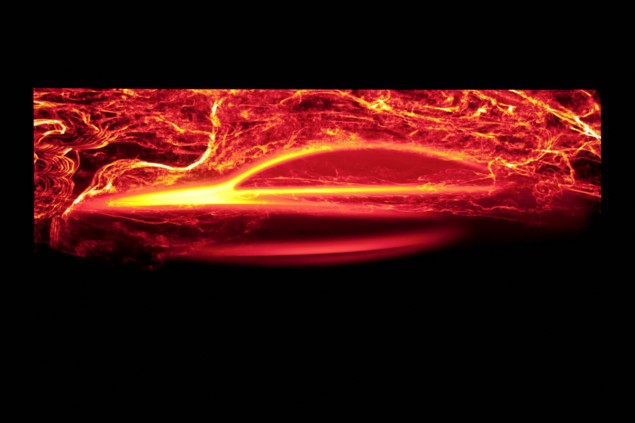
Mercedes-Benz History: A Look Back at the W201 Compact Series
At the end of November 1982, Mercedes-Benz presented the 190 and 190 E models from the W 201 model series to the press
At the end of November 1982, Mercedes-Benz presented the 190 and 190 E models from the W 201 model series to the press. The compact and technologically groundbreaking saloon supplemented the Mercedes-Benz passenger car product line with a third model series, alongside the mid-range series and the S-Class. With this step towards a broader model series portfolio, the 190/190 E clearly showed the way forward into the future of the entire brand. This is because it not only marked the start of the segment designated internally within the company as the compact class, which subsequently came to bear the designation C-Class from 1993 with the launch of the W 202 series. In fact, with this fresh and advanced saloon, it also marked the start of the great model offensive from Mercedes-Benz.
Some 30 years after making their premiere, the saloons of the W 201 model series continue to demonstrate their strengths to impressive effect: to this day, their clear lines still delight with their timeless modernity. In retrospect, the vehicle technology too has also been characterised by a host of innovative ideas and concepts.
Besides the modern design, for which Bruno Sacco was responsible, the affectionately named “Baby Benz” as the 190 model was known also scored well in terms of its high degree of passive safety and modern suspension technology, good aerodynamics and intelligent lightweight design. Among other features, Mercedes-Benz specifically developed and patented independent multilink rear suspension for the 190, in which each rear wheel is supported by five independent links, thus helping to ensure equally high levels of ride comfort and handling precision.
Designers and engineers drove the compact class even further forward into the future with two model facelifts in 1988 and 1991. More than 10 years after the market launch, in February 1993 the Sindelfingen plant ceased production of the first generation of the compact class. The 190-models continued to be produced in the Bremen plant until August, mainly for export. The total number of vehicles produced – some 1,879,629 – reflects to impressive effect the resounding success which the new compact class enjoyed for the brand. In May 1993, Mercedes-Benz presented the C-Class (W 202 series) as the successor to the “Baby-Benz”.
The evolution of the W 201 model series
Following the presentation of the new model series, initially in 1983 only the 190 and 190 E models were available with 2-litre four-cylinder petrol engines (66 kW/90 hp and 90 kW/122 hp). In the autumn of 1983, Mercedes-Benz presented the 53 kW (72 hp) 190 D “whisper diesel” at the International Motor Show in Frankfurt, which caused something of a sensation as a four-cylinder diesel engine which was not only more efficient but also particularly quiet due to engine soundproofing.
Also making an appearance in 1983 was the 190 E 2.3-16 model, whose engine featured a newly developed four-valve cylinder head and produced 136 kW (185 hp). This top-of-the-range model in the W 201 series promised a special level of sportiness – and in fact in the summer of 1983, the Saloon clocked up several long-distance world records in Nardo in Italy, including runs over distances of 25,000 kilometres, 25,000 miles and 50,000 kilometres, at average speeds of almost 250 km/h.
In the years which followed, Mercedes-Benz consistently expanded the compact class model range. Additions included export models such as the 190 D 2.2 and 190 E 2.3 models, specifically designed for the North American market. Overall the performance potential of the W 201 continued to grow beyond the production period with a number of new models: for example the five-cylinder 190 D 2.5 (1985, 66 kW/90 hp) and, as the first six-cylinder compact class model, the 190 E 2.6 (1986, 122 kW/166 hp).
The pinnacle of performance was ultimately marked by the 190 E 2.5-16 (143 kW/195 hp) in 1988, and the further stages of development derived from this vehicle which took output up to 173 kW (235 hp). At the same time they also formed the basis for the motor sport touring cars with which Mercedes-Benz achieved a great deal of success in the world of motor sport – right through to the victory in the German Touring Car Championship (DTM) in 1992 by Klaus Ludwig in the AMG-Mercedes 190 E 2.5-16 Evolution II.
“No other car has generated anything like the curiosity as this new development from the world’s oldest motor manufacturer”, wrote specialist magazine “auto, motor und sport” in 1983 about the new compact class. A modern, fresh feel, combined with technical leadership aspirations in what for the brand was a new segment, filled the public and specialists alike with enthusiasm at that time. The W 201 has retained this sense of flair. Today, some 30 years after its premiere, it still comes across as a young, modern classic.
Did you know?
Two outstanding exhibitions will be taking place this autumn:
“Mille Miglia – Leidenschaft und Rivalität” (“Mille Miglia – Passion and Rivalry”) at the Mercedes-Benz Museum, Stuttgart, from October 10, 2012 to January 6, 2013.
“Silver Arrows 1934-1939” at the Louwman Museum, The Hague, the Netherlands, from October 11, 2012 to January 6, 2013.
Mercedes-Benz History: The Route to the Riding Car
In the second half of 1883 Daimler and Maybach built the first prototype engine, a horizontal four-stroke single-cylinder unit
Gottlieb Daimler and his ingenious colleague Wilhelm Maybach moved to Cannstatt near Stuttgart in 1882. Differences between the fifty-year-old Nikolaus August Otto and Daimler, two years his junior, had led to the latter’s departure from the Gasmotorenfabrik Deutz on the outskirts of Cologne. Now a wealthy man Daimler, could afford to make himself independent.
For 75,000 Goldmarks he bought a villa in Taubenheimstrasse in Cannstatt and moved there with his wife Emma and five children in June 1882. The property was ideal for his purposes: not only was it directly next to the spa facilities Daimler regularly visited for treatment for his weak heart, but it also benefited from a large garden and spacious summer house. He had an extension added to the latter, and installed a gas and water supply – his test workshop was ready.
In early October, Maybach also arrived in Cannstatt. He moved into a nearby property and initially converted one room of his apartment into a design office. Here he kept the drawing board on which he turned Daimler’s ideas into technical drafts: Maybach was skilled at giving them a functional form – and Daimler knew the value of his technician. When the two men agreed a contract even before leaving Deutz, Maybach was guaranteed substantial remuneration.
The goal shared by the two men was to develop a small, lightweight high-speed engine that was above all suitable for powering a vehicle. They were not alone, however. All around the world others were working on the same idea.

In 1885, the so-called riding car was built in Gottlieb Daimler's workshop as a test unit to prove the suitability of Daimler's and Wilhelm Maybach's gas or petroleum engine for everyday use.
Without knowing of each other’s work, Daimler and Benz had by this time already come to a common starting point: they both opted for petrol as the fuel for their engines and they would be the first to realise their efforts. The decision to use this fuel, which had excellent combustion characteristics, was fundamental to their internal combustion engines for vehicles.
Key decisions: fuel and ignition system
A second stumbling block in engine technology was the ignition system. This was so slow in conventional stationary engines of the day that it restricted maximum engine speed and therefore engine output, since the ignition processes could not be repeated quickly enough. Maybach dedicated himself to this problem, working his way through innumerable patent documents until he finally came across the Englishman Watson’s uncontrolled hot-tube ignition system, which proved suitable for the high engine speeds they aspired to. The hot-tube ignition system devised by Maybach guaranteed steady ignition.
Daimler was to apply the hot-tube ignition system to his engines until 1898. They worked on a simple principle: a tube, heated from the outside, protruded into the cylinder at about the position occupied by the spark plug today. When compressed by the piston in the cylinder, the fuel mixture was pushed against the hot tube and ignited spontaneously.
In a legal document, written to counter an invalidity suit lodged against his hot-tube ignition patent, Daimler described the problems associated with this invention: “It was a lengthy process, requiring endless experimentation and the unstinting and dedicated efforts of the practised and experienced engineer. And this despite initially wholly discouraging results in experimenting with free ignition, and with the many and frequent ‘premature igniters’, which during the drive and compression phases, before dead centre was reached, suddenly and unexpectedly kicked the flywheel backwards instead of driving it forwards, wrenching the crank from the hand of the experimenter with the force of an electric shock, and thus making the practicability of uncontrolled self-ignition seem unachievable; but nevertheless by refusing to give in and through stubborn experimentation, as well as modifications to the shape and dimensions of the combustion chamber and changes to the mixture charge etc. I achieved acceptable and ultimately excellent results and thus confirmation of the feasibility of my uncontrolled ignition system.”

In 1885, the so-called riding car was built in Gottlieb Daimler's workshop as a test unit to prove the suitability of Daimler's and Wilhelm Maybach's gas or petroleum engine for everyday use.
Once this hurdle had been overcome, it was time to find the prototype engine’s correct right method of operation. From their work at the Gasmotorenfabrik Deutz, both men were very familiar with the four-stroke principle. They opted for this, presumably knowing that Otto’s four-stroke patent DRP 532 was still valid, even though it was coupled with Otto’s layer-by-layer charging of the cylinder and a slow combustion of the gas mixture. In the patent specification for DRP No. 28022, awarded on 16 December 1883, Daimler therefore justified his application for a “Gas engine with hot-tube ignition” for uncooled and heat-insulated engine with uncontrolled hot-tube ignition by focusing on its explosive and rapid combustion. The patent was a masterpiece in the art of wording, since strictly speaking it was the same as Otto’s four-stroke principle and would subsequently become the object of bitter patent lawsuits. But Daimler’s claim was upheld. On 23 December 1883 he was granted German Patent No.
DRP 28243 for the “Regulation of engine speed by controlling the exhaust valve”, another important invention for the efficient operation of the internal combustion engine.
Birth of the first prototype engine in 1883
In the second half of 1883 Daimler and Maybach then built the first prototype engine, a horizontal four-stroke single-cylinder unit. Thanks to the hot-tube ignition and curved groove control operating the exhaust valve, from a displacement of approximately
100 cubic centimetres it developed an output of around 0.18 kW at 600 rpm, considerably higher than the previous peak engine speeds of 180 rpm achieved by a four-stroke gas engine. The intake valve, known as a “snifting valve” opened and closed automatically with the aid of vacuum pressure . The engine block was specially cast at the Kurz bell foundry in Stuttgart, where it was recorded in the order books as a “small model engine”. The company delivered it on 15 August 1883.
On account of its revolutions per minute the engine was termed “high-speed”. The various inventions that followed over the next few years were aimed at increasing engine speed – the logical way to further improving output. Even then, however, consideration was given to efficiency in order to maximise running time of the engine using available fuel reserves in the tank.
The next version of the prototype engine was unveiled in 1884. This time it was a vertical four-stroke single-cylinder unit, dubbed the “grandfather clock” on account of its appearance. It was registered for patent on 3 April 1885 (DRP No. 34926). It was specifically designed for low weight and compactness to fulfil the condition that it was suitable for installation in vehicles. Initial output was 0.74 kW. The design was innovative also in that the transmission components and flywheel were enclosed in an oil and dust-tight crankcase. The engine also featured for the first time the “floating” carburettor – better known today as the surface carburettor – developed by Maybach, which enabled problem-free combustion of petrol. This floating carburettor ensured a constant volume of fuel; since the air was fed through a constantly high fuel layer it was possible to achieve a constant fuel-air mix – a crucial and fundamental invention for regular engine operation.
The patent specifications included a sub-clause which was remarkable in its foresight: “An atomising pump may be used in the place of the vaporising device” – a concept that later gave rise to the injection pump.
The riding car – first test vehicle
The first test vehicle for the “grandfather clock” was the riding car of 1885. A two-wheeled vehicle, this closely resembled the bicycle – this too was a relatively recent invention and still considered state-of-the-art. But for stability reasons Daimler opted for wood as the material for his frame. The engine was mounted beneath the driving seat in 1885. From a displacement of 265 cubic centimetres it developed an output of 0.4 kW at 600 rpm. Power was transmitted from the engine belt pulley via a drive belt to the rear wheels. Two speeds were possible – 6 or 12 km/h – depending on the belt pulley selected at standstill.

Replica of the Daimler riding car of 1885 in the spa gardens of Bad Cannstatt. The riding car is the world's first motorbike. Gottlieb Daimler applied for the patent on 29 August 1885.
The engine even incorporated a consistent approach to the principles of lightweight design, as one detail in particular demonstrated: Maybach’s cylinder design was not attached by means of a flange, instead the lower part of the cylinder was reinforced slightly and equipped with a fine screw thread. Around fifty years later this design was revisited when engineers were seeking a light and secure method for fitting aero engine cylinders.
A contemporary publication described the operation of the riding car: “To start the engine one must first light the small flame beneath the hot ignition tube and crank the engine once using the crank; these preparations take only a minute. The engine runs smoothly, since a silencer dampens exhaust gases entering the exhaust pipe. To set the vehicle in motion, the driver climbs aboard, takes hold of the steering bar and connects the engine to the bicycle. This is done by means of the lever, cord and tension pulley, which shifts the drive belt onto the pulley. The belt pulleys serve to vary the speed; with the drive belt set in the upper position the vehicle moves slowly, in the lower position one can move more quickly. The brake is pulled by means of a cord which is within easy reach of the driver; to bring the cycle to a standstill, one simply turns off the drive belt by means of a lever located between the seat and the steering wheel and all movement ceases.”
The riding car was the most important precursor to individual mobility achieved through the internal combustion engine. For one thing, it demonstrated the potential of the engine created by Daimler and Maybach to power a vehicle. But it also documented the fact that a human being could maintain full control of this engine for purposes of individual mobility. Subsequent automobiles would then develop this concept to a high level of maturity.
In November 1885 Gottlieb Daimler’s son Adolf successfully drove this unsprung, iron-wheeled “riding car” along the three-kilometre stretch between Cannstatt and Untertürkheim and back. Given the conditions of roads at the time, it could hardly have been a comfortable journey – nevertheless the world’s first “automobile” passed the test. For Daimler and Maybach it was merely a step on the way to inventing the motor car, which followed in 1886 in the form of the motor carriage – along with the Patent Motor Car of Carl Benz. The successes of the two inventors would go down as great moments in history.
Throwback Thursday: Mercedes-Benz Research Vehicles
Daimler has devoted itself to innovation over the years and has presented research vehicles to the public regularly
Carl Benz designed his famous Patent Motor Car over 125 years ago in 1886 based on the principal that research is a motor of progress. He calculated, tinkered, discarded ideas – and in the end went on to build a vehicle that apart from the wheels had little in common with previous ones.
Daimler is the world’s oldest car manufacturer and successes have always been due to the in-depth research and innovation. The Mercedes-Benz brand adopted this prinicipal and in turn seen the same successes. Engineering under the three-pointed star is always ahead of its time, setting the standards on a global scale. This applies particularly to the company’s research cars, the features that designers and engineers realise in the fully operational research cars often extend far into the future – but every now and then, one of these features will find its way into a current Mercedes-Benz vehicle.
Daimler has devoted itself to this path of innovation over the years and has presented research vehicles to the public at almost regular intervals. These reflect a recent chapter in the company’s 125-year history – and a very exciting one indeed, because a look at the past and current research vehicles is both retrospective and preview of the future of the automobile – for instance, the F 800 Style research car from Mercedes-Benz.

Mercedes-Benz C 111-I with a three-rotor Wankel-engine, 1969
Mercedes-Benz has always been testing new automotive concepts on fully operational vehicles. This has been done even more systematically from 1969. In the C 111, the Wankel or rotary-piston engine was tested initially, later to be followed by other drive systems. This car was thus one of the forerunners of the research cars. The latter’s history began in 1978 with the “Auto 2000” with which Mercedes-Benz engaged in in-depth basic research for new automobiles. It was followed by the NAFA in 1981. The more recent lineup began with the F 100 of 1991 – the “F” standing for the German word for research car. Since then, research cars all fitting the description “holistic” have been produced with almost infallible regularity: they serve not just to test single components but often demonstrate an entirely new vehicle concept in the form of a ready-to-drive automobile incorporating many forward-looking technologies.
Apart from research cars, the company distinguishes several other types of vehicle which serve to develop new models.
Technology vehicles are production cars equipped with new technology for the purpose of testing. For example, Daimler’s Research division used several modified A-Class cars to test fuel cell systems and drives, before this technology was brought onto the market in small series production with the B-Class F-CELL.
Test vehicles are close relatives of the research cars. They serve to put new technologies from the research labs out onto the test track to try them out in practical operation.

Concept cars at Daimler AG are near-production ready-to-drive vehicle studies. They position a future vehicle model in the market. One example is the Study A of 1993 which shows several characteristic attributes of the subsequent A-Class. Concept cars are equipped with new technology which already sees use in production cars or will soon reach production standard.
Vehicle studies are feasibility studies that show new ideas in the form of a complete automobile. But they usually are not roadworthy. This category includes NAFA, a short-distance vehicle study which originated 30 years ago. It had a short, high body and thus was a forerunner of the Mercedes-Benz A-Class and the smart city fortwo.
From idea to finished research car
- Engineers and designers come up with concepts for the mobility of the future
- Two years of development from the visionary idea to the finished reseach car
- Every research car has a different technological focus
Daimler research cars are fully operational because they are supposed to make new technology experienceable, drivable, and assessable. They then fulfill their purpose, which is to provide insights into the automobile of tomorrow. Each of these special cars follows the concept of holism. It is not single components which are being tested; rather the entire vehicle springs from an original idea. That this calls some conventions into question, that unusual solutions may cause astonishment or enthusiasm, is all part of the visionary brainwork for the automobile of the future.
As a result, the sometimes very unusual concepts stimulate public discussion of tomorrow’s mobility and provide important indications to the market researchers at Daimler as to what customers want and need. For the cars are oriented to customers, and research must be oriented to the future. Designers, engineers and marketing experts jointly draw up the technical specifications for a new research car. Each car is a reflection of a clear strategy – sometimes it stresses the technological competence of the company, sometimes ergonomics, sometimes driving safety. The designers and engineers then have their work cut out for them complying with all the specifications that result from the visionary ideas.

From autumn 1981 the “Auto 2000” research car was used to test new engine and aerodynamic concepts
It requires thinking up something entirely new and unusual. The original ideas are constantly reviewed for feasibility, with information technology and its simulation tools being a great help. If it works on the screen, the approval for made-to-measure manufacture is given. Practically every part of a research car is manufactured to order, a costly procedure: electronic systems are drafted, the interior compartment is redesigned and set up, the bodywork formed. It is not simply a question of setting up a technical product. Every vehicle feature reflects great attention to detail and the striving for the highest possible quality of workmanship. It takes some two years before a research car is ready to drive.
| Year | Model | Engineering tested |
| 1969 | C 111-I | Three-rotor Wankel engine, plastic bodywork |
| 1970 | C 111-II | Four-rotor Wankel engine |
| 1978 | Auto 2000 | Reduction of fuel consumption |
| 1981 | NAFA | Compact short-distance vehicle |
| 1991 | F 100 | Ergonomics, ambient sensors |
| 1991 | C 112 | Dynamic handling, Active Body Control |
| 1995 | Vario Research Car | Car body variants, ergonomics, display systems |
| 1996 | F 200 Imagination | Drive-by-wire, cockpit design |
| 1997 | F 300 Life Jet | Active tilt control, dynamic handling |
| 2002 | F 400 Carving | Dynamic handling, active camber adjustment |
| 2003 | F 500 Mind | Interior compartment concept, variable door concept, hybrid diesel drive, x-by-wire systems |
| June 2005 | Mercedes-Benz bionic car | Aerodynamics, lightweight design, diesel engine with novel SCR emission control |
| October 2005 | F 600 HYGENIUS | Fuel cell drive, variable operating concept, variable interior design, safety equipment |
| September 2007 | F 700 | DIESOTTO engine, PRE-SCAN suspension, variable deluxe interior compartment concept with REVERSE seat and innovative operating concept |
| February 2010 | F 800 Style | Multiple drive platform for five-seater luxury limousine, Cam-Touch-Pad HMI, graphic distance to empty display “Range on Map” in electric mode, DISTRONIC PLUS traffic jam vehicle follow assist |
Mercedes-Benz History – Mercedes-Benz 220 SE in Argentina
In 1962, after 2,874 miles, Ewy Rosqvist emerged victorious in the VI Touring Car Grand Prix of Argentina in their Mercedes
On November 4, 1962, after completing 2,874 miles, Ewy Rosqvist and her co-driver Ursula Wirth emerged victorious in the VI Touring Car Grand Prix of Argentina in their Mercedes-Benz 220 SE. The entire country excitedly celebrated the outstanding victory of the Mercedes-Benz women’s team in South America’s tough long-distance rally.
Prior to the race the two Swedish women had been derided somewhat, however by the end of the race they had shown the public and the competition what they were made of: Rosqvist and Wirth not only finished the race as overall winners, they literally dominated the gruelling contest from the word go. In 1962, for the first time, a single vehicle won all six stages of the Grand Prix in succession, and in doing so the two Swedish women also set a new record.
This victory not only caused a sensation in Argentina – the outstanding success of Rosqvist and Wirth took the whole world by storm. In addition to an appreciation of their sporting achievement, there was also amazement at the fact that two women were able to succeed in this exceptionally gruelling contest against a field of competitors made up exclusively of men.
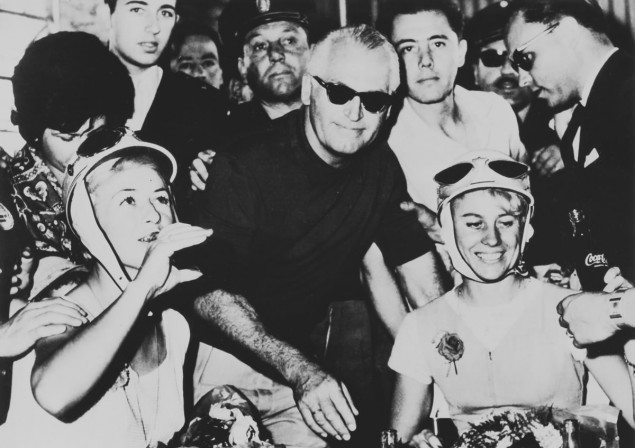
At the start of the 1960s, top international female athletes were still very rare in many disciplines. This is confirmed by a report from the news magazine “Der Spiegel” dating from 1966, which portrayed the two Swedish female racing drivers, together with female marathon runners and other female endurance athletes, as pioneers of female high-performance sport.
Ewy Rosqvist was certainly no novice in the sport of motor racing when she set off on behalf of Mercedes-Benz in the 1962 Grand Prix of Argentina. Born in 1929 in Ystad in southern Sweden, she was the daughter of a farmer and learned to drive at an early age. Her first car was a Mercedes-Benz 170 S, bought for her by her father.
Working as a veterinary assistant, she gained a great deal of experience driving on long, poorly built roads: “The driving which I […] had to carry out each day amounted to between 150 and 200 kilometres, almost all on unpaved roads, gravel paths and farm roads,” explained Ewy Rosqvist in her book “Fahrt durch die Hölle” [Driving through Hell] (Munich: Copress-Verlag 1963).
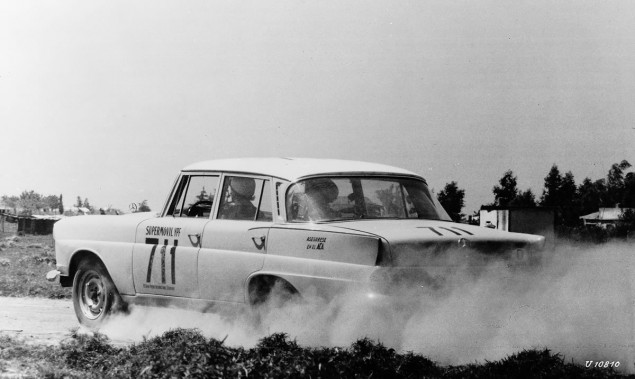
In 1954, Rosqvist experienced her first rally – as a passenger in the Midnight Sun Rally, which her husband and father were competing in. “That was so much fun that I decided to take part in a rally myself, or as a co-driver, as soon as possible,” the female driver recalled. And indeed – two years later, the young woman also found herself on the starting line of the Midnight Sun Rally. In 1959, Rosqvist won the European Rally Championship Women’s Cup for the first time in a Volvo. The then Daimler-Benz AG subsequently took on the successful female driver in the spring of 1962, as part of the Mercedes-Benz works team.
In the autumn of 1962, Mercedes-Benz sent a total of four works teams to Argentina, where in the previous year Manfred Schock and his co-driver Manfred Schieck had won the Grand Prix for Mercedes-Benz for the first time (the Mercedes-Benz team of Hans Herrmann/Rainer Günzler finished in second place). In addition to Rosqvist and Wirth in the 220 SE bearing the starting number 711 and the registration number S-LH 839, also on hand were Hermann Kühne and Manfred Schieck, also in a 220 SE (starting number 719), as well as Eugen Böhringer/Peter Lang (starting number 731) and Carlos Menditegui/Augustin Linares (starting number 703), each in W 112 model series Mercedes-Benz 300 SE models. Juan Manuel Fangio, the Argentine chief driver of the Mercedes-Benz racing division in 1954 and 1955, also accompanied the team during the 1962 Grand Prix.
The Stuttgart team under the direction of Karl Kling made use of the day before the start of the race to drive along the 4624-kilometre route so that the co-drivers could memorise the details of the course and make notes. During the rally, the route was broken down into six stages of between 515.4 and 863.5 kilometres. After setting out from Buenos Aires, it headed to Villa Carlos Paz, San Juan, Catamarca, Tucuman, Cordoba and back to Buenos Aires again. A one-day break was arranged between each of the race days.
A total of 286 cars registered for the Grand Prix, divided into seven different classes for the highly demanding event. Of these, 258 vehicles actually started the race but only 43 made it to the finish – less than one fifth. The other three Mercedes-Benz works teams also dropped out. A particularly tragic twist here was the fatal accident suffered by Hermann Kühne during the second stage.
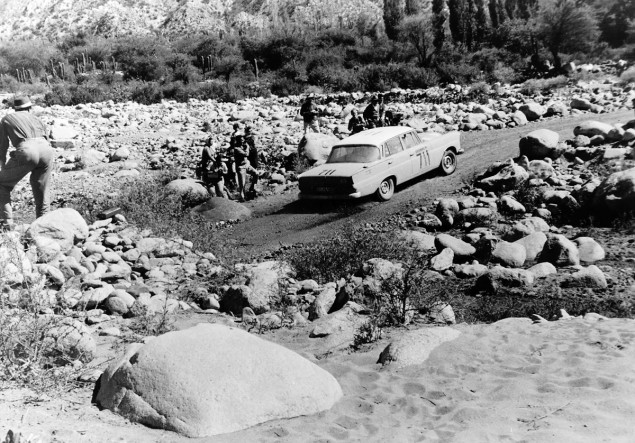
Before the start, the newspapers still somewhat ridiculed the fact that a women’s team were setting out on the marathon rally through Argentina. When Rosqvist and Wirth chalked up a victory on the first stage, their success was soon praised as a respectable achievement. However, when the duo then also won the second stage, there was no more holding back and the Swedish women were wildly celebrated by the country’s media. The state of the nation at that time was captured in the German language newspaper “Freie Presse”, which was published in Buenos Aires: “It was not the Cuban missile crisis, but rather the two blondes from Scandinavia who dominated the headlines in the country’s daily newspapers.”
By the end of the Grand Prix, Ewy Rosqvist and Ursula Wirth had won all six stages of the rally. The pair topped the overall rankings with a time of 34:51:03 hours, more than three hours ahead of the second-placed Boris Stipic, and also A.V. del Carril in third place (both in Volvos). The average speed of the winners was 126.87 km/h – a new record. To put this in context, Walter Schock had won the previous year’s “Gran Premio Internacional Standard Supermovil YPF” with an average speed of 121.23 km/h.
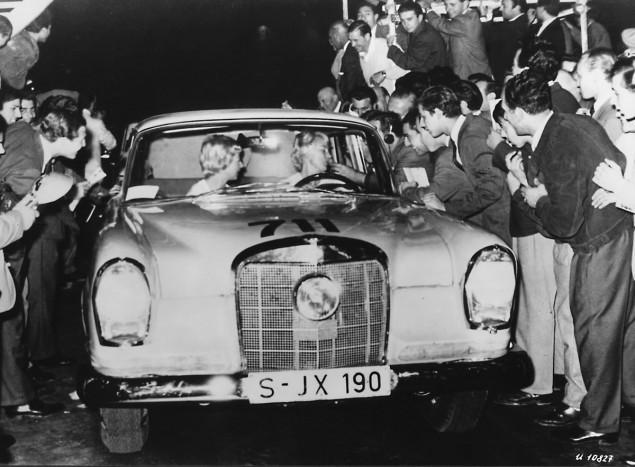
The vehicle with which Rosqvist and Wirth won the race was a virtually near production standard vehicle from the W 111 model series. Mercedes-Benz had purposely sourced a vehicle with regular steering as this gave more sensitive steering feedback. Only on the difficult mountain stages would Ewy Rosqvist have preferred a car with hydraulic power steering, as she wrote in a report on her Argentine experience: “Today I would have given anything for a power steering system!”
The victory of Rosqvist/Wirth in 1962 was the second success achieved by Mercedes-Benz at the “Gran Premio Internacional Standard Supermovil YPF” in a row. And in the following two years vehicles from Stuttgart again dominated the competition, which was followed with a great deal of interest in the important American market. In 1963 and 1964, Eugen Böhringer/Klaus Kaiser emerged victorious in each case in a Mercedes-Benz 300 SE. In 1963, Ewy Rosqvist finished in third place with Ursula Wirth as co-driver in a 220 SE, and in 1964 she again secured third place, this time with Eva-Maria Falk in a 300 SE.
Mercedes-Benz ML-Class Receives Widebody Kit and Power Upgrade from Hofele Design
Hofele Design revealed their new 14-piece widebody kit for the Mercedes-Benz ML and dubbed it the Starcruiser GT 550
German tuner, Hofele Design revealed their new 14-piece widebody kit for the 2012 Mercedes-Benz ML and dubbed it the “Starcruiser GT 550.” The Starcruiser kit includes a new front bumper with large air intakes and LED DRL, aggressive wheel arch extensions, a wider rear bumper diffuser and quad exhaust tail pipes. The Starcruiser GT 550 can be fit with a set of REVERSO II alloy wheels in sizes 9×20 and 10×22. The ML can be dropped by up to 40 mm thanks to a lowering module, this can be done at speeds of up to 49 mph.
Hofele Design also boosted the Mercedes SUV’s engine, improving output to 312 horsepower and 516 lb/ft of torque, an increase from the standard 258 horsepower and 457 lb/ft of torque. The interior has a bi-color leather interior with ornamental seams and stitched elements.
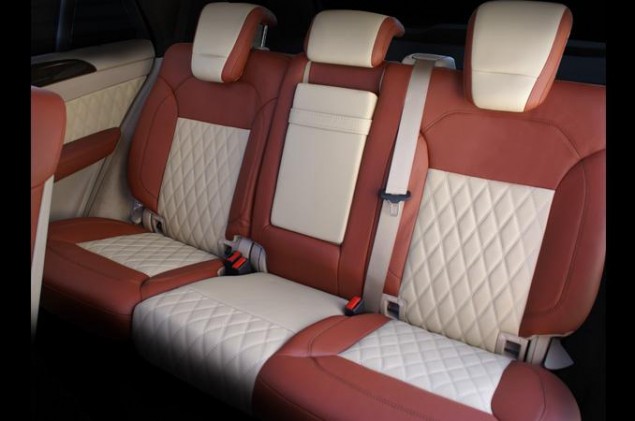
For those of you unfamiliar with Hofele Designs, as they may now be more well known for working with Audi or VW than with Mercedes, but that wasn’t always the case. Hofele Design’s founder, Karl Hofele, worked alongside Carl Benz at Benz and Cie, on a 200 HP Benz-airplane engine in 1915. From there, Karl Hofele became a pioneer in the aviation industry before his son, Bruno Hofele took the reigns.
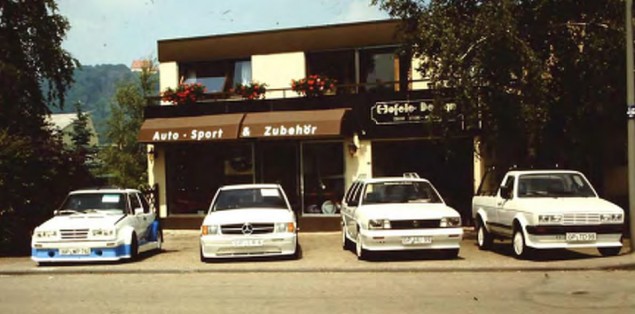
Bruno Hofele participated in the construction of the New Unimog in the 1950’s. Bruno went on to develop his patented ski-box that was later adopted by Mercedes-Benz for corporate vehicles. The came Bruno’s sons, the Hofele brothers, interested in rally car racing and rebuilding and redesigning cars. There first major tuning job was on a Fiat-Bertone X 1/9. And as they say, the rest is history.
AMG Retro Collection Helps Celebrate 45 Year Anniversary
Commemorate AMG's 45th Anniversary in 1970's style with the AMG Retro Edition Collection from Mercedes-Benz Accessories
On June 1, 1967, Mercedes-Benz engineers Hans-Werner Aufrecht and Erhard Melcher teamed up to found AMG Motorenbau und Entwicklungsgesellschaft mbH (AMG Engine Production and Development, Ltd.). In 1971 the company became famous overnight with a second place finish at the the 24-hour race in Spa-Francorchamps with the 300 SEL 6.8 red touring car with the start number 35.
Both of these events are commemorated with 1970’s style in the AMG Retro Edition from Mercedes-Benz Accessories GmbH, which you can see in the photo gallery below and which are now available from Mercedes’ partners and the online shop.
These historic dates are featured on the classic white polo shirt made from 100% cotton. Discreet red highlighting on the collar, inner button placket and on the neck band, and a red stripe on the sleeve cuffs also commemorate the first AMG racing car, as do the badges on the sleeves showing the date 1971 and the number 35. The first AMG logo is printed in silver in 3D on the left-hand side of the chest, with the words “Founded 1967” on the back of the neck. Even the buttons bear the AMG logo. The men’s polo shirt is available in sizes S to XXL. To go with the polo shirt there is a cap showing the early version of the AMG logo, the badges “1971” and “35”, and the words “Founded 1967”.
A fine leather collection is available made from vintage-look cognac-coloured calfskin, and the items in this collection are sure to become the user’s everyday style accessories. The collection includes a weekend travel bag (dimensions: 47 x 30 x 25 cm) with sturdy handles, dark-brown cotton lining and base feet, a wallet and a belt. All of these items feature the same exceptional high-quality leather workmanship, with inserts made from perforated leather, the early version of the AMG logo embossed on the outside and the words “Founded 1967” stamped on the inside. To go with the leather collection there is also a key ring.
A tasteful pin in the form of the AMG heritage logo commemorates the anniversary of the company’s establishment. It is made of matt silver-coloured rhodium-plated brass with a patina effect. Completing the AMG Retro Edition is a coffee mug with original racing features from the AMG 300 SEL 6.8 and a set of 2 classic espresso cups with the early version of the AMG logo, both of which come in special gift boxes.
Mercedes-Benz SL-Class 60 Year History
Groundbreaking technology and race victories, the 1952 Mercedes-Benz 300 SL racing car picked up where the Silver Arrow left off
For the past 60 years, the Mercedes-Benz SL-Class has represented the brand with its elegant lines, technical innovations and its speed. The SL’s success stories began with the 300 SL race car in 1952 when it began winning several international races. These victories provided the initial spark for the 300 SL Gullwing (W 198 I, built from 1954) and 190 SL (W 121, from 1955) production vehicles. Later model series of this powerhouse car – the W 113 ‘pagoda’ and the R 107, R 129 and R 230 – brought the SL-Class seamlessly into the new millennium.
The SL sports cars have always sold extremely well, particularly in terms of exports. By the end of the 1950s, the 300 SL gullwing coupé and the 190 SL roadster had already set quite a standard for international sales, although later SL models were also able to match the success of the sports car’s first generation.
The design and engineering innovations of each SL model put it at the forefront of its time. But customers have also benefited greatly in the long-term from the purchase of an SL sports car. And why? Because the models of the 1950s and later generations have long since been regarded as vintage cars of value or coveted modern classics. Mercedes-Benz Classic is committed to helping owners retain and increase the value of their cars. It still supplies genuine spare parts, for example, and sells vintage cars through its Young Classics dealership or under the Mercedes-Benz Classic banner.
The R 231 model being launched in 2012 is the latest generation of the Mercedes-Benz SL. The foundation for its success are 60 outstanding years of Mercedes-Benz sports car history under the Super-Leicht (super lightweight) or SL designation.
Exclusive sports cars for the world
Groundbreaking technology and international triumphs – in 1952, the Mercedes-Benz 300 SL racing car (W 194) appeared to pick up where the pre-war Silver Arrow had left off. And just as in those days, the success of the 300 SL brought the Stuttgart-based car manufacturer back to the attention of a motor sport-loving worldwide public. In a period which saw Germany rebuilding after the war, this proved of inestimable value to the company. There was one major difference, however, between the pre-war Grand-Prix racers and the gullwing coupés with their tubular space frames. Whereas the Silver Arrow never broke free from its racing mould, the 300 SL was reborn two years after its competition debut in the form of a breathtaking series sports car.
This Mercedes-Benz 300 SL (W 198 I) burst onto the world stage in February 1954 at the International Motor Sports Show in New York. This luxury coupé – which shared its DNA with the internationally successful SL sports car – did, after all, emerge from a partnership between Germany and America. Mercedes-Benz’s official US importer Maximilian E. Hoffman was the man who convinced senior management in Stuttgart to build a series sports car modelled on the W 194. And so it was fitting for the W 198 I to be publicly unveiled in New York to automotive experts from all over the world, alongside a prototype of the 190 SL (W 121).
Born in Vienna in 1904 as Maximilian Edwin Hoffmann, the automotive enthusiast had previously worked as an importer in Austria in the 1920s and 1930s. Volvo saloons were among the cars that his company sold. Hoffmann, son of a Catholic mother and a Jewish father, emigrated to France in the late 1930s. To escape the Nazis, he fled France for the United States of America in 1941, where he re-established himself as an automotive importer after the Second World War. In 1947, he opened his first showroom on New York’s Park Avenue and had his last name anglicised to Hoffman.
From 1951 onwards, Hoffman sold Mercedes-Benz cars as well. The exclusive German automotive brand matched not only the ethos of his business, but also his personality. A New York Times retrospective described the automotive dealer as follows: “Hoffman was compared to the legendary art dealer of the early 20th century for his ability to captivate clients with his salesmanship, superb taste and forceful personality.”
On top of all this, Hoffman had a keen nose for trends. This made itself felt in September 1952, when he secured the contract to become the official importer of Mercedes-Benz passenger cars for the eastern United States – a sales territory that later expanded to cover the west coast as well. Crucially, Hoffman did not restrict himself to merely selling Mercedes-Benz cars in America. His influence on the Stuttgart-based company was much more direct than that; most notably, he demanded that they offer sporty, good-looking cars.
In September 1953, at a meeting with the board of directors of what was then Daimler-Benz AG, he pressed for the introduction of new sports cars. Hoffman correctly judged the market for such an extraordinary series sports car as the Mercedes-Benz 300 SL, but even in 1954 he would still much rather have been selling the open-top roadster version. This followed in 1957 in the form of the 300 SL Roadster (W 198 II).
The new sports car was an immediate success, particularly in the USA. Within 17 months, 996 gullwings had been sold, of which 850 went to the USA. That was 85 percent of all the models produced in 1954 and 1955. The US export ratio did level off afterwards, but it remained impressive. Up to 1963, Mercedes-Benz exported more than half of its 300 SL W 198 models to the USA, exactly 51 percent of all the 1,400 coupés and 1,858 roadsters that were produced. The export ratio for all international markets put together was 86 percent.
Even before the launch in New York, there was a sense at Mercedes-Benz that this exceptional sports cars had huge potential to be a style icon. In February 1954, Friedrich Nallinger and Rudolf Uhlenhaut registered a design patent for the gullwing on behalf of Daimler-Benz AG. In December 1955, the United States Patent Office published the relevant document (design number 176,278), which protected “the ornamental design for an automobile, substantially as shown and described herein”. The patent serves both as the birth certificate of the Mercedes-Benz’s SL series sports cars and as and as evidence of the designers’ awareness that this pioneering vehicle was truly original.
Introduced in prototype form in 1954 and built as a production vehicle from 1955, the 190 SL became just as captivating a symbol of the sporty motoring ethos of Mercedes-Benz as the 300 SL coupé – the car from which the designers borrowed so heavily. From 1955 onwards, almost 80 per cent of the 25,881 vehicles produced were exported, and nearly 40 percent of all 190 SL models were sold in the USA. 1956 is thought to be a record year: from January to December, Mercedes-Benz sold a total of 3,109 passenger cars in the United States – and no fewer than 1,849 of these were SL 190 sports cars, almost 60 percent of the company’s entire US exports for the year.
The manner in which the SL sports car – from a standing start – established itself as a sought-after automobile for sporty and style-conscious drivers in key export markets was instrumental in Mercedes-Benz’s success. Most important of all, of course, were sales to customers in the USA and other foreign markets, which generated huge revenues from cars in the upper range of the Mercedes-Benz price list. In addition, the SL sports car conveyed the image of a modern automotive brand whose vehicles united a sporty aesthetic with groundbreaking technology. Millionaires, actors, artists – it was often celebrities who proudly turned out in their 300 SLs and other Mercedes-Benz cars, raising the profile of the brand in the public eye.
This international success was reflected time and time again in the exceptionally high export ratios of the various SL model series. For some vehicle generations, four out of every five cars went abroad. And – as remained the case down the decades – the biggest market for them was almost always the USA.
It was no different for the W 113, which appeared in spring 1963 as the replacement for the 300 SL Roadster and 190 SL. The designers and engineers at Mercedes Benz struck a delicate balance to position the car, which became known as the ‘pagoda’ because of its distinctive, slightly concave hardtop, between the high-performance 300 SL Roadster sports car and its ‘baby brother’, the 190 SL. The result was a luxurious, two-seater tourer boasting great performance and optimum handling safety. Nearly 70 percent of all pagodas were exported; once again, this model sold best in the USA (40 percent of the entire production).
For the W 113, Mercedes-Benz responded to the specific demands of the export markets through specific modifications. Customers in the United States ordered far more cars with automatic transmission, air conditioning and whitewall tyres than their counterparts in Europe. The USA even supplied the name for a special version of the Mercedes-Benz roadster – the ‘California Coupé’, which had two fold-down seats instead of the soft top. This edition could only be driven open-top or hard-top.
The 107 series roadster, made between 1971 and 1989, has the highest US export rate of any SL model to date: 62 percent of all cars in this series went to the United States and almost four fifths of the 237,287 vehicles produced in total were exported. Mercedes-Benz developed a low-compression version of the 350 SL solely for export to North America, which had a 143 kW (195 bhp) 4.5 litre V8 engine adapted to meet US legislation regulating exhaust emissions. In April 1973, both versions of the 107 series, the roadster and the coupé, were introduced to other markets as well in the 4.5 litre V8 format, which now had an output of 165 kW (225 bhp).
Another special edition for North America, Japan and Australia arrived in 1985 in the form of the 560 SL, whose 5.6 litre V8 engine delivered 170 kW (230 bhp). It was sold in these markets instead of the 500 SL. This spectacular sports car had the same V8 engine as the 500 SL but with an extended stroke.
Modifications of this kind were necessary to meet the strict regulations on emission reductions in the USA. The bulky rubber bumpers, introduced in 1974, were also a byproduct of North American legislation. In the case of the SL R 107, this protection against collision was around 20 centimetres thick. Together with the modified headlamps of the export version, this gave the US model series a highly distinctive look.
The R 129 SL Roadsters gave a whole new meaning to the term ‘special model’. For the first time, the company produced exclusive editions for specific markets instead of merely adapting the cars to meet the legal requirements and aesthetic preferences of the export countries. This included, of course, the ’40th Anniversary Roadster Edition’ of the SL 320 and SL 500, released in the US market in 1997. Producing 750 vehicles in total, Mercedes-Benz commemorated the launch of the 300 SL Roadster (W 198 I) in 1957. The ‘Silver Arrow Edition USA’, made in 2001, comprised 1,515 vehicles in the SL 500 and SL 600 formats.
But the focus was not exclusively on the USA. There were special versions for the UK and Japanese markets as well, such as the one-off ‘designo MB UK’ series (150 cars) and ‘designo MB Japan’ (67 cars), and the ‘designo-Vintage Edition UK’ and ‘designo-Heritage Edition UK’ (49 cars each). As in North America, Mercedes-Benz sold the R 129 in the UK market as a final one-off series limited to 100 vehicles – the ‘Silver Arrow Edition UK’.
The R 230 series, the first SL Roadster with a steel vario roof, appeared in the summer of 2001. By October 2011, almost 170,000 of these sports cars had been sold. And with an export ratio of 78 percent (USA: 45 percent), this vehicle generation was an international bestseller in the great SL tradition. For both the R 230 and the R 129, there were few special models with modified engines. Although developed for the European market, the models had long since fulfilled the strict emissions standards of North America and other export markets as well. Nevertheless, there were still subtle differences between the US versions and the series models for Europe. The European SL 500, for example, was not renamed after being given a facelift in 2006, even though its M 113 5-litre V8 engine had been replaced by a 5.5 litre equivalent. In North America, the sports car’s cubic capacity increased by 10 percent (engine output rose as well from 225 kW/306 bhp to 285 kW/388 bhp), and its new name was worn proudly on the boot lid – the SL 550.
In 2012, a new SL in the R 231 series arrived on the market. Sports cars enthusiasts around the world heralded the latest generation of a legend that had been established 60 years earlier by the 300 SL racing car.
“Better than shares”: The SL as a classic car and long-term investment
The strong values of the SL-Class apply not only to Mercedes-Benz’s current sports cars generation, but also to the veterans of the series. Within a short time after production had ended, the iconic 300 SL was thought of by many as the ultimate dream car – so it was only fitting that in 1999 it was voted sportscar of the century by an expert panel of judges.
But also the 190 SL, the W 113 ‘pagodas’ and the R 107 and R 129 SL Roadster have long been sought-after as vintage cars or modern classics. The timeless appeal of these extraordinary sports cars is reflected not only in the passion that they inspire in people, but also in how much they retain their value. In November 2011, Motor Klassik magazine described certain classic cars as being “better than shares”. Included in this category is, of course, the Mercedes-Benz 300 SL gullwing. Examples of this model series in good condition have grown in value by 171 percent since 2001.
This is not a flash in the pan, but a long-term trend. And on this basis, experts at Mercedes-Benz Classic believe that prices will continue to rise for well-looked-after SL classics. The January 2012 edition of Motor Klassik magazine gave the following piece of advice to potential buyers of the 300 SL, series W 198 I: “For most classic car fans, owning a gullwing coupé will remain a dream. Top-of-the-line models reach prices of more than one million euros at auction.”
The classic car magazine also took a close look at the other SL models. Its top performers were cars that offer “something for all tastes” (R 107) because of the many different types that were made, and those that are regarded as “future classics” (R 129). But for a classic sports car to retain its value – and this is the crucial point – it must be maintained to an adequate standard.
In this respect, Mercedes-Benz Classic lends its help to owners both of vintage SL sports cars and modern classics. The outstanding availability of spare parts, including the central star on the radiator grill of the 1950s 300 SL, is securing the future of these vehicles as mobile museum pieces. Mercedes-Benz Classic provides knowledgeable, expert advice to owners of classic cars. But this is about more than just providing a service. It also helps to preserve a special chapter in the story of automotive engineering.
Since the 300 SL gullwing and the 190 SL made their debuts, the SL series sports cars have consistently set standards in terms of technical excellence and aesthetics. Top engineering innovations include the direct injection in the W 198, the safety bodyshell of the ‘pagoda’ and the pop-up roll bar of the R 129. And as a style icon that moves with the times, the sports car can still be seen today at international classic car rallies, in films and in prestigious collections all over the world.
111th Anniversary of Mercedes Vehicle Competition Success
Wilhelm Werner led by 12 minutes at the halfway point, and won – after a 6 hour, 45 minute and 48 second race
March 25 1901 was a Monday – a strange day for a motor race, to modern eyes. But in spite of inclement weather in the South of France, the second day of the 1901 Nice Speed Weeks saw the race for “speed cars” held over a route from Nice to Salon, and back; a total of 392.5 km on open roads. This was the first major outing of the year for the new Daimler competition vehicles, newly christened ‘Mercedes’ after one of the daughters of importer Emil Jellinek.
The new cars had attempted to race in Pau the previous month, but had failed shortly after the start. However, the Nice-Salon-Nice race proved more successful: driver Wilhelm Werner (mechanic to the Baron Henri de Rothschild) led by 12 minutes at the halfway point, and eventually won – after a bruising 6 hours, 45 minutes and 48 seconds of racing – by the healthy margin of 26 minutes and 10 seconds (by way of comparison, this would represent a lead of nearly 6 minutes in a 1.5 hour modern Grand Prix!), at an average of 58.1 kph.
Sunday marks the 111th anniversary of the first competition success for a Mercedes vehicle; in the intervening years, Mercedes – which became Mercedes-Benz in 1926 – has set new benchmarks in every series in which it has raced. Last Sunday’s Australian Grand Prix marked the 89th Formula One victory for Mercedes-Benz power, and the 36th win for the current generation of V8 engine, continuing a heritage that is longer than any other in the sport.
2013 Mercedes-Benz SL-Class Model Range
The new SL 500 (3,935 lbs) weighs around 275 lbs less than its predecessor and the SL 350 (3,715 lbs) is 308 lbs lighter
Designed originally as a racing car in 1952, the SL became a production model in 1954 and met the world as a 300 SL Gullwing. Even the very first SL’s offered powerful sportiness, exciting design, effortlessly superior style, technical innovations and the ultimate in engineering artistry, offerings that can still be found in today’s Mercedes SL after 60 years.
The unique combination of systematic sportiness, refined luxury and yet unrestricted suitability for everyday use at the same time is what makes the Mercedes-Benz SL the dream car it is – and it is also what lies behind its success where sales are concerned. The SL was always ahead of its time technically – even when it was rolling off the production line for 18 years at a time, as was the case with the SL bearing the internal code R 107 (from 1971 to 1989). Over 650,000 SL vehicles have left the production halls in Sindelfingen and Bremen since 1954, and from the last model generation alone – which celebrated its premiere in 2001 – nearly 170,000 specimens found their way into the hearts of the enthusiasts amongst fans of high-calibre sports cars.
The new generation of the Mercedes-Benz SL now being presented is the sixth generation model to follow the 1952 racing car. In the unique tradition of the SL it is entering its era as an athlete, refined aesthete and innovative trendsetter with an extraordinarily high utility value. Mercedes-Benz is initially offering the new SL with two engines – as the SL 350 with a V6 engine and as the SL 500 with a V8. The new BlueDIRECT engines have an output of 225 kW (306 hp) in the SL 350 and 320 kW (435 hp) in the SL 500 (a 12-percent increase over the predecessor).
Moreover, the new SL breathes new life into the meaning of the famous abbreviation “SL” – super-light – through systematic weight reduction. For the first time ever, Mercedes-Benz is implementing an all-aluminium bodyshell in series production. The newly developed vehicle weights approximately 110 kilograms less than a comparable bodyshell made of sheet steel. Nevertheless it is even more rigid – and safer – than its predecessor. Mercedes-Benz has achieved this through a systematic intelligent material mix of aluminium alloys and aluminium components which are tailor-made for the respective requirements, combined with just a few portions of high-strength steel and magnesium.
Although the new SL is even more comfortable and has more safety devices on board than its predecessor and therefore does actually sacrifice some of the weight saved through the aluminium bodyshell, the scales show some astonishing figures: the new SL 500 (3,935 lbs) weighs around 275 lbs less than its predecessor. On balance, the SL 350 (3,715 lbs) is 308 lbs lighter – all thanks to a host of other intelligent enhanced details to reduce weight, which Mercedes-Benz has also implemented in the new SL in addition to the aluminium bodyshell.
And these measurement results do not just impress as figures on the page; they are very much perceptible and tangible in practice, too. The resulting increase in longitudinal and lateral dynamics facilitates superb performance with a decided passion for cornering. The greater track width at both the front (+ 38 mm) and rear (+ 77 mm) axle serves the handling which is at once sporty and agile and keeps the car under safe control. Drivers will find the new SL even more agile than its predecessor – sheer pleasure for those of a sporty orientation.
There are two suspension variants from which to choose. The SL is supplied as standard with semi-active adjustable damping (lowered by ten millimetres in the AMG sports package). The active suspension system ABC (Active Body Control) is available as an optional extra. Unique the world over, it has been enhanced especially for the new SL.
In keeping with the Mercedes-Benz tradition, the new SL couples its sharpened athletic profile and agile nimbleness with a luxurious ambience. Its high-quality equipment and appointments contribute to the exquisite motoring pleasure that can be experienced every kilometre of the way. Fine materials, finished with great attention to detail, shape its style and character. The levels of comfort here – unique in the segment of luxury sports cars – blend with high everyday practicality, for the new SL shines with top marks where open-top motoring, suspension comfort and comfort on long journeys are concerned – plus its exemplarily low background noise, which is comparable with that of a saloon. This all adds up to the fact that this vehicle is a Gran Turismo in the very best sense of the word.
The safest and the most sparing
Thanks to the crash-optimised aluminium structure, standard-fit PRE-SAFE® and assistance systems on the same high level as the S-Class, the SL is the world’s safest roadster.
What’s more, it is the most frugal one in its class. The SL 350 consumes 6.9 litres over 100 kilometres, which is virtually 30 percent less than its predecessor (CO2 159 g/km). The SL 500, too, posts a persuasive set of efficiency figures: 9.1 litres per 100 kilometres (minus 22%) correspond to 212g/km CO2.
The design, meanwhile, displays all the classic proportions so characteristic of the SL. Right from the first glance the masculine-looking roadster with a broad tail end is immediately identifiable as a member of the current family of sports cars from Mercedes-Benz. It emphasises its autonomy through a multitude of details created with loving care.
The sixth generation of the SL also offers a vario-roof that can be retracted into the boot using an electrohydraulic mechanism to save space, converting the SL into a roadster or a coupé, depending on the driver’s wishes and the weather. Unlike its predecessor, three versions are available for the new SL: painted, with a glass roof or with the unique panoramic vario-roof featuring MAGIC SKY CONTROL. The transparent roof switches to light or dark at the push of a button. When light it is virtually transparent, offering an open-air experience even in cold weather. In its dark state the roof provides welcome shade and prevents the interior from heating up in bright sunlight.
MAGIC VISION CONTROL is a new intelligent, high-efficiency windscreen wiper/washer system. Its system of channels supplies water to the windscreen just in front of the laser-cut wiper blade lip. As a result, when spraying, there are no gushes of water on the windscreen to disrupt visibility, and yet the windscreen is kept clean.
Also unique, the Frontbass system uses the free spaces in the aluminium structures in front of the footwell for housing the bass loudspeakers. As a result, the new SL features clear, crisp bass sounds that facilitate a concert hall ambience even with the top down.
Both innovations are part of the extensive standard equipment of the new SL.
History of the Mercedes-Benz SL – Video
The SL started its career in the racing circuit in 1952 and became a legend after winning 4 out of 5 races
An automotive icon turns 60 and thanks to the latest video from Mercedes-Benz TV, we are able to experience the history of this exceptional sports car. The SL started its career in the racing circuit in 1952 and after winning 4 out of 5 races, the SL became a legend. The series version of the racing SL was launched 2 years later and won sports car of the century in 1999. The 190 SL was the first SL to be offered as a convertible and ushered in an entirely new audience to the SL. The 230 SL was next in line and was nicknamed the pagoda. Not only was the 230 SL extremely comfortable, it was also the first SL with an automatic transmission. In 1971 the R107 was released with an 8 cylinder engine and was in production for 18 years. The success of the SL continued into the 90’s when the R129 was presented in 1989. From 1992 on the SL was available with a 12 cylinder and thanks to revolutionary safety technology, the SL is once again one of the safest cars on the road. With the generation change in 2001, the SL continues to combine sportiness, style, comfort and innovation.
Mercedes-Benz History – Mercedes-Benz 300 SE Coupe and Cabriolet
In the 1960's, driving a luxury-class coupé was an expression of automotive culture that was as exclusive as it was elegant
In March of 1962, Mercedes-Benz celebrated the premiere of two luxurious premium-class cars at the 32nd Geneva Motor Show – the 300 SE Coupé and the 300 SE Cabriolet (W 112 series).
In terms of their styling, both the coupé and the cabriolet were based on the respective variants of the 220 SE (W 111). The full-length floor unit was adopted from the tailfin saloon, underscoring the stately presence of both two-door vehicles with their 2.75-metre wheelbase and overall length of 4.88 metres.
However, the new models did feature trim elements in addition to those of the 2.2-litre-engine model, as well as being equipped with engine and technology of the 300 SE saloon. Initially, the M 189 IV straight-six cylinder light-metal engine delivered 160 bhp (118 kW) at 5000 rpm, having an increased output of 170 bhp (125 kW) at 5400 rpm from 1964 onwards. Depending on the rear-axle ratio and the engine installed, coupé and cabriolet could reach top speeds of between 175 km/h and 195 km/h.
The vehicles’ standard equipment included a four-speed automatic transmission, power steering, pneumatic suspension and a dual-circuit brake system with disc brakes on front and rear wheels. The additional chrome decoration consisted of a continuous trim strip in the longitudinal groove running from the headlamps to the tail lights, and distinctive trim strips on the front and rear wheel arches.
Coupé culture and cabriolet fascination in their purest form
The two new models not only represented the summit of their model series in March 1962. They also set the general standards for two highly exclusive bodywork forms behind each of which a particular interpretation of the fascination for cars stood: the premium-class coupé and the cabriolet.
Driving a luxury-class coupé is an expression of automotive culture that is as exclusive as it is elegant: the two-door, closed touring car combined flowing forms and sporty ambience with powerful drive systems and fine appointments.
The luxury-class cabriolet, on the other hand, open to the sky, breaks down the boundary between passenger compartment and its surroundings. In particular with the top drawn back, this type of vehicle combines originality of automotive travel with distinguished yet sporty motoring. In addition, the sturdy convertible top offers the protection of a coupé if wished.
Luxury-class coupés and cabriolets from Mercedes-Benz realize these special values in an exemplary manner over and over again, for which reason the brand and model culture of Mercedes-Benz has given proof of understanding and appreciation for both vehicle concepts through a large number of models.
Luxury coupés and cabriolets of the Stuttgart-based brand are not just grounded in this great tradition, they always look towards the future as well. In the 1962 300 SE Coupé and 300 SE Cabriolet this particular aspiration found its expression in consonance with its time. This was understood by “auto, motor und sport” magazine in its 7/1962 issue, that hailed the two new 112/3-series cars as the “non-plus-ultra of modern automotive construction”.
Closely related to the “tailfin”, yet independent
For all their technical and stylistic affinity with the saloon, the two-door vehicles were convincing original, independent vehicle designs. Thus Mercedes-Benz did not use a single central body-in-white part from the four-door model for the coupé and cabriolet. And for the design the developers explored their own paths, for instance, the saloon’s tailfins were merely suggested in the coupé and the cabriolet.
On the other hand, the two-door vehicles were closely related to each other: except for the missing roof and the necessary bodywork reinforcements the cabriolet was similar to the coupé in all details. The coupé even offered the potential for further models, as shown by a modified version of a 300 SE Coupé in 1962: for this singular vehicle the Mercedes-Benz research department removed the rear roof edging together with the rear window and installed a retractable folding top, creating a particularly exclusive landaulet (landau). However, this version was never produced in series.
The two 3-litre models were modified in many details in the course of their construction period. For example, from March 1963 a 4-speed manual transmission became available for the 300 SE Coupé and Cabriolet. And January 1964 brought the replacement of the injection system by a 6-plunger injection pump, which increased the engine’s output by 10 bjp (7 kW) to 170 bhp (125 kW).
Already a timeless classic during the time of its manufacture
The luxury-class coupés and cabriolets from Mercedes-Benz already revealed themselves as classics in the 1960s. In the summer of 1965 the W 111 and W 112 “tailfin” saloons were superseded by model series W 108, and only the 230 S model, created by reworking model 220 Sb, continued to be built until 1968, among other things as the 230 S Universal estate saloon. The coupés and cabriolets, on the other hand, remained in the programme: these exclusive two-door cars appeared fresh and elegant, in no way outdated, even when standing next to the saloons of the more recent generation. For the two-door models there were, however, alterations in some details, based on the engineering of the new saloons. In the case of the 300 SE, these included, for example, larger-dimensioned disc brakes and 14-inch wheels.
Production of the 300 SE Coupé and 300 SE Cabriolet was discontinued in Dezember 1967. In September 1969 280 SE 3.5 series Coupé and Cabriolet were ready as their worthy successors, powered by an entirely re-engineered 3.5-litre V8 engine delivering 200 bhp (147 kW). With a total of just 708 units produced, the open version of the 300 SE is the most exclusive variant of all Mercedes-Benz coupés and cabriolets of this luxury class, while 2419 units of the 300 SE series coupé were built from 1962 to 1967.
Mercedes-Benz F 300 Life Jet Was the Best of Both Worlds
The F 300 Life Jet combines the safety and comfort of a car with the feel and cornering dynamics of a motorcycle
The F 300 Life Jet was introduced in 1997 at theFrankfurt International Motor Show as a concept that combined the safety and comfort of a car with the feel and cornering dynamics of a motorcycle.
Mercedes’ F 300 Life Jet had a four-stroke spark-ignition engine, four cylinders with 1.6 litres displacement and 75 kW (102 hp). It had rear-wheel drive and an electrohydraulically controlled five-speed manual transmission that featured sequential gear changing.
Technical highlights of the F 300 Life Jet included:
- Active Tilt Control (ATC)
- Actively controlled rotational headlights
- Light sensor
- Production launch in the Mercedes-Benz S-Class (1998, W 220 series)
- Electrohydraulic manual transmission (shift-by-wire)
- Newly developed tires
The development of the F 300 Life Jet was initiated by a specific question: how can one combine the feel and cornering dynamics of a motorcycle with the safety and comfort of a car?
Motorcyclists enjoy the freedoms of their vehicles, they lean into bends, sense the power of the engine and the agility, feel at one with the elements and enjoy pure motoring pleasure – all features which the F 300 Life Jet also affords. Over and above this, it offers the advantages of a car, with three wheels, stability is better than on two. The top can be closed, and seat belts are incorporated. The motoring experience can be shared with a second person inside the vehicle, unimpeded by protective clothing, helmet and wind noise. Air conditioning makes for pleasant temperatures.
Bodywork leaning into bends
Until the development of Active Tilt Control (ATC), nobody had successfully designed a three-wheeler vehicle that featured cornering tilt technology. ATC comprises a complex electronic system that calculates the tilt angle in relation to the vehicle’s speed, acceleration, steering angle and yaw behaviour, so that at all times the body angle corresponds with the actual driving situation.
The commands of the electronics are transmitted to a hydraulic cylinder on the front axle. Depending on steering angle, it presses one of the two spring struts outwards so that wheel and body go into the tilt angle figured out by the computer. The maximum angle of inclination is 30 degrees. Special tyres which permit large camber and slip angles were specially developed in cooperation with a tire manufacturer. The rims of the F 300 Life Jet are made of magnesium and tip the scales at only about 75 percent of what a conventional aluminium motorcycle rim would weigh.
Lightweight chassis made of aluminium
The chassis of the two-seater is an aluminium construction weighing just 89 kilograms. The bodywork styling is oriented to jet design. It is as long as your standard car, but not as wide – a prerequisite for leaning into bends. The F 300 Life Jet has room for two persons seated one behind the other. The special features of the body include an upward-opening space-saving hinged door for the driver, a hinged door which swings to the rear for the passenger, and a fixed two-part roof made of aluminium and transparent plastic. In good weather the two halves of the roof can be removed in a jiffy and deposited in a stowage compartment aft of the rear wheel, converting the F 300 Life Jet into an open roadster.
The illumination engineering is in keeping with the unusual vehicle concept. The headlight has three reflector sections and two bulbs. The electronics of the headlight ensure the best possible roadway illumination also in bends: they are linked to the computer of the Active Tilt Control and turn the headlight to conform to the body tilt; when required they also cut in a special cornering light. This increases the range of the low-beam headlight by more than 80 percent. A light sensor controls the beam: the light comes on automatically at dusk or when the vehicle enters a tunnel. Neon lamps are used for the turn signals, stoplights and marker lights. The slender tubes are accommodated in the fenders.
Transmission with sequential gearshift
The engine – a 1.6 litre unit from the Mercedes-Benz A-Class – and the electro-hydraulically shifted transmission (shift-by-wire) are installed in a space-saving position between the interior and the rear wheel. Power is transmitted via toothed belt to the rear wheel. 75 kW (102 hp) are good for accelerating from standstill to 100 km/h (62 mph) in 7.7 seconds and attaining a top speed of 211 km/h (131 mph). Consumption is around 5.3 litres of fuel per 100 kilometres (44.3 mpg). The gears are changed by a light forward and backward motion of the shift lever on the right side of the cockpit after stepping on the clutch pedal. This technique is known as “sequential gearshift”. It enables particularly rapid shifting and underscores the dynamic character of the F 300 Life Jet.
The cockpit of the F 300 Life Jet is reminiscent of that of an aeroplane. Steering wheel, gauges, shift lever and seats have jet plane character and give the driver the impression that he or she has just taken a seat in the cockpit of an airplane. The segmented steering wheel is also an active element of the “control centre”. Buttons for operating the car radio and phone are integrated in the side sections of its impact surface so that drivers do not have to take their hands off the steering wheel.
From the computer into the world of research
The F 300 Life Jet was the first research vehicle to have been designed entirely on the computer and then brought to life. It served not only to test new vehicle equipment but also a design tool called CASCaDE (Computer-Aided Simulation of Car, Driver and Environment), developed by Daimler-Benz. Very early on, the computer was able to supply information on the drivability of the F 300 Life Jet by means of simulation.
The company opts for out-of-the-ordinary approaches where these serve to advance the automobile and mobility – as demonstrated by the F 300 Life Jet. It may possibly establish a new type of vehicle combining everything that modern people want for perfect enjoyment on wheels: the fresh-air feeling of a convertible, the individuality of a roadster, the performance of a sports car, the comfort of a compact car, and the safety of a Mercedes-Benz.
Behind the Scenes Video at Mercedes-Benz Classic Center
The job is to make the classic Mercedes-Benz vehicles exactly what they were when they first rolled out of the factory
Restoring cars has long been a hobby for father and son, but for a small group of mechanics at the Mercedes-Benz Classic Center, it’s an incredibly unique job. The job is to make the classic Mercedes-Benz vehicles exactly what they were when they first rolled out of the factory, every detail an exact match – the trick is to do it without leaving a trace that they were there. Regardless of whether you are interested in the story of the men at the Mercedes-Benz Classic Center, the cars are beautiful and it is worth the three minutes.