The Power of Ideas
Tapping into employees' hidden qualities in an open environment – and applying them to suitable projects
Tapping into employees’ hidden qualities in an open environment – and applying them to suitable projects – is the objective behind Daimler IT’s Design Thinking initiative.
Creative, user-oriented and interdisciplinary thinking is the main thrust of the initiative currently available to all interested employee in the IT department at Daimler’s Möhringen site in Stuttgart, Germany.
Jan Brecht, CIO Daimler: “New methods, new approaches, unconventional, creative, solution-oriented – this aligns with Daimler IT’s strategic direction. Design Thinking forms part of our strategic programme. We are using this initiative to underline the approach to developing services and solutions within the Group while taking into account the user’s perspective.”
A temporary pop-up space will be open from late October until mid-December across two storeys within the Daimler campus in Möhringen, giving all Daimler employees open access to explore Design Thinking. Coaches have been specially trained for this initiative to support the projects put forward by members of staff. Taster courses take place twice a day on the main floor and these are open to any who wishes to take part. The upper level can be booked for Design Thinking projects complete with trainer.
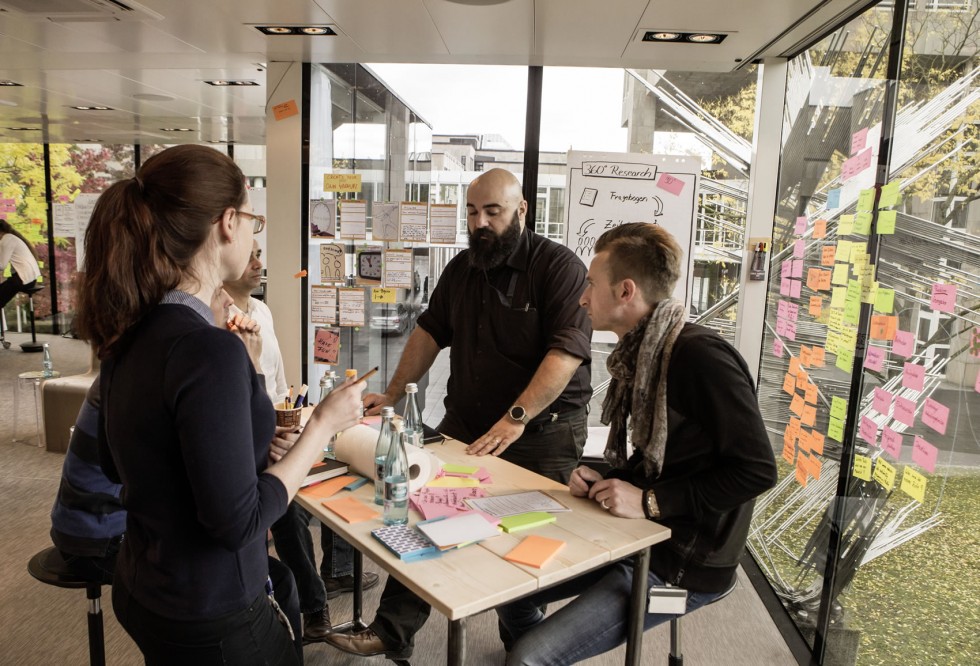
The 13 coaches come from various parts of the business and will help to embed the philosophy throughout the Group on a long-term basis. Another core element of Design Thinking is the place where ideas originate: the office container is intended as a prototype to help understand user needs – and is thus based on Design Thinking.
Helmut Schütt, CIO Daimler Trucks, Buses and Vans and sponsor of the initiative: “With Design Thinking we are creating a platform where the power of ideas can unfold. The role of IT – away from system administration to becoming an enabler and in-house business partner and problem-solver – is set to impressively prove its value here. We are particularly pleased that the creative space is already fully booked from 31 October until 19 December.”
Mercedes-Benz Looks to the Future
The traffic of the future will become increasingly interactive – and not just networking of vehicles
Mercedes-Benz, robotics experts and linguists discuss how people can communicate with autonomous vehicles in the future. Traffic in the city of the future will be largely dominated by cars that drive themselves. Beyond the technical and legal aspects, the automotive manufacturer is therefore looking very closely at social issues in this context. Communication between people and machine intelligence is a key aspect here.
The fact that cars are able to perform more and more tasks autonomously, meaning that they are gradually becoming mobile robots, is now beyond dispute. This will not just lead to changes in motoring itself, however; traffic conditions on the whole will change, too. This is why Mercedes-Benz looks at much more than just the technical issues when developing autonomous cars. Company representatives from the Group Research and Futurology department therefore met with robotics research experts and linguists to discuss the key issues at the second Mercedes-Benz Future Talk: How will we communicate with autonomous cars in the future? Can an autonomous car “wave” a pedestrian over the road? Is the car speaking to me or to the person next to me? And what does “speaking” even mean in this context? Will we have to learn robot grammar or must the car be able to understand us? And how can this language be developed? Should it be intuitive or artificial?

A driving robot ? – in the future the car drives independently
“The traffic of the future will become increasingly interactive – and I don’t just mean the networking of vehicles,” stated Prof. Dr. Kohler, Head of Group Research and Sustainability and Chief Environmental Officer at Daimler AG. “We view it as our elementary task to put autonomous cars on the road not just as technological achievements but also to make them an integral part of the traffic of the future. Here the social aspects are at least equally important as the sensors in the car.”
The in-depth discussions between all those attending the Mercedes-Benz Future Talk “Robotics” revealed that there are still many unanswered questions in the field of human-machine interaction. It became clear that robots are much more than humanoids with a human-like appearance or figures from science-fiction films. This is also substantiated by Martina Mara, who conducts research into the psychology of human-robot relationships at Ars Electronica Futurelab: “The tin man, or synthetic human-machine, may be the image we have in our mind when we hear the word ‘robot’. In the case of real robots away from the cinema screen, however, there is often only limited acceptance if there are too many similarities with humans.” According to Mara, it is more important to make it clear as quickly as possible just how intelligent a robot is, which forms of communication it can master and how it signals what its next steps will be.

Gesture communication between humans and autonomous driving cars
Alexander Mankowsky, a futurologist at Daimler AG, added: “We see the car that drives itself – the autonomous robot – embedded in the overall picture of future mobility, with humans playing the main role in our vision of the future. The task is to develop a cooperative system in which one or more communication languages are essential to allow interaction between humans and machine intelligence in the dense urban environment.” He also thinks that there may even be a robot-language dictionary in the future. According to Mankowsky, calling for people to adapt to the machines should not be the aim by any means in any of the deliberations. It is much more a case of building trust and confidence as human-machine communication gets more and more intensive.
Prof. Dr. Ellen Fricke introduced a linguistic perspective into the discussion. The gesture researcher from the Chemnitz Technical University and co-founder of the Berlin Gesture Center put forward the following arguments: “If we consider gestures to be an option for successfully communicating with autonomous cars, it is of course important to look at which human gestures in everyday use are especially suitable as a starting point for this. Another equally key question is this: how does the autonomous car shape us? And what effects will the gestures used for human-car interaction have on the gestures used for interhuman communication in the future?” Also Fricke pointed out: “Not only an encyclopedia of robot gestures is required, but as the very first step, a comprehensive digital database of human gestures of everyday use. This can be an intial point for a construction of gestures addressed to autonomous robots.”
On an everyday level, communication with autonomous vehicles is still new territory. This is why Mercedes-Benz joined forces with Ars Electronica Futurelab to create an “experimentation field” capable of testing various forms of interaction between humans and kinetic robots using prototypes. In a test setting, three interactive quadcopters were hailed, stopped or steered in a certain direction using gesture control or a haptic control object, for instance. This gave an initial idea of what co-existence between humans and autonomous machines could feel like in the shared space of the future.

Experimental research of Human-Machine, Interaction at the Mercedes-Benz Future Talk Robotics
Mercedes-Benz is convinced that what seems a long way off can quickly become a reality, believing that it is essential to develop a shared interaction language to enable functioning social “human-machine cooperation” in the traffic of the future. The automotive manufacturer will continue to work towards this goal.
Mercedes-Benz Future Talk – interdisciplinary dialogue
The Future Talk introduced last year by Mercedes-Benz established a new dialogue format and asked the question “How Utopian is the future?”. By exchanging ideas with vanguards from various disciplines, the brand shares its visions and, as the inventor of the automobile, demonstrates its expertise in shaping a desirable, mobile future.
Mercedes-Benz Participates in Future Talk Berlin
The cities of the future will no longer be divided into functional areas such as living, working, shopping, and leisure
What does the future look like? This was the main question weighing on experts from Daimler as they discussed visionary ideas at the Future Talk in Berlin with specialists from several different fields.
Professor Dr. Herbert Kohler, Vice President Group Research and Sustainability and Chief Environmental Officer at Daimler AG pointed out: “As part of our culture of innovation, we want to provide an impetus for visionary thinking. Future Talk offers us the opportunity – outside our own four walls – to enter into a dialog with avant-garde thinkers and discuss our ideas. We are convinced that innovations are only effective if they follow a clear vision for the future. Therefore, it is important to comprehend social trends and developments at an early stage and sift out the relevant aspects for an automobile manufacturer. This includes topics such as the changing user behavior of the customers as well as new opportunities and challenges due to increasing connectivity of the vehicle. That is the only way to develop successful product and business ideas and design them appropriately.”

Professor Dr. Herbert Kohler, Vice President Group Research and Sustainability and Chief Environmental Officer at Daimler AG
Double Purpose: your own car becomes public
Cars are either private or public today. The car – a protective space where we can listen to music as loudly as we like, where we can laugh, cry and swear without any inhibitions. The car – an oversized bag with all the important and not-so-important things that we carry around with us. Compare that with the anonymity of the rental car – cleaned after every journey and devoid of any personal touches.
Behind ‘Double Purpose’ stands the vision of an all-in-one solution. Conceptual approach is to combine the various uses of vehicles without making compromises: once you have driven your own car to work, you make it available as an autonomously driven taxi or car-sharing vehicle, generating extra income. The interior can easily be modified so that the car can be used as a public vehicle without compromising its function as a private one. After its use as a public vehicle, the car is simply converted back to a standard car by its owner.
“Every society shapes its surroundings to meet its needs,” says Professor Tobias Wallisser. “Privacy plays a key part in that. Private space is a luxury and implies a need for protection and security. At the same time, we look for a sense of togetherness, and closeness to the community. This is paradoxical, but human – as German writer Kurt Tucholsky said in his poem ‘The Ideal’ of 1927: Yes, that´s what I like: a villa in the countryside with a large terrace in front of the Baltic Sea, behind it the Friedrichstraße with a beautiful view, country-chic, from the bathroom you can see the Zugspitze – but in the evening it´s not far away to the cinema.”
People crave for a private, self-controlled retreat area, a place that summarize the privacy space, adds Wallisser. The trend of ‘cocooning’ also sees the home as a fortress, as a bastion of the individual, as a place of tranquility away from the frantic everyday life. Simultaneously digital media provides this place with a constant stream of news from the outside world what brings up the question of whether these rooms are really private.
Mobile Revolution: and the city is changing
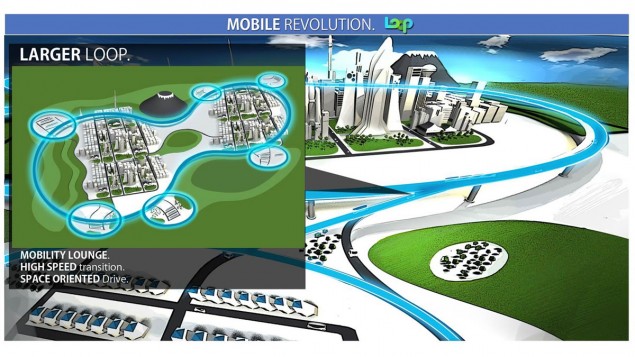
The cities of the future will no longer be divided into functional areas such as living, working, shopping, and leisure. This functional arrangement is inflexible and forces city residents to travel long distances. The necessary infrastructure also makes it difficult to find spaces where a ‘life of proximity’ can be enjoyed.
The ‘Mobile Revolution’ approach is based on a city that is not organized by functions but by mobility requirements. This city is divided into rings with different speeds. The inner rings are slower and have shops that can be reached on foot. The outer larger rings are faster and link the small centers so that big city facilities are still accessible. Innovative transport systems will allow the transportation of goods to be routed underground and away from the streets, and people will mainly travel above ground where there is light and fresh air.
The city is changing and transport is changing with it: for long distances on the large city loops, the car offers space – a ‘Mobility Lounge’ that can be used as an office, a comfortable seating area or a sales room. On the inner loops, highly compact single-seaters offer the occupant protection and privacy and help if walking is difficult or shopping too heavy. The ‘Mobile Revolution’ is therefore leading to a system of different mobility devices that combine efficiency with an individualized urban lifestyle.
Carchitecture: combines cars and architecture
Buildings and vehicles have much in common: from construction to use to recycling, they depend on energy and resources. In a building, the energy is for air conditioning, lighting and technical infrastructure such as lifts and escalators. Resources are not only used for the main structure itself but also for technical installations such as heating, cooling, and ventilation. At the present time, these functions are duplicated: both your home and car have heating systems. At the same time electric cars have energy storage which is missing in the building. The vehicle, however, has little space for energy generation.
This is where ‘Carchitecture’ comes in. Developing car design so that they can incorporate mobile and immobile elements could prove a worthwhile strategy in future. The link between a house and a car is energy: the energy flow is made possible through electric power in cars and the intelligence of energy houses in the future. The connection between the house and car is symbiotic in nature: the car is an energy accumulator on wheels, the house is a supplier and receiver of energy. So, in future, an electric vehicle could replace the installed heating system for a building.

CARchitecture - Corporation of mobile and immobile elements as a worthwhile strategy in future
It’s time for a new Utopia
There is no future without a past: Alexander Mankowsky, Futurologist at Society and Technology Research Group at Daimler AG and Professor Philipp Hübl open the Future Talk in Berlin by presenting influential utopian ideas from the past and discuss the necessity of future visions for societal evolution.
“We sense some kind of discomfort in society about the current lack of clear direction,” says Alexander Mankowsky. “It is time now for new utopias – in fact desirable ones. We are always trying to bring together the ideas of our creative thinkers and the expectations of society. Of course, mobility is our core competency. Besides, authenticity is always vital – you cannot have meaningful technical visions without social and cultural environments in which they can be realized.”
Philipp Hübl continues: “Political and social utopias in the past failed largely because they went against human nature – whereas the technical visions usually came true. Anyone who wants to predict how people will live in the technological society of the future must understand what defines the very nature of a human being, independent of random or enforced circumstances or trends.”
The science of future research looks for the constant in an ever changing world. But especially the social and societal aspects represent a challenge, because they are the most complex due to the endless parameters, so Hübl. There is the desire for authenticity, genuineness and uniqueness as well as the search for the idyllic environment with plants, food, water and light as a ‘perfect world’ and retreat. At the same time mobility applies today as a metaphor for life, for experience, travel and independence. In the end, Hübl proposes the question if we could endure several visions simultaneously, or maybe we actually do not want to choose one.
From the visions of the past to the mobility of the future: Holger Hutzenlaub, Head of Mercedes-Benz Advanced Design Germany and smart Design, presents the results of a Daimler future workshop. The pictorial worlds developed at the workshop show possible scenarios for future mobility and ways of making cars even more useful. The four scenarios, Giving Back to the City, Double Purpose, Mobile Revolution and Carchitecture, look at different strategies for shaping the world of tomorrow.
Giving Back to the City: follows a philanthropic approach
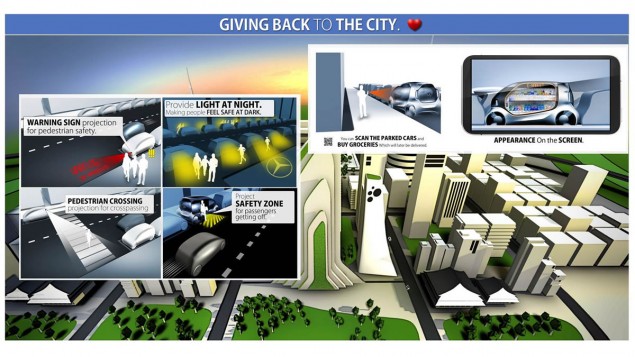
The idea of ‘Giving Back to the City’ came about because of the way people perceive cars which are often seen as the ‘bad guys’ – for example when it comes to parking. Thus, the task was: how can we create a more positive perception of cars? What additional functions must cars have in order to offer people benefits above and beyond transportation? There is no doubt that cars are becoming more and more intelligent – they are fitted with a vast amount of sensory systems and technology. ‘Giving Back to the City’ is a philanthropic approach that aims to use these technologies to create benefits for the wider community.
Cars increasingly become data hubs that assimilate and process large amounts of data from the surrounding area, as well as contributing information themselves. They are developing into robots with their own intelligence and the capacity to act. A parked vehicle, for example, could signal to children that a road is safe to cross or, if they are lost, even point them in the right direction. When crossing a traffic lane, a car could send signals to the traffic infrastructure allowing other vehicles to slow down. ‘Virtual crosswalk’ could make it possible to safely cross a road at any point.
The modern ‘living in transit’ requires more flexible shopping opportunities. Large screens on the sides of cars could display products that a passer-by could order, as if in a virtual shopping zone. At the same time, these screens could serve as advertising pillars, providing information on the current location or saying something about the vehicle’s owner. Access to the digital world and unlimited communication would be possible without a smart phone 24 hours a day no matter where you were.
Martina Mara also sees cars in the future as autonomous self-directed, social agents – with many senses for what happens in their environment. The ‘MoveBot’ performs more and more as an intelligent information robot that is active on its own in the city of the future. Beyond that the autonomous, social car of the future could be connected with other service robots in our everyday life. One opportunity regarding Martina Mara would be a complete merger: according to current requirements the robot could clean the transparent smart-material-facades or serve as transportation.
“The gap between man and machine is getting smaller and smaller and robotic systems react more and more as social partners. Living together with an autonomous machine could make life of following generations much easier,” says Martina Mara and adds: “Such a vision of the future could also evoke uncertainty, perhaps even eeriness. To accept autonomous technologies as friendly species, we should have our needs for control and personal freedom in mind when it comes to their design.”
In a human-robot co-existence from a socio-psychological point of view there is certainly to consider the aspect of losing control; something that we human beings usually do not like that much. Will we get along with intelligent, autonomous robotic vehicles moving back and forth and around us? Can we trust them? Do they know more than we do? An autonomous system that decides for itself, its next steps which we as humans cannot predict, could also spread fear. Advices of the spectrum of possibilities and information on the proposed decisions of the ‘MoveBot’ could reduce or even avoid uncertainties.
Interdisciplinary dialog is our goal
Visions are necessary to drive forward the debate in society on mobility and the design of urban living space. Future Talk at Daimler explores the complete spectrum from idealistic ideas on future mobility and the associated challenges, to possible solutions and mobility concepts. The company is sharing its visions with innovative thinkers from various disciplines. Daimler, the inventor of the car and an innovator in individual mobility, continues to demonstrate its commitment to shaping the future of mobility.