The Silent Flex: Mercedes-Benz’s GLC EV Redefines Cool
With 483 horses, rear-wheel swagger, and tactile buttons that whisper luxury, the 2026 Mercedes-Benz GLC EV proves you don’t need to shout to own the room.
If the electric car revolution is a party, Mercedes-Benz just showed up fashionably late, but you better believe it’s wearing custom-tailored wool, not a neon tracksuit.
Meet the 2026 Mercedes-Benz GLC EV. Or as the brand wants you to call it: “GLC with EQ Technology.” Mercedes, please. That sounds like something you’d find scribbled on a circuit board schematic. Let’s keep it simple: this is the GLC EV, and it’s here to remind everyone that Stuttgart still knows how to whisper luxury with a sly smile, rather than shouting about range in all caps.

This isn’t just another appliance in a sea of EVs trying to out-buzz each other with gimmicks and YouTuber launch videos. The GLC EV is a proper Mercedes, restrained, confident, and (finally) forward-looking in a segment where others have been sprinting for years. Porsche already pulled up in a Macan EV. BMW is flexing with the iX3. And Mercedes? It skipped the warm-up lap and quietly dropped an entirely new 800-volt architecture under this thing like it’s no big deal.
Spoiler: it is.
Under the Hood (Which You Can Actually Open This Time)
Let’s start with the architecture, because this is where things get sexy for the nerds and gearheads. Mercedes has given the GLC EV its first swing on the MB.EA platform, 800 volts of next-gen potential that support up to 320 kW DC fast charging. In Europe, that means 161 miles of range in 10 minutes. In the U.S., where we’re stuck with slower Tesla Superchargers (yep, it’ll use NACS from day one), the performance may dip, but it still sips electrons like a supermodel with a green juice.
The powertrain? Dual motors, 483 horsepower, and a two-speed transmission that, dare we say it, gives off Taycan vibes. It’s fast, sure, but not childish. There’s no launch control clown show here. Just poised, linear, grown-up acceleration. This is a Benz, not a TikTok stunt car.
Looks That Could Kill (or at Least Subtly Seduce)
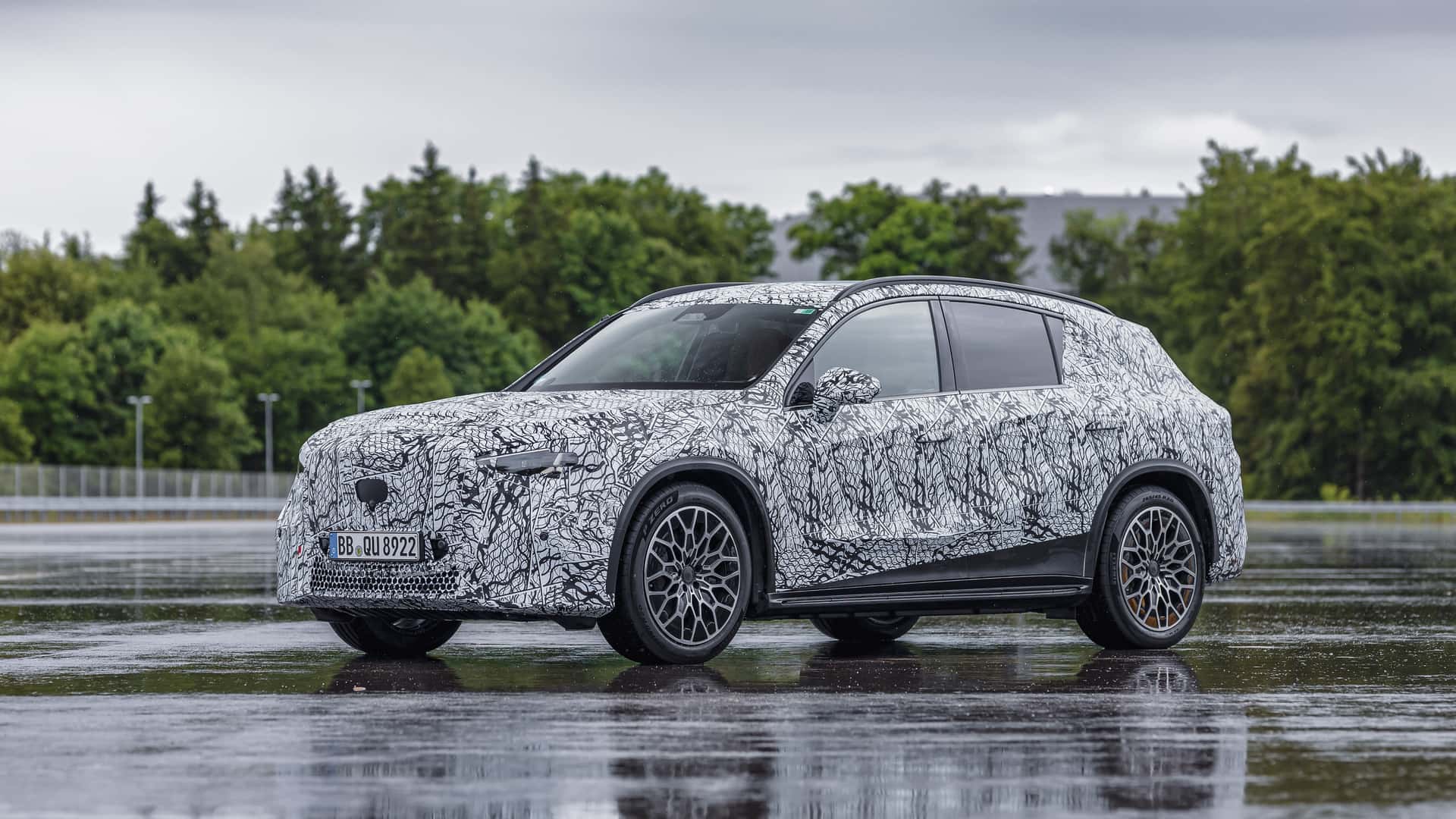
We haven’t seen it naked yet, thanks, camouflage, but the proportions are promising. Longer wheelbase. Lower roofline. That tall-wagon silhouette that says “yes, I read Wallpaper magazine, thanks for noticing.”
Inside, the future feels more analog than expected, and that’s a good thing. Mercedes heard the collective scream of humanity begging for actual buttons. So the GLC EV brings back tactile scroll wheels for volume and real toggle switches for cruise control. Even the seat adjusters move again, as God and Bruno Sacco intended. No more haptic hallucinations.
It’s as if Mercedes said, “Let’s make something that feels like driving, not swiping.”

The Ride: Butter, Not Margarine
On the road, or at least on Mercedes’ proving ground, the GLC EV floated like a cloud with a Ph.D. Its dual-mode air suspension soaked up potholes without turning the cabin into a bounce house. Rear-wheel steering makes it more agile than your barista’s vintage fixie, and the braking system is, dare we say, sorted. No more gummy pedal feel. Just smooth, predictable transitions between regen and friction. Finally.
And while it’s no AMG 63 fire-breather, this thing still moves. The torque hits with a whisper, not a slap. You won’t get whiplash, but you might get goosebumps.

The Verdict (For Now)
We don’t know what it’ll cost. We don’t know exactly how it looks. And thanks to some lingering software mysteries, we can’t tell you if the UX is genius or a fever dream. But here’s what we do know: the GLC EV feels like Mercedes is finally doing EVs on its terms. Not chasing Tesla. Not copying Porsche. Not rebranding a gas car and calling it new. This is a clean-sheet, whisper-quiet, leather-lined electric middle finger to the idea that luxury has to be loud.
If Mercedes can get the pricing right (despite that nasty 25% import tariff), and if the software brains match the mechanical brawn, the GLC EV could be the elegant answer to a segment that’s been all swagger and no soul.
This is not the EV that screams. It’s the one that smirks.
And honestly? We’re here for it.
Electric Roads May Be In Our Future
Nicola Tesla first proposed wireless energy transfer more than a century ago
We ask a lot of our cars – heat me, cool me, be silent, be comfy, be exciting and, increasingly, propel me without costly and polluting gasoline. It’s the latter request that confounds, since batteries, the most obvious replacements for gas, are heavy and have limited energy storage.
But what if the energy storage burden was shifted from our overworked cars to the road?
Researchers at the Energy Dynamics Laboratory at Utah State University are working on just such a solution, called electrified roads.
Electric vehicles, or EVs, could pick up small amounts of electricity as they drive over charging pads buried under the asphalt and connected to the electrical grid. Researchers say that a continuously available power supply would allow EVs to cut battery size as much as 80 percent, drastically reducing vehicle cost.
“Basically you get power directly from the grid to the motors as the car moves,” said Hunter Wu, a Utah State researcher who was recruited from The University of Auckland in New Zealand, where the technology was pioneered, to further develop the concept. “You can travel from the West Coast to the East Coast continuously without charging.”
Nicola Tesla first discovered the principles of wireless charging, or inductive power transfer, in the late 19th Century. It works by creating an electromagnetic charging field that transfers energy to a receiving pad set to the same frequency.
Manufacturers are already marketing wireless charging pads for electric vehicles – retrofitted to accept the charges – that can deliver a 5-kilowatt charge with 90 percent efficiency from a distance of about 10 inches.
There is also a trial application of electric roads – albeit at slow speeds and using very long charging pads – for buses at the Korea Advanced Institute of Science and Technology, south of Seoul.
But Wu is thinking of something much more radical: charging at interstate speeds. This will require several technical breakthroughs, he said.
“At 75 mph, you’re only going to stay on a pad for about 30 milliseconds,” he said. “We need to turn the pad embedded in the road on and off really quickly.”
The pads would need to be able to signal to each other that a car is coming and the car would also need to communicate its need for a charge, he said.
Wu said the pad must also deliver power even when the car isn’t directly over top of it – a capability called horizontal misalignment that the current generation of stationary inductive power transfer chargers don’t have.
John Boys, a University of Auckland professor who is credited with refining the technology, said it would be possible to transfer up to 30 kW of power at an average efficiency of 80 percent on the highway. Assuming that chargers would be available at home and work, Boys said, a car would only need “a battery big enough to make it to the nearest interstate or major road.”
Wu said the cost of electrified roads, pegged at $1.5 million to 2.5 million per lane mile, could be made up through charging a toll along the roadway.
Not only would the cost of EVs, but range anxiety would be totally eliminated, he said.
“This technology,” Wu said, “would propel EVs forward.”
Source: txchnologist
Plans for Electric Vehicles Confirmed by Mercedes-Benz
Daimler confirmed its plans to partner with Robert Bosch to develop electric motors for a new generation of electric vehicles
Daimler has today confirmed its plans to form a partnership with Robert Bosch GmbH to develop electric motors for a new generation of electric vehicles. If all goes well, production of the electric motors will begin production in early 2012. The motors will initially be used in Mercedes-Benz and smart electric cars starting in the later part of 2012.
Production of EV at BMW is not slated to begin until 2013, putting Mercedes far in front of the competition.
Specific vehicle details have yet to be released, but we expect the first vehicles to receive the electric motors will be the SLS AMG E-Cell and the A-Class E-Cell.
Press Release
Daimler AG and Robert Bosch GmbH plan to expand their long-standing partnership and cooperate in the development and production of electric motors for all-electric vehicles in Europe. The companies have signed a letter of intent and begun negotiations to establish a 50:50 joint venture that should be concluded in the first half of 2011.
Both companies aim, by bundling their competencies, to accelerate development advances in electric motors as well as to make accordant synergies accessible. According to their letter of intent, joint production should start in 2012. It is envisioned that the electric motors developed will be used in Mercedes-Benz and smart electric vehicles from 2012. Subsequent sales to other automakers are to be handled by Bosch. The joint activites will be located in the greater Stuttgart area and in Hildesheim.
The Bosch Group is a leading supplier of technology and services to the automotive sector. It has a high level of competence in developing and producing electric motors, which it is already manufacturing in series in Hildesheim.
The automotive manufacturer Daimler has built up 20 years of experience in the area of electric vehicles as well as their key components electric motor and battery, giving it a comprehensive understanding of how results can be best achieved in this field.