Safety is at the Forefront of the New Mercedes-Benz EQC
At the most advanced crash test center in the world, vehicles that include prototypes with large electric batteries are tested under harsh crash conditions.
At the most advanced crash test center in the world, vehicles, including prototypes with large electric batteries, are tested under harsh crash conditions. Thanks to this extensive experience with high-voltage drive systems, Mercedes-Benz has discovered a special safety concept and a whole array of constructive measures which deliver the EQC’s high level of crash safety:
- A new subframe surrounds the drive components located in the front section, and this unit is supported by the usual mounting points.
- The battery is surrounded by a robust frame with an integral crash structure. Deformation elements are installed between the frame and the battery, and these are able to absorb additional forces in the event of a severe side impact.
- A battery guard in the front area of the battery is able to prevent the energy storage unit from being pierced by foreign objects.
- The high-voltage system can also be shut down automatically in a crash, depending on its severity. A distinction is made between a reversible and an irreversible cut-off. When it is shut down the voltage in the high-voltage system outside of the battery reduces to below the safety-relevant voltage limit in a very short time.
- Another feature of the comprehensive high-voltage safety concept is that the charging process is automatically curtailed if an impact is detected when stationary at a quick-charging station (DC charging). There are also shutdown points where emergency teams can deactivate the high-voltage system manually.
- In addition to assessing the occupant values during a crash, the battery’s accident safety was also tested at the development centre of Deutsche ACCUMOTIVE, a wholly-owned Daimler subsidiary. Test criteria included the battery’s behaviour under impact and when penetrated by foreign bodies, with overheating and overloading also simulated.

Mercedes-Benz EQC: Crash-Erprobung im Mercedes-Benz Technologiezentrum Fahrzeugsicherheit (TFS) in Sindelfingen.;Stromverbrauch kombiniert: 22,2 kWh/100 km; CO2-Emissionen kombiniert: 0 g/km, vorläufige Angaben*
Mercedes-Benz EQC: Crash-testing at the Mercedes-Benz Technology Centre for Vehicle Safety (TFS) in Sindelfingen.;combined power consumption: 22.2 kWh/100 km; combined CO2 emissions: 0 g/km, provisional figures*
Beyond the structural safety and the battery protection concept, the model’s specially adapted restraint systems are particularly important for the occupants in the event of an accident.
- Three-point seat belts with pyrotechnical belt tensioners and belt force limiters are installed for the driver, front passenger and passengers on the outer rear seats (normal three-point seat belt in the centre at the rear).
- i-Size (Europe) and ISOFIX (other countries) child seat attachment points for securely attaching appropriate child seats on the outer rear seats
- Window airbags in the roof area between the A, B and C-pillars for the head area of the driver, front passenger and passengers on the outer rear seats
- Combined thorax/pelvis side impact airbags for driver and front passenger. Additional optional side impact airbags for the outer rear seats.
- Airbags for driver and front passenger in the event of a severe frontal impact, with dual-stage, time-delayed deployment on the passenger side
- Knee airbag for the driver
Numerous measures help to ensure that when Mercedes-Benz vehicles suffer an accident, consequential damage is reduced and rescue of the occupants is assisted. As soon as a protective system (e.g. belt tensioner and airbag) is triggered, an emergency call or a service call is made or a breakdown is detected, the following measures can be initiated depending on the accident type and severity:
- Automatic activation of Mercedes-Benz emergency call to notify emergency services of the location and emergency situation and initiate rescue.
- Shutdown of the high-voltage system
- Activation of the hazard warning system to warn other road users
- Interior lighting switched on
- Front side windows lowered for ventilation in the event of airbag deployment
- Central locking system unlocked
- Lifting of the electrically adjustable steering column
- Notification of a detected breakdown or accident situation to Car-to-X communication and to the Mercedes-Benz service centre
- A rescue sticker provides a direct link to the vehicle’s rescue data sheet. Corresponding stickers are affixed to the charging flap and to the opposite B-pillar of the vehicle for this purpose. In the aftermath of an accident, rescue services can scan the QR code with a smartphone or tablet PC for fast and reliable access to the rescue data sheet for the specific vehicle concerned, thus facilitating rescue operations.
- Alongside the rescue data sheets, the Rescue Assist App for smartphones and tablets also has three-dimensional views of the vehicle – now also offline in case there is no mobile network available at the accident scene.
Video impressions from the EQC’s crash testing can be found here.
[1] Figures for power consumption and CO2 emissions are provisional and were determined by the Technical Service. The range figures are also provisional. EC type approval and a certificate of conformity with official figures are not yet available. Differences between the stated figures and the official figures are possible.
GALLERY 2020 MERCEDES-BENZ EQC
The EQC 400 will be the first battery-electric Mercedes model to go on sale, as part of the EQ range.
The Mercedes-Bez EQC was unveiled the other and it will enter production in 2019 in Germany.
To ease the waiting time (in the U.S. it’s 2020) and to think about a possible purchase from time to time, here we have a new gallery for you.

Die Anlauffabrik im Mercedes-Benz Werk Sindelfingen testet vorab die Produktionsabläufe und nimmt die Vorserienfahrzeuge in Betrieb. Dadurch erfolgt die Serienproduktion des neuen Mercedes-Benz EQC im Mercedes-Benz Werk Bremen ab 2019 mit höchstem Reifegrad: Nach dem Zusammenfügen der Karosserie mit dem Fahrwerk folgt mit dem Einbau der Batterie die „zweite Hochzeit“.
The Pilot Plant at the Mercedes-Benz plant in Sindelfingen tests the manufacturing processes in advance and puts the preproduction vehicles into operation. This ensures the highest level of maturity for the start of series production of the new Mercedes-Benz EQC at the Mercedes-Benz plant in Bremen in 2019: Once the body has been joined to the chassis, there is a “second marriage” with the installation of the battery.

Die Anlauffabrik im Mercedes-Benz Werk Sindelfingen testet vorab die Produktionsabläufe und nimmt die Vorserienfahrzeuge in Betrieb. Dadurch erfolgt die Serienproduktion des neuen Mercedes-Benz EQC im Mercedes-Benz Werk Bremen ab 2019 mit höchstem Reifegrad: Die beiden elektrischen Antriebsstränge (eATS) werden in einer „ersten Hochzeit“ in die Karosserie des EQC eingebaut.
The Pilot Plant at the Mercedes-Benz plant in Sindelfingen tests the manufacturing processes in advance and puts the preproduction vehicles into operation. This ensures the highest level of maturity for the start of series production of the new Mercedes-Benz EQC at the Mercedes-Benz plant in Bremen in 2019: The two electric drive systems are installed in the body of the EQC in a “first marriage”.

Der neue Mercedes-Benz ECQ, Exterieur, Designskizze, Front-Scheinwerfer;Stromverbrauch kombiniert: 22,2 kWh/100 km; CO2 Emissionen kombiniert: 0 g/km*, Angaben vorläufig
The new Mercedes-Benz EQC, exterior, design sketch, front headlight;combined power consumption: 22.2 kWh/100 km; combined CO2 emissions: 0 g/km*, provisional figures

Der neue Mercedes-Benz ECQ, Exterieur, Designskizze, Front-Scheinwerfer;Stromverbrauch kombiniert: 22,2 kWh/100 km; CO2 Emissionen kombiniert: 0 g/km*, Angaben vorläufig
The new Mercedes-Benz EQC, exterior, design sketch, front headlight;combined power consumption: 22.2 kWh/100 km; combined CO2 emissions: 0 g/km*, provisional figures

Der neue Mercedes-Benz ECQ, Exterieur, Designskizze, Rücklicht;Stromverbrauch kombiniert: 22,2 kWh/100 km; CO2 Emissionen kombiniert: 0 g/km*, Angaben vorläufig
The new Mercedes-Benz EQC, exterior, design sketch, tail light;combined power consumption: 22.2 kWh/100 km; combined CO2 emissions: 0 g/km*, provisional figures

Der neue Mercedes-Benz ECQ, Interieur, Designskizze;Stromverbrauch kombiniert: 22,2 kWh/100 km; CO2 Emissionen kombiniert: 0 g/km*, Angaben vorläufig
The new Mercedes-Benz EQC, interior, design sketch;combined power consumption: 22.2 kWh/100 km; combined CO2 emissions: 0 g/km*, provisional figures

Der neue Mercedes-Benz ECQ, Interieur, Designskizze;Stromverbrauch kombiniert: 22,2 kWh/100 km; CO2 Emissionen kombiniert: 0 g/km, Angaben vorläufig*
The new Mercedes-Benz EQC interior, design sketch;combined power consumption: 22.2 kWh/100 km; combined CO2 emissions: 0 g/km, provisional figures*

Der neue Mercedes-Benz ECQ, Exterieur, Designskizze;Stromverbrauch kombiniert: 22,2 kWh/100 km; CO2 Emissionen kombiniert: 0 g/km, Angaben vorläufig*
The new Mercedes-Benz EQC, exterior, design sketch;combined power consumption: 22.2 kWh/100 km; combined CO2 emissions: 0 g/km, provisional figures*

Der neue Mercedes-Benz ECQ, Exterieur, Designskizze;Stromverbrauch kombiniert: 22,2 kWh/100 km; CO2 Emissionen kombiniert: 0 g/km, Angaben vorläufig*
The new Mercedes-Benz EQC, exterior, design sketch;combined power consumption: 22.2 kWh/100 km; combined CO2 emissions: 0 g/km, provisional figures*

Der neue Mercedes-Benz ECQ, Exterieur, Designskizze;Stromverbrauch kombiniert: 22,2 kWh/100 km; CO2 Emissionen kombiniert: 0 g/km, Angaben vorläufig*
The new Mercedes-Benz EQC, exterior, design sketch;combined power consumption: 22.2 kWh/100 km; combined CO2 emissions: 0 g/km, provisional figures*

Der neue Mercedes-Benz EQC, Exterieur, Designskizze;Stromverbrauch kombiniert: 22,2 kWh/100 km; CO2 Emissionen kombiniert: 0 g/km, Angaben vorläufig*
The new Mercedes-Benz EQC, exterior, design sketch;combined power consumption: 22.2 kWh/100 km; combined CO2 emissions: 0 g/km, provisional figures*

Der neue Mercedes-Benz ECQ, Exterieur, Designskizze;Stromverbrauch kombiniert: 22,2 kWh/100 km; CO2 Emissionen kombiniert: 0 g/km*, Angaben vorläufig
The new Mercedes-Benz EQC, exterior, design sketch;combined power consumption: 22.2 kWh/100 km; combined CO2 emissions: 0 g/km*, provisional figures

Der neue Mercedes-Benz ECQ, Exterieur, Designskizze;Stromverbrauch kombiniert: 22,2 kWh/100 km; CO2 Emissionen kombiniert: 0 g/km*, Angaben vorläufig
The new Mercedes-Benz EQC, exterior, design sketch;combined power consumption: 22.2 kWh/100 km; combined CO2 emissions: 0 g/km*, provisional figures

Der Mercedes-Benz EQC trägt an Vorder- und Hinterachse je einen kompakten elektrischen Antriebsstrang (eATS) und hat damit die Fahreigenschaften eines Allradantriebs. Die intelligente Steuerung erlaubt über einen weiten Betriebsbereich eine dynamische Momentenverteilung zwischen den beiden angetriebenen Achsen und schafft so die Voraussetzungen für hohe Fahrdynamik. Kernstück des Mer cedes-Benz EQC ist die im Fahrzeugboden angeordnete Lithium-Ionen-Batterie aus eigener Produktion.;Stromverbrauch kombiniert: 22,2 kWh/100 km; CO2 Emissionen kombiniert: 0 g/km*, Angaben vorläufig
The EQC has a compact electric powerpack at each axle, giving the vehicle the driving characteristics of an all-wheel drive. Over a wide operating range, the intelligent control allows dynamic torque distribution between the two driven axles, creating the conditions for high vehicle dynamics. The centrepiece of the Mercedes-Benz EQC is the lithium-ion battery from in-house production housed in the vehicle floor.;combined power consumption: 22.2 kWh/100 km; combined CO2 emissions: 0 g/km*, provisional figures

Der Mercedes-Benz EQC trägt an Vorder- und Hinterachse je einen kompakten elektrischen Antriebsstrang (eATS) und hat damit die Fahreigenschaften eines Allradantriebs. Die intelligente Steuerung erlaubt über einen weiten Betriebsbereich eine dynamische Momentenverteilung zwischen den beiden angetriebenen Achsen und schafft so die Voraussetzungen für hohe Fahrdynamik. Kernstück des Mer cedes-Benz EQC ist die im Fahrzeugboden angeordnete Lithium-Ionen-Batterie aus eigener Produktion.;Stromverbrauch kombiniert: 22,2 kWh/100 km; CO2 Emissionen kombiniert: 0 g/km*, Angaben vorläufig
The EQC has a compact electric powerpack at each axle, giving the vehicle the driving characteristics of an all-wheel drive. Over a wide operating range, the intelligent control allows dynamic torque distribution between the two driven axles, creating the conditions for high vehicle dynamics. The centrepiece of the Mercedes-Benz EQC is the lithium-ion battery from in-house production housed in the vehicle floor.;combined power consumption: 22.2 kWh/100 km; combined CO2 emissions: 0 g/km*, provisional figures

Der Mercedes-Benz EQC trägt an Vorder- und Hinterachse je einen kompakten elektrischen Antriebsstrang (eATS) und hat damit die Fahreigenschaften eines Allradantriebs. Die intelligente Steuerung erlaubt über einen weiten Betriebsbereich eine dynamische Momentenverteilung zwischen den beiden angetriebenen Achsen und schafft so die Voraussetzungen für hohe Fahrdynamik. Kernstück des Mer cedes-Benz EQC ist die im Fahrzeugboden angeordnete Lithium-Ionen-Batterie aus eigener Produktion.;Stromverbrauch kombiniert: 22,2 kWh/100 km; CO2 Emissionen kombiniert: 0 g/km*, Angaben vorläufig
The EQC has a compact electric powerpack at each axle, giving the vehicle the driving characteristics of an all-wheel drive. Over a wide operating range, the intelligent control allows dynamic torque distribution between the two driven axles, creating the conditions for high vehicle dynamics. The centrepiece of the Mercedes-Benz EQC is the lithium-ion battery from in-house production housed in the vehicle floor.;combined power consumption: 22.2 kWh/100 km; combined CO2 emissions: 0 g/km*, provisional figures

Der Mercedes-Benz EQC trägt an Vorder- und Hinterachse je einen kompakten elektrischen Antriebsstrang (eATS) und hat damit die Fahreigenschaften eines Allradantriebs. Die intelligente Steuerung erlaubt über einen weiten Betriebsbereich eine dynamische Momentenverteilung zwischen den beiden angetriebenen Achsen und schafft so die Voraussetzungen für hohe Fahrdynamik. Kernstück des Mer cedes-Benz EQC ist die im Fahrzeugboden angeordnete Lithium-Ionen-Batterie aus eigener Produktion.;Stromverbrauch kombiniert: 22,2 kWh/100 km; CO2 Emissionen kombiniert: 0 g/km*, Angaben vorläufig
The EQC has a compact electric powerpack at each axle, giving the vehicle the driving characteristics of an all-wheel drive. Over a wide operating range, the intelligent control allows dynamic torque distribution between the two driven axles, creating the conditions for high vehicle dynamics. The centrepiece of the Mercedes-Benz EQC is the lithium-ion battery from in-house production housed in the vehicle floor.;combined power consumption: 22.2 kWh/100 km; combined CO2 emissions: 0 g/km*, provisional figures

Der Mercedes-Benz EQC trägt an Vorder- und Hinterachse je einen kompakten elektrischen Antriebsstrang (eATS) und hat damit die Fahreigenschaften eines Allradantriebs. Die intelligente Steuerung erlaubt über einen weiten Betriebsbereich eine dynamische Momentenverteilung zwischen den beiden angetriebenen Achsen und schafft so die Voraussetzungen für hohe Fahrdynamik. Kernstück des Mer cedes-Benz EQC ist die im Fahrzeugboden angeordnete Lithium-Ionen-Batterie aus eigener Produktion.;Stromverbrauch kombiniert: 22,2 kWh/100 km; CO2 Emissionen kombiniert: 0 g/km, Angaben vorläufig*
The EQC has a compact electric powerpack at each axle, giving the vehicle the driving characteristics of an all-wheel drive. Over a wide operating range, the intelligent control allows dynamic torque distribution between the two driven axles, creating the conditions for high vehicle dynamics. The centrepiece of the Mercedes-Benz EQC is the lithium-ion battery from in-house production housed in the vehicle floor.;combined power consumption: 22.2 kWh/100 km; combined CO2 emissions: 0 g/km, provisional figures*

Der Mercedes-Benz EQC trägt an Vorder- und Hinterachse je einen kompakten elektrischen Antriebsstrang (eATS) und hat damit die Fahreigenschaften eines Allradantriebs. Die intelligente Steuerung erlaubt über einen weiten Betriebsbereich eine dynamische Momentenverteilung zwischen den beiden angetriebenen Achsen und schafft so die Voraussetzungen für hohe Fahrdynamik. Kernstück des Mer cedes-Benz EQC ist die im Fahrzeugboden angeordnete Lithium-Ionen-Batterie aus eigener Produktion.;Stromverbrauch kombiniert: 22,2 kWh/100 km; CO2 Emissionen kombiniert: 0 g/km*, Angaben vorläufig
The EQC has a compact electric powerpack at each axle, giving the vehicle the driving characteristics of an all-wheel drive. Over a wide operating range, the intelligent control allows dynamic torque distribution between the two driven axles, creating the conditions for high vehicle dynamics. The centrepiece of the Mercedes-Benz EQC is the lithium-ion battery from in-house production housed in the vehicle floor.;combined power consumption: 22.2 kWh/100 km; combined CO2 emissions: 0 g/km*, provisional figures

Der Mercedes-Benz EQC trägt an Vorder- und Hinterachse je einen kompakten elektrischen Antriebsstrang (eATS) und hat damit die Fahreigenschaften eines Allradantriebs. Die intelligente Steuerung erlaubt über einen weiten Betriebsbereich eine dynamische Momentenverteilung zwischen den beiden angetriebenen Achsen und schafft so die Voraussetzungen für hohe Fahrdynamik. Kernstück des Mercedes-Benz EQC ist die im Fahrzeugboden angeordnete Lithium-Ionen-Batterie aus eigener Produktion.;Stromverbrauch kombiniert: 22,2 kWh/100 km; CO2 Emissionen kombiniert: 0 g/km*, Angaben vorläufig
The EQC has a compact electric powerpack at each axle, giving the vehicle the driving characteristics of an all-wheel drive. Over a wide operating range, the intelligent control allows dynamic torque distribution between the two driven axles, creating the conditions for high vehicle dynamics. The centrepiece of the Mercedes-Benz EQC is the lithium-ion battery from in-house production housed in the vehicle floor.;combined power consumption: 22.2 kWh/100 km; combined CO2 emissions: 0 g/km*, provisional figures

Der Mercedes-Benz EQC trägt an Vorder- und Hinterachse je einen kompakten elektrischen Antriebsstrang (eATS) und hat damit die Fahreigenschaften eines Allradantriebs. Die intelligente Steuerung erlaubt über einen weiten Betriebsbereich eine dynamische Momentenverteilung zwischen den beiden angetriebenen Achsen und schafft so die Voraussetzungen für hohe Fahrdynamik. Kernstück des Mercedes-Benz EQC ist die im Fahrzeugboden angeordnete Lithium-Ionen-Batterie aus eigener Produktion.;Stromverbrauch kombiniert: 22,2 kWh/100 km; CO2 Emissionen kombiniert: 0 g/km*, Angaben vorläufig
The EQC has a compact electric powerpack at each axle, giving the vehicle the driving characteristics of an all-wheel drive. Over a wide operating range, the intelligent control allows dynamic torque distribution between the two driven axles, creating the conditions for high vehicle dynamics. The centrepiece of the Mercedes-Benz EQC is the lithium-ion battery from in-house production housed in the vehicle floor.;combined power consumption: 22.2 kWh/100 km; combined CO2 emissions: 0 g/km*, provisional figures

Der Mercedes-Benz EQC trägt an Vorder- und Hinterachse je einen kompakten elektrischen Antriebsstrang (eATS) und hat damit die Fahreigenschaften eines Allradantriebs. Die intelligente Steuerung erlaubt über einen weiten Betriebsbereich eine dynamische Momentenverteilung zwischen den beiden angetriebenen Achsen und schafft so die Voraussetzungen für hohe Fahrdynamik. Kernstück des Mercedes-Benz EQC ist die im Fahrzeugboden angeordnete Lithium-Ionen-Batterie aus eigener Produktion.;Stromverbrauch kombiniert: 22,2 kWh/100 km; CO2 Emissionen kombiniert: 0 g/km*, Angaben vorläufig
The EQC has a compact electric powerpack at each axle, giving the vehicle the driving characteristics of an all-wheel drive. Over a wide operating range, the intelligent control allows dynamic torque distribution between the two driven axles, creating the conditions for high vehicle dynamics. The centrepiece of the Mercedes-Benz EQC is the lithium-ion battery from in-house production housed in the vehicle floor.;combined power consumption: 22.2 kWh/100 km; combined CO2 emissions: 0 g/km*, provisional figures
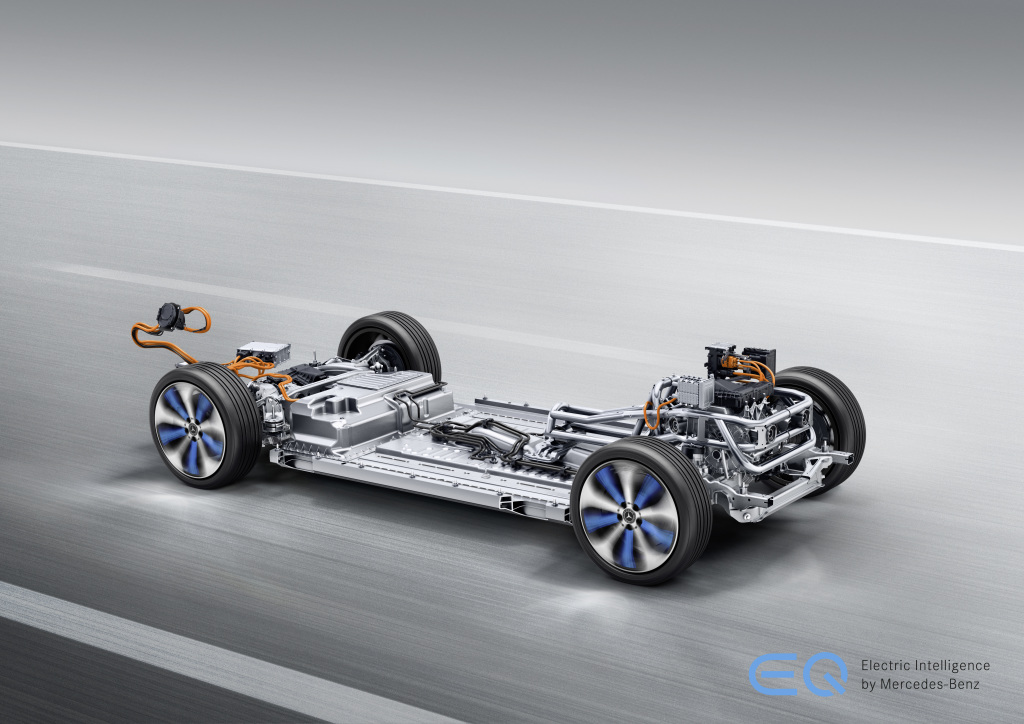
Der Mercedes-Benz EQC trägt an Vorder- und Hinterachse je einen kompakten elektrischen Antriebsstrang (eATS) und hat damit die Fahreigenschaften eines Allradantriebs. Die intelligente Steuerung erlaubt über einen weiten Betriebsbereich eine dynamische Momentenverteilung zwischen den beiden angetriebenen Achsen und schafft so die Voraussetzungen für hohe Fahrdynamik. Kernstück des Mercedes-Benz EQC ist die im Fahrzeugboden angeordnete Lithium-Ionen-Batterie aus eigener Produktion.;Stromverbrauch kombiniert: 22,2 kWh/100 km; CO2 Emissionen kombiniert: 0 g/km*, Angaben vorläufig
The EQC has a compact electric powerpack at each axle, giving the vehicle the driving characteristics of an all-wheel drive. Over a wide operating range, the intelligent control allows dynamic torque distribution between the two driven axles, creating the conditions for high vehicle dynamics. The centrepiece of the Mercedes-Benz EQC is the lithium-ion battery from in-house production housed in the vehicle floor.;combined power consumption: 22.2 kWh/100 km; combined CO2 emissions: 0 g/km*, provisional figures

Der Mercedes-Benz EQC trägt an Vorder- und Hinterachse je einen kompakten elektrischen Antriebsstrang (eATS) und hat damit die Fahreigenschaften eines Allradantriebs. Die intelligente Steuerung erlaubt über einen weiten Betriebsbereich eine dynamische Momentenverteilung zwischen den beiden angetriebenen Achsen und schafft so die Voraussetzungen für hohe Fahrdynamik. Kernstück des Mercedes-Benz EQC ist die im Fahrzeugboden angeordnete Lithium-Ionen-Batterie aus eigener Produktion.;Stromverbrauch kombiniert: 22,2 kWh/100 km; CO2 Emissionen kombiniert: 0 g/km*, Angaben vorläufig
The EQC has a compact electric powerpack at each axle, giving the vehicle the driving characteristics of an all-wheel drive. Over a wide operating range, the intelligent control allows dynamic torque distribution between the two driven axles, creating the conditions for high vehicle dynamics. The centrepiece of the Mercedes-Benz EQC is the lithium-ion battery from in-house production housed in the vehicle floor.;combined power consumption: 22.2 kWh/100 km; combined CO2 emissions: 0 g/km*, provisional figures

Der Mercedes-Benz EQC trägt an Vorder- und Hinterachse je einen kompakten elektrischen Antriebsstrang (eATS) und hat damit die Fahreigenschaften eines Allradantriebs. Die intelligente Steuerung erlaubt über einen weiten Betriebsbereich eine dynamische Momentenverteilung zwischen den beiden angetriebenen Achsen und schafft so die Voraussetzungen für hohe Fahrdynamik. Kernstück des Mercedes-Benz EQC ist die im Fahrzeugboden angeordnete Lithium-Ionen-Batterie aus eigener Produktion.;Stromverbrauch kombiniert: 22,2 kWh/100 km; CO2 Emissionen kombiniert: 0 g/km*, Angaben vorläufig
The EQC has a compact electric powerpack at each axle, giving the vehicle the driving characteristics of an all-wheel drive. Over a wide operating range, the intelligent control allows dynamic torque distribution between the two driven axles, creating the conditions for high vehicle dynamics. The centrepiece of the Mercedes-Benz EQC is the lithium-ion battery from in-house production housed in the vehicle floor.;combined power consumption: 22.2 kWh/100 km; combined CO2 emissions: 0 g/km*, provisional figures

Der Mercedes-Benz EQC trägt an Vorder- und Hinterachse je einen kompakten elektrischen Antriebsstrang (eATS) und hat damit die Fahreigenschaften eines Allradantriebs. Die intelligente Steuerung erlaubt über einen weiten Betriebsbereich eine dynamische Momentenverteilung zwischen den beiden angetriebenen Achsen und schafft so die Voraussetzungen für hohe Fahrdynamik. Kernstück des Mercedes-Benz EQC ist die im Fahrzeugboden angeordnete Lithium-Ionen-Batterie aus eigener Produktion.;Stromverbrauch kombiniert: 22,2 kWh/100 km; CO2 Emissionen kombiniert: 0 g/km*, Angaben vorläufig
The EQC has a compact electric powerpack at each axle, giving the vehicle the driving characteristics of an all-wheel drive. Over a wide operating range, the intelligent control allows dynamic torque distribution between the two driven axles, creating the conditions for high vehicle dynamics. The centrepiece of the Mercedes-Benz EQC is the lithium-ion battery from in-house production housed in the vehicle floor.;combined power consumption: 22.2 kWh/100 km; combined CO2 emissions: 0 g/km*, provisional figures

Der Mercedes-Benz EQC trägt an Vorder- und Hinterachse je einen kompakten elektrischen Antriebsstrang (eATS) und hat damit die Fahreigenschaften eines Allradantriebs. Die intelligente Steuerung erlaubt über einen weiten Betriebsbereich eine dynamische Momentenverteilung zwischen den beiden angetriebenen Achsen und schafft so die Voraussetzungen für hohe Fahrdynamik. Kernstück des Mercedes-Benz EQC ist die im Fahrzeugboden angeordnete Lithium-Ionen-Batterie aus eigener Produktion.;Stromverbrauch kombiniert: 22,2 kWh/100 km; CO2 Emissionen kombiniert: 0 g/km*, Angaben vorläufig
The EQC has a compact electric powerpack at each axle, giving the vehicle the driving characteristics of an all-wheel drive. Over a wide operating range, the intelligent control allows dynamic torque distribution between the two driven axles, creating the conditions for high vehicle dynamics. The centrepiece of the Mercedes-Benz EQC is the lithium-ion battery from in-house production housed in the vehicle floor.;combined power consumption: 22.2 kWh/100 km; combined CO2 emissions: 0 g/km*, provisional figures

Der Mercedes-Benz EQC trägt an Vorder- und Hinterachse je einen kompakten elektrischen Antriebsstrang (eATS) und hat damit die Fahreigenschaften eines Allradantriebs. Die intelligente Steuerung erlaubt über einen weiten Betriebsbereich eine dynamische Momentenverteilung zwischen den beiden angetriebenen Achsen und schafft so die Voraussetzungen für hohe Fahrdynamik. Kernstück des Mercedes-Benz EQC ist die im Fahrzeugboden angeordnete Lithium-Ionen-Batterie aus eigener Produktion.;Stromverbrauch kombiniert: 22,2 kWh/100 km; CO2 Emissionen kombiniert: 0 g/km*, Angaben vorläufig
The EQC has a compact electric powerpack at each axle, giving the vehicle the driving characteristics of an all-wheel drive. Over a wide operating range, the intelligent control allows dynamic torque distribution between the two driven axles, creating the conditions for high vehicle dynamics. The centrepiece of the Mercedes-Benz EQC is the lithium-ion battery from in-house production housed in the vehicle floor.;combined power consumption: 22.2 kWh/100 km; combined CO2 emissions: 0 g/km*, provisional figures

Der Mercedes-Benz EQC trägt an Vorder- und Hinterachse je einen kompakten elektrischen Antriebsstrang (eATS) und hat damit die Fahreigenschaften eines Allradantriebs. Die intelligente Steuerung erlaubt über einen weiten Betriebsbereich eine dynamische Momentenverteilung zwischen den beiden angetriebenen Achsen und schafft so die Voraussetzungen für hohe Fahrdynamik. Kernstück des Mercedes-Benz EQC ist die im Fahrzeugboden angeordnete Lithium-Ionen-Batterie aus eigener Produktion.;Stromverbrauch kombiniert: 22,2 kWh/100 km; CO2 Emissionen kombiniert: 0 g/km*, Angaben vorläufig
The EQC has a compact electric powerpack at each axle, giving the vehicle the driving characteristics of an all-wheel drive. Over a wide operating range, the intelligent control allows dynamic torque distribution between the two driven axles, creating the conditions for high vehicle dynamics. The centrepiece of the Mercedes-Benz EQC is the lithium-ion battery from in-house production housed in the vehicle floor.;combined power consumption: 22.2 kWh/100 km; combined CO2 emissions: 0 g/km*, provisional figures

Der Mercedes-Benz EQC trägt an Vorder- und Hinterachse je einen kompakten elektrischen Antriebsstrang (eATS) und hat damit die Fahreigenschaften eines Allradantriebs. Die intelligente Steuerung erlaubt über einen weiten Betriebsbereich eine dynamische Momentenverteilung zwischen den beiden angetriebenen Achsen und schafft so die Voraussetzungen für hohe Fahrdynamik. Kernstück des Mercedes-Benz EQC ist die im Fahrzeugboden angeordnete Lithium-Ionen-Batterie aus eigener Produktion.;Stromverbrauch kombiniert: 22,2 kWh/100 km; CO2 Emissionen kombiniert: 0 g/km*, Angaben vorläufig
The EQC has a compact electric powerpack at each axle, giving the vehicle the driving characteristics of an all-wheel drive. Over a wide operating range, the intelligent control allows dynamic torque distribution between the two driven axles, creating the conditions for high vehicle dynamics. The centrepiece of the Mercedes-Benz EQC is the lithium-ion battery from in-house production housed in the vehicle floor.;combined power consumption: 22.2 kWh/100 km; combined CO2 emissions: 0 g/km*, provisional figures

Der Mercedes-Benz EQC trägt an Vorder- und Hinterachse je einen kompakten elektrischen Antriebsstrang (eATS) und hat damit die Fahreigenschaften eines Allradantriebs. Die intelligente Steuerung erlaubt über einen weiten Betriebsbereich eine dynamische Momentenverteilung zwischen den beiden angetriebenen Achsen und schafft so die Voraussetzungen für hohe Fahrdynamik. Kernstück des Mercedes-Benz EQC ist die im Fahrzeugboden angeordnete Lithium-Ionen-Batterie aus eigener Produktion.;Stromverbrauch kombiniert: 22,2 kWh/100 km; CO2 Emissionen kombiniert: 0 g/km*, Angaben vorläufig
The EQC has a compact electric powerpack at each axle, giving the vehicle the driving characteristics of an all-wheel drive. Over a wide operating range, the intelligent control allows dynamic torque distribution between the two driven axles, creating the conditions for high vehicle dynamics. The centrepiece of the Mercedes-Benz EQC is the lithium-ion battery from in-house production housed in the vehicle floor.;combined power consumption: 22.2 kWh/100 km; combined CO2 emissions: 0 g/km*, provisional figures

Der Mercedes-Benz EQC trägt an Vorder- und Hinterachse je einen kompakten elektrischen Antriebsstrang (eATS) und hat damit die Fahreigenschaften eines Allradantriebs. Die intelligente Steuerung erlaubt über einen weiten Betriebsbereich eine dynamische Momentenverteilung zwischen den beiden angetriebenen Achsen und schafft so die Voraussetzungen für hohe Fahrdynamik. Kernstück des Mercedes-Benz EQC ist die im Fahrzeugboden angeordnete Lithium-Ionen-Batterie aus eigener Produktion.;Stromverbrauch kombiniert: 22,2 kWh/100 km; CO2 Emissionen kombiniert: 0 g/km*, Angaben vorläufig
The EQC has a compact electric powerpack at each axle, giving the vehicle the driving characteristics of an all-wheel drive. Over a wide operating range, the intelligent control allows dynamic torque distribution between the two driven axles, creating the conditions for high vehicle dynamics. The centrepiece of the Mercedes-Benz EQC is the lithium-ion battery from in-house production housed in the vehicle floor.;combined power consumption: 22.2 kWh/100 km; combined CO2 emissions: 0 g/km*, provisional figures

Der Mercedes-Benz EQC trägt an Vorder- und Hinterachse je einen kompakten elektrischen Antriebsstrang (eATS) und hat damit die Fahreigenschaften eines Allradantriebs. Die intelligente Steuerung erlaubt über einen weiten Betriebsbereich eine dynamische Momentenverteilung zwischen den beiden angetriebenen Achsen und schafft so die Voraussetzungen für hohe Fahrdynamik. Kernstück des Mercedes-Benz EQC ist die im Fahrzeugboden angeordnete Lithium-Ionen-Batterie aus eigener Produktion.;Stromverbrauch kombiniert: 22,2 kWh/100 km; CO2 Emissionen kombiniert: 0 g/km*, Angaben vorläufig
The EQC has a compact electric powerpack at each axle, giving the vehicle the driving characteristics of an all-wheel drive. Over a wide operating range, the intelligent control allows dynamic torque distribution between the two driven axles, creating the conditions for high vehicle dynamics. The centrepiece of the Mercedes-Benz EQC is the lithium-ion battery from in-house production housed in the vehicle floor.;combined power consumption: 22.2 kWh/100 km; combined CO2 emissions: 0 g/km*, provisional figures

Der Mercedes-Benz EQC trägt an Vorder- und Hinterachse je einen kompakten elektrischen Antriebsstrang (eATS) und hat damit die Fahreigenschaften eines Allradantriebs. Die intelligente Steuerung erlaubt über einen weiten Betriebsbereich eine dynamische Momentenverteilung zwischen den beiden angetriebenen Achsen und schafft so die Voraussetzungen für hohe Fahrdynamik. Kernstück des Mercedes-Benz EQC ist die im Fahrzeugboden angeordnete Lithium-Ionen-Batterie aus eigener Produktion.;Stromverbrauch kombiniert: 22,2 kWh/100 km; CO2 Emissionen kombiniert: 0 g/km*, Angaben vorläufig
The EQC has a compact electric powerpack at each axle, giving the vehicle the driving characteristics of an all-wheel drive. Over a wide operating range, the intelligent control allows dynamic torque distribution between the two driven axles, creating the conditions for high vehicle dynamics. The centrepiece of the Mercedes-Benz EQC is the lithium-ion battery from in-house production housed in the vehicle floor.;combined power consumption: 22.2 kWh/100 km; combined CO2 emissions: 0 g/km*, provisional figures

Der Mercedes-Benz EQC trägt an Vorder- und Hinterachse je einen kompakten elektrischen Antriebsstrang (eATS) und hat damit die Fahreigenschaften eines Allradantriebs. Die intelligente Steuerung erlaubt über einen weiten Betriebsbereich eine dynamische Momentenverteilung zwischen den beiden angetriebenen Achsen und schafft so die Voraussetzungen für hohe Fahrdynamik. Kernstück des Mercedes-Benz EQC ist die im Fahrzeugboden angeordnete Lithium-Ionen-Batterie aus eigener Produktion.;Stromverbrauch kombiniert: 22,2 kWh/100 km; CO2 Emissionen kombiniert: 0 g/km*, Angaben vorläufig
The EQC has a compact electric powerpack at each axle, giving the vehicle the driving characteristics of an all-wheel drive. Over a wide operating range, the intelligent control allows dynamic torque distribution between the two driven axles, creating the conditions for high vehicle dynamics. The centrepiece of the Mercedes-Benz EQC is the lithium-ion battery from in-house production housed in the vehicle floor.;combined power consumption: 22.2 kWh/100 km; combined CO2 emissions: 0 g/km*, provisional figures

Der Mercedes-Benz EQC trägt an Vorder- und Hinterachse je einen kompakten elektrischen Antriebsstrang (eATS) und hat damit die Fahreigenschaften eines Allradantriebs. Die intelligente Steuerung erlaubt über einen weiten Betriebsbereich eine dynamische Momentenverteilung zwischen den beiden angetriebenen Achsen und schafft so die Voraussetzungen für hohe Fahrdynamik. Kernstück des Mercedes-Benz EQC ist die im Fahrzeugboden angeordnete Lithium-Ionen-Batterie aus eigener Produktion.;Stromverbrauch kombiniert: 22,2 kWh/100 km; CO2 Emissionen kombiniert: 0 g/km*, Angaben vorläufig
The EQC has a compact electric powerpack at each axle, giving the vehicle the driving characteristics of an all-wheel drive. Over a wide operating range, the intelligent control allows dynamic torque distribution between the two driven axles, creating the conditions for high vehicle dynamics. The centrepiece of the Mercedes-Benz EQC is the lithium-ion battery from in-house production housed in the vehicle floor.;combined power consumption: 22.2 kWh/100 km; combined CO2 emissions: 0 g/km*, provisional figures

Der Mercedes-Benz EQC trägt an Vorder- und Hinterachse je einen kompakten elektrischen Antriebsstrang (eATS) und hat damit die Fahreigenschaften eines Allradantriebs. Die intelligente Steuerung erlaubt über einen weiten Betriebsbereich eine dynamische Momentenverteilung zwischen den beiden angetriebenen Achsen und schafft so die Voraussetzungen für hohe Fahrdynamik. Kernstück des Mercedes-Benz EQC ist die im Fahrzeugboden angeordnete Lithium-Ionen-Batterie aus eigener Produktion.;Stromverbrauch kombiniert: 22,2 kWh/100 km; CO2 Emissionen kombiniert: 0 g/km*, Angaben vorläufig
The EQC has a compact electric powerpack at each axle, giving the vehicle the driving characteristics of an all-wheel drive. Over a wide operating range, the intelligent control allows dynamic torque distribution between the two driven axles, creating the conditions for high vehicle dynamics. The centrepiece of the Mercedes-Benz EQC is the lithium-ion battery from in-house production housed in the vehicle floor.;combined power consumption: 22.2 kWh/100 km; combined CO2 emissions: 0 g/km*, provisional figures

Der Mercedes-Benz EQC trägt an Vorder- und Hinterachse je einen kompakten elektrischen Antriebsstrang (eATS) und hat damit die Fahreigenschaften eines Allradantriebs. Die intelligente Steuerung erlaubt über einen weiten Betriebsbereich eine dynamische Momentenverteilung zwischen den beiden angetriebenen Achsen und schafft so die Voraussetzungen für hohe Fahrdynamik. Kernstück des Mercedes-Benz EQC ist die im Fahrzeugboden angeordnete Lithium-Ionen-Batterie aus eigener Produktion.;Stromverbrauch kombiniert: 22,2 kWh/100 km; CO2 Emissionen kombiniert: 0 g/km*, Angaben vorläufig
The EQC has a compact electric powerpack at each axle, giving the vehicle the driving characteristics of an all-wheel drive. Over a wide operating range, the intelligent control allows dynamic torque distribution between the two driven axles, creating the conditions for high vehicle dynamics. The centrepiece of the Mercedes-Benz EQC is the lithium-ion battery from in-house production housed in the vehicle floor.;combined power consumption: 22.2 kWh/100 km; combined CO2 emissions: 0 g/km*, provisional figures

Der Mercedes-Benz EQC trägt an Vorder- und Hinterachse je einen kompakten elektrischen Antriebsstrang (eATS) und hat damit die Fahreigenschaften eines Allradantriebs. Die intelligente Steuerung erlaubt über einen weiten Betriebsbereich eine dynamische Momentenverteilung zwischen den beiden angetriebenen Achsen und schafft so die Voraussetzungen für hohe Fahrdynamik. Kernstück des Mercedes-Benz EQC ist die im Fahrzeugboden angeordnete Lithium-Ionen-Batterie aus eigener Produktion.;Stromverbrauch kombiniert: 22,2 kWh/100 km; CO2 Emissionen kombiniert: 0 g/km*, Angaben vorläufig
The EQC has a compact electric powerpack at each axle, giving the vehicle the driving characteristics of an all-wheel drive. Over a wide operating range, the intelligent control allows dynamic torque distribution between the two driven axles, creating the conditions for high vehicle dynamics. The centrepiece of the Mercedes-Benz EQC is the lithium-ion battery from in-house production housed in the vehicle floor.;combined power consumption: 22.2 kWh/100 km; combined CO2 emissions: 0 g/km*, provisional figures

Der Mercedes-Benz EQC trägt an Vorder- und Hinterachse je einen kompakten elektrischen Antriebsstrang (eATS) und hat damit die Fahreigenschaften eines Allradantriebs. Die intelligente Steuerung erlaubt über einen weiten Betriebsbereich eine dynamische Momentenverteilung zwischen den beiden angetriebenen Achsen und schafft so die Voraussetzungen für hohe Fahrdynamik. Kernstück des Mercedes-Benz EQC ist die im Fahrzeugboden angeordnete Lithium-Ionen-Batterie aus eigener Produktion.;Stromverbrauch kombiniert: 22,2 kWh/100 km; CO2 Emissionen kombiniert: 0 g/km*, Angaben vorläufig
The EQC has a compact electric powerpack at each axle, giving the vehicle the driving characteristics of an all-wheel drive. Over a wide operating range, the intelligent control allows dynamic torque distribution between the two driven axles, creating the conditions for high vehicle dynamics. The centrepiece of the Mercedes-Benz EQC is the lithium-ion battery from in-house production housed in the vehicle floor.;combined power consumption: 22.2 kWh/100 km; combined CO2 emissions: 0 g/km*, provisional figures

Der Mercedes-Benz EQC trägt an Vorder- und Hinterachse je einen kompakten elektrischen Antriebsstrang (eATS) und hat damit die Fahreigenschaften eines Allradantriebs. Die intelligente Steuerung erlaubt über einen weiten Betriebsbereich eine dynamische Momentenverteilung zwischen den beiden angetriebenen Achsen und schafft so die Voraussetzungen für hohe Fahrdynamik. Kernstück des Mercedes-Benz EQC ist die im Fahrzeugboden angeordnete Lithium-Ionen-Batterie aus eigener Produktion.;Stromverbrauch kombiniert: 22,2 kWh/100 km; CO2 Emissionen kombiniert: 0 g/km, Angaben vorläufig*
The EQC has a compact electric powerpack at each axle, giving the vehicle the driving characteristics of an all-wheel drive. Over a wide operating range, the intelligent control allows dynamic torque distribution between the two driven axles, creating the conditions for high vehicle dynamics. The centrepiece of the Mercedes-Benz EQC is the lithium-ion battery from in-house production housed in the vehicle floor.;combined power consumption: 22.2 kWh/100 km; combined CO2 emissions: 0 g/km, provisional figures*

Der Mercedes-Benz EQC trägt an Vorder- und Hinterachse je einen kompakten elektrischen Antriebsstrang (eATS) und hat damit die Fahreigenschaften eines Allradantriebs. Die intelligente Steuerung erlaubt über einen weiten Betriebsbereich eine dynamische Momentenverteilung zwischen den beiden angetriebenen Achsen und schafft so die Voraussetzungen für hohe Fahrdynamik. Kernstück des Mercedes-Benz EQC ist die im Fahrzeugboden angeordnete Lithium-Ionen-Batterie aus eigener Produktion.;Stromverbrauch kombiniert: 22,2 kWh/100 km; CO2 Emissionen kombiniert: 0 g/km*, Angaben vorläufig
The EQC has a compact electric powerpack at each axle, giving the vehicle the driving characteristics of an all-wheel drive. Over a wide operating range, the intelligent control allows dynamic torque distribution between the two driven axles, creating the conditions for high vehicle dynamics. The centrepiece of the Mercedes-Benz EQC is the lithium-ion battery from in-house production housed in the vehicle floor.;combined power consumption: 22.2 kWh/100 km; combined CO2 emissions: 0 g/km*, provisional figures
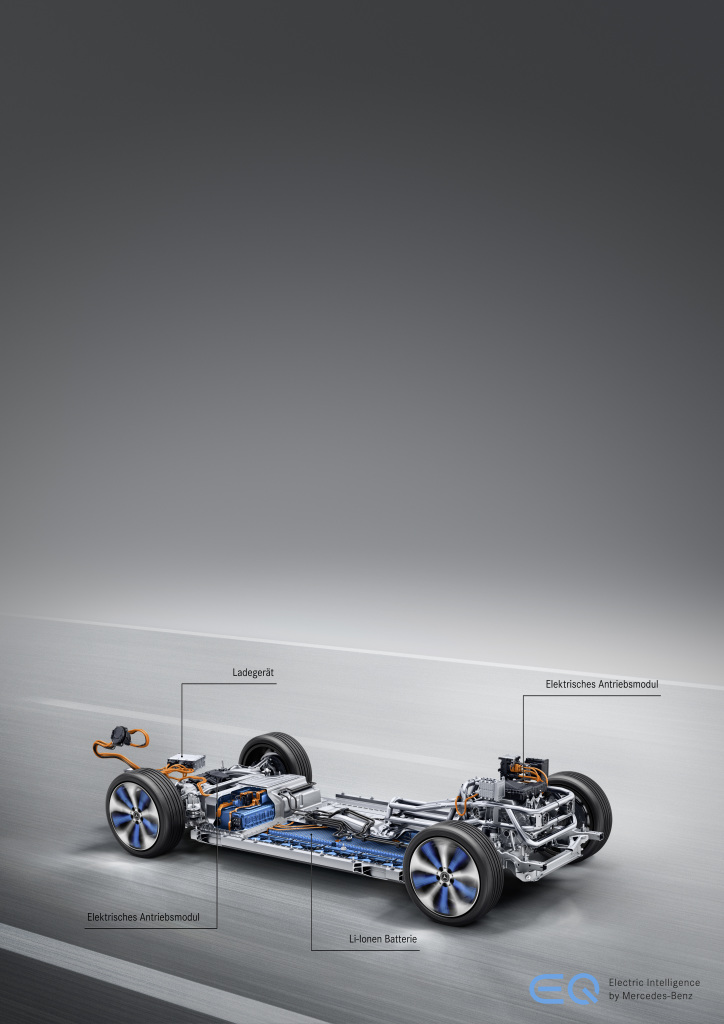
Der Mercedes-Benz EQC trägt an Vorder- und Hinterachse je einen kompakten elektrischen Antriebsstrang (eATS) und hat damit die Fahreigenschaften eines Allradantriebs. Die intelligente Steuerung erlaubt über einen weiten Betriebsbereich eine dynamische Momentenverteilung zwischen den beiden angetriebenen Achsen und schafft so die Voraussetzungen für hohe Fahrdynamik. Kernstück des Mercedes-Benz EQC ist die im Fahrzeugboden angeordnete Lithium-Ionen-Batterie aus eigener Produktion.;Stromverbrauch kombiniert: 22,2 kWh/100 km; CO2 Emissionen kombiniert: 0 g/km*, Angaben vorläufig
The EQC has a compact electric powerpack at each axle, giving the vehicle the driving characteristics of an all-wheel drive. Over a wide operating range, the intelligent control allows dynamic torque distribution between the two driven axles, creating the conditions for high vehicle dynamics. The centrepiece of the Mercedes-Benz EQC is the lithium-ion battery from in-house production housed in the vehicle floor.;combined power consumption: 22.2 kWh/100 km; combined CO2 emissions: 0 g/km*, provisional figures

Der Mercedes-Benz EQC ist mit der neusten Generation einer Lithium-Ionen-Batterie (Li-Ion) ausgerüstet. Das Systemdesign der Batterie ist modular aufgebaut, es besteht aus zwei Modulen mit jeweils 48 und vier Modulen mit 72 Zellen.;Stromverbrauch kombiniert: 22,2 kWh/100 km; CO2 Emissionen kombiniert: 0 g/km, Angaben vorläufig*
The Mercedes-Benz EQC is equipped with the latest generation of a lithium-ion (Li-Ion) battery. The battery system is modular in design, consisting of two modules with 48 cells each and four with 72 cells each. ;combined power consumption: 22.2 kWh/100 km; combined CO2 emissions: 0 g/km, provisional figures*

Der Mercedes-Benz EQC ist mit der neusten Generation einer Lithium-Ionen-Batterie (Li-Ion) ausgerüstet. Das Systemdesign der Batterie ist modular aufgebaut, es besteht aus zwei Modulen mit jeweils 48 und vier Modulen mit 72 Zellen.;Stromverbrauch kombiniert: 22,2 kWh/100 km; CO2 Emissionen kombiniert: 0 g/km*, Angaben vorläufig
The Mercedes-Benz EQC is equipped with the latest generation of a lithium-ion (Li-Ion) battery. The battery system is modular in design, consisting of two modules with 48 cells each and four with 72 cells each.;combined power consumption: 22.2 kWh/100 km; combined CO2 emissions: 0 g/km*, provisional figures

Der Mercedes-Benz EQC ist mit der neusten Generation einer Lithium-Ionen-Batterie (Li-Ion) ausgerüstet. Das Systemdesign der Batterie ist modular aufgebaut, es besteht aus zwei Modulen mit jeweils 48 und vier Modulen mit 72 Zellen.;Stromverbrauch kombiniert: 22,2 kWh/100 km; CO2 Emissionen kombiniert: 0 g/km*, Angaben vorläufig
The Mercedes-Benz EQC is equipped with the latest generation of a lithium-ion (Li-Ion) battery. The battery system is modular in design, consisting of two modules with 48 cells each and four with 72 cells each.;combined power consumption: 22.2 kWh/100 km; combined CO2 emissions: 0 g/km*, provisional figures

Der neue Mercedes-Benz ECQ; Vorserienproduktion der EQC-Batterie;Stromverbrauch kombiniert: 22,2 kWh/100 km; CO2 Emissionen kombiniert: 0 g/km*, Angaben vorläufig
The new Mercedes-Benz EQC; Preseries production of EQC battery;combined power consumption: 22.2 kWh/100 km; combined CO2 emissions: 0 g/km*, provisional figures

Der neue Mercedes-Benz ECQ; Vorserienproduktion der EQC-Batterie;Stromverbrauch kombiniert: 22,2 kWh/100 km; CO2 Emissionen kombiniert: 0 g/km*, Angaben vorläufig
The new Mercedes-Benz EQC; Preseries production of EQC battery;combined power consumption: 22.2 kWh/100 km; combined CO2 emissions: 0 g/km*, provisional figures

Der neue Mercedes-Benz ECQ; Vorserienproduktion der EQC-Batterie;Stromverbrauch kombiniert: 22,2 kWh/100 km; CO2 Emissionen kombiniert: 0 g/km*, Angaben vorläufig
The new Mercedes-Benz EQC; Preseries production of EQC battery;combined power consumption: 22.2 kWh/100 km; combined CO2 emissions: 0 g/km*, provisional figures

Der neue Mercedes-Benz ECQ; Vorserienproduktion der EQC-Batterie;Stromverbrauch kombiniert: 22,2 kWh/100 km; CO2 Emissionen kombiniert: 0 g/km*, Angaben vorläufig
The new Mercedes-Benz EQC; Preseries production of EQC battery;combined power consumption: 22.2 kWh/100 km; combined CO2 emissions: 0 g/km*, provisional figures

Der neue Mercedes-Benz ECQ; Vorserienproduktion der EQC-Batterie;Stromverbrauch kombiniert: 22,2 kWh/100 km; CO2 Emissionen kombiniert: 0 g/km*, Angaben vorläufig
The new Mercedes-Benz EQC; Preseries production of EQC battery;combined power consumption: 22.2 kWh/100 km; combined CO2 emissions: 0 g/km*, provisional figures

Der neue Mercedes-Benz ECQ; Vorserienproduktion der EQC-Batterie;Stromverbrauch kombiniert: 22,2 kWh/100 km; CO2 Emissionen kombiniert: 0 g/km*, Angaben vorläufig
The new Mercedes-Benz EQC; Preseries production of EQC battery;combined power consumption: 22.2 kWh/100 km; combined CO2 emissions: 0 g/km*, provisional figures

Der neue Mercedes-Benz ECQ; Vorserienproduktion der EQC-Batterie;Stromverbrauch kombiniert: 22,2 kWh/100 km; CO2 Emissionen kombiniert: 0 g/km*, Angaben vorläufig
The new Mercedes-Benz EQC; Preseries production of EQC battery;combined power consumption: 22.2 kWh/100 km; combined CO2 emissions: 0 g/km*, provisional figures

Mercedes-Benz EQC 400 4MATIC, (BR N293) / designo Diamantweiß bright / Exterior: AMG Line / Interior: AMG Line / Der neue Mercedes-Benz EQC – der erste Mercedes-Benz der Produkt- und Technologiemarke EQ. Mit seinem nahtlosen klaren Design ist der EQC ein Vorreiter einer avantgardistischen Elektro-Ästhetik mit wegweisenden Designdetails und markentypischen Farbakzenten außen wie innen.;Stromverbrauch kombiniert: 22,2 kWh/100 km; CO2 Emissionen kombiniert: 0 g/km*, Angaben vorläufig
Mercedes-Benz EQC 400 4MATIC, (BR N293) / designo diamond white bright / Exterior: AMG Line / Interior: AMG Line / The new Mercedes-Benz EQC – the first Mercedes-Benz under the product and technology brand EQ. With its seamless, clear design, the EQC is a pioneer for an avant-garde electric look with trailblazing design details and colour highlights typical of the brand both inside and out.;combined power consumption: 22.2 kWh/100 km; combined CO2 emissions: 0 g/km*, provisional figures

Mercedes-Benz EQC 400 4MATIC, (BR N293) / designo Diamantweiß bright / Exterior: AMG Line / Interior: AMG Line / Der neue Mercedes-Benz EQC – der erste Mercedes-Benz der Produkt- und Technologiemarke EQ. Mit seinem nahtlosen klaren Design ist der EQC ein Vorreiter einer avantgardistischen Elektro-Ästhetik mit wegweisenden Designdetails und markentypischen Farbakzenten außen wie innen. / In Europa gibt es weit über 200 verschiedene Betreiber von Ladestationen an öffentlichen Plätzen. Mercedes me Charge ermöglicht auch den Zugang zu den Schnellladestationen des paneuropäischen Schnellladenetzes von IONITY. Die kurzen Ladezeiten sorgen insbesondere bei Langstrecken für eine angenehme Reise. Entlang der Hauptverkehrsachsen in Europa wird IONITY bis 2020 insgesamt rund 400 Schnellladestationen errichten und betreiben.;Stromverbrauch kombiniert: 22,2 kWh/100 km; CO2 Emissionen kombiniert: 0 g/km*, Angaben vorläufig
Mercedes-Benz EQC 400 4MATIC, (BR N293) / designo diamond white bright / Exterior: AMG Line / Interior: AMG Line / The new Mercedes-Benz EQC – the first Mercedes-Benz under the product and technology brand EQ. With its seamless, clear design, the EQC is a pioneer for an avant-garde electric look with trailblazing design details and colour highlights typical of the brand both inside and out. / There are well over 200 operators of charging stations in public places in Europe. Mercedes me Charge also allows access to the quick-charging stations of the pan-European network IONITY. Especially over long distances, the short charging times make for a pleasant journey. By 2020 IONITY will construct and operate around 400 quick stations along the main traffic arteries in Europe.;combined power consumption: 22.2 kWh/100 km; combined CO2 emissions: 0 g/km*, provisional figures

Mercedes-Benz EQC 400 4MATIC, (BR N293) / designo Diamantweiß bright / Exterior: AMG Line / Interior: AMG Line / Der neue Mercedes-Benz EQC – der erste Mercedes-Benz der Produkt- und Technologiemarke EQ. Mit seinem nahtlosen klaren Design ist der EQC ein Vorreiter einer avantgardistischen Elektro-Ästhetik mit wegweisenden Designdetails und markentypischen Farbakzenten außen wie innen. / In Europa gibt es weit über 200 verschiedene Betreiber von Ladestationen an öffentlichen Plätzen. Mercedes me Charge ermöglicht auch den Zugang zu den Schnellladestationen des paneuropäischen Schnellladenetzes von IONITY. Die kurzen Ladezeiten sorgen insbesondere bei Langstrecken für eine angenehme Reise. Entlang der Hauptverkehrsachsen in Europa wird IONITY bis 2020 insgesamt rund 400 Schnellladestationen errichten und betreiben.;Stromverbrauch kombiniert: 22,2 kWh/100 km; CO2 Emissionen kombiniert: 0 g/km*, Angaben vorläufig
Mercedes-Benz EQC 400 4MATIC, (BR N293) / designo diamond white bright / Exterior: AMG Line / Interior: AMG Line / The new Mercedes-Benz EQC – the first Mercedes-Benz under the product and technology brand EQ. With its seamless, clear design, the EQC is a pioneer for an avant-garde electric look with trailblazing design details and colour highlights typical of the brand both inside and out. / There are well over 200 operators of charging stations in public places in Europe. Mercedes me Charge also allows access to the quick-charging stations of the pan-European network IONITY. Especially over long distances, the short charging times make for a pleasant journey. By 2020 IONITY will construct and operate around 400 quick stations along the main traffic arteries in Europe.;combined power consumption: 22.2 kWh/100 km; combined CO2 emissions: 0 g/km*, provisional figures

Mercedes-Benz EQC 400 4MATIC, (BR N293) / designo Diamantweiß bright / Exterior: AMG Line / Interior: AMG Line / Der neue Mercedes-Benz EQC – der erste Mercedes-Benz der Produkt- und Technologiemarke EQ. Mit seinem nahtlosen klaren Design ist der EQC ein Vorreiter einer avantgardistischen Elektro-Ästhetik mit wegweisenden Designdetails und markentypischen Farbakzenten außen wie innen. / In Europa gibt es weit über 200 verschiedene Betreiber von Ladestationen an öffentlichen Plätzen. Mercedes me Charge ermöglicht auch den Zugang zu den Schnellladestationen des paneuropäischen Schnellladenetzes von IONITY. Die kurzen Ladezeiten sorgen insbesondere bei Langstrecken für eine angenehme Reise. Entlang der Hauptverkehrsachsen in Europa wird IONITY bis 2020 insgesamt rund 400 Schnellladestationen errichten und betreiben.;Stromverbrauch kombiniert: 22,2 kWh/100 km; CO2 Emissionen kombiniert: 0 g/km*, Angaben vorläufig
Mercedes-Benz EQC 400 4MATIC, (BR N293) / designo diamond white bright / Exterior: AMG Line / Interior: AMG Line / The new Mercedes-Benz EQC – the first Mercedes-Benz under the product and technology brand EQ. With its seamless, clear design, the EQC is a pioneer for an avant-garde electric look with trailblazing design details and colour highlights typical of the brand both inside and out. / There are well over 200 operators of charging stations in public places in Europe. Mercedes me Charge also allows access to the quick-charging stations of the pan-European network IONITY. Especially over long distances, the short charging times make for a pleasant journey. By 2020 IONITY will construct and operate around 400 quick stations along the main traffic arteries in Europe.;combined power consumption: 22.2 kWh/100 km; combined CO2 emissions: 0 g/km*, provisional figures

Mercedes-Benz EQC 400 4MATIC, (BR N293) / designo Diamantweiß bright / Exterior: AMG Line / Interior: AMG Line / Der neue Mercedes-Benz EQC – der erste Mercedes-Benz der Produkt- und Technologiemarke EQ. Mit seinem nahtlosen klaren Design ist der EQC ein Vorreiter einer avantgardistischen Elektro-Ästhetik mit wegweisenden Designdetails und markentypischen Farbakzenten außen wie innen. / In Europa gibt es weit über 200 verschiedene Betreiber von Ladestationen an öffentlichen Plätzen. Mercedes me Charge ermöglicht auch den Zugang zu den Schnellladestationen des paneuropäischen Schnellladenetzes von IONITY. Die kurzen Ladezeiten sorgen insbesondere bei Langstrecken für eine angenehme Reise. Entlang der Hauptverkehrsachsen in Europa wird IONITY bis 2020 insgesamt rund 400 Schnellladestationen errichten und betreiben.;Stromverbrauch kombiniert: 22,2 kWh/100 km; CO2 Emissionen kombiniert: 0 g/km*, Angaben vorläufig
Mercedes-Benz EQC 400 4MATIC, (BR N293) / designo diamond white bright / Exterior: AMG Line / Interior: AMG Line / The new Mercedes-Benz EQC – the first Mercedes-Benz under the product and technology brand EQ. With its seamless, clear design, the EQC is a pioneer for an avant-garde electric look with trailblazing design details and colour highlights typical of the brand both inside and out. / There are well over 200 operators of charging stations in public places in Europe. Mercedes me Charge also allows access to the quick-charging stations of the pan-European network IONITY. Especially over long distances, the short charging times make for a pleasant journey. By 2020 IONITY will construct and operate around 400 quick stations along the main traffic arteries in Europe.;combined power consumption: 22.2 kWh/100 km; combined CO2 emissions: 0 g/km*, provisional figures

Mercedes-Benz EQC 400 4MATIC, (BR N293) / designo Diamantweiß bright / Exterior: AMG Line / Interior: AMG Line / Der neue Mercedes-Benz EQC – der erste Mercedes-Benz der Produkt- und Technologiemarke EQ. Mit seinem nahtlosen klaren Design ist der EQC ein Vorreiter einer avantgardistischen Elektro-Ästhetik mit wegweisenden Designdetails und markentypischen Farbakzenten außen wie innen. / In Europa gibt es weit über 200 verschiedene Betreiber von Ladestationen an öffentlichen Plätzen. Mercedes me Charge ermöglicht auch den Zugang zu den Schnellladestationen des paneuropäischen Schnellladenetzes von IONITY. Die kurzen Ladezeiten sorgen insbesondere bei Langstrecken für eine angenehme Reise. Entlang der Hauptverkehrsachsen in Europa wird IONITY bis 2020 insgesamt rund 400 Schnellladestationen errichten und betreiben.;Stromverbrauch kombiniert: 22,2 kWh/100 km; CO2 Emissionen kombiniert: 0 g/km*, Angaben vorläufig
Mercedes-Benz EQC 400 4MATIC, (BR N293) / designo diamond white bright / Exterior: AMG Line / Interior: AMG Line / The new Mercedes-Benz EQC – the first Mercedes-Benz under the product and technology brand EQ. With its seamless, clear design, the EQC is a pioneer for an avant-garde electric look with trailblazing design details and colour highlights typical of the brand both inside and out. / There are well over 200 operators of charging stations in public places in Europe. Mercedes me Charge also allows access to the quick-charging stations of the pan-European network IONITY. Especially over long distances, the short charging times make for a pleasant journey. By 2020 IONITY will construct and operate around 400 quick stations along the main traffic arteries in Europe.;combined power consumption: 22.2 kWh/100 km; combined CO2 emissions: 0 g/km*, provisional figures

Mercedes-Benz EQC 400 4MATIC, (BR N293) / designo Diamantweiß bright / Exterior: AMG Line / Interior: AMG Line / Der neue Mercedes-Benz EQC – der erste Mercedes-Benz der Produkt- und Technologiemarke EQ. Mit seinem nahtlosen klaren Design ist der EQC ein Vorreiter einer avantgardistischen Elektro-Ästhetik mit wegweisenden Designdetails und markentypischen Farbakzenten außen wie innen. / In Europa gibt es weit über 200 verschiedene Betreiber von Ladestationen an öffentlichen Plätzen. Mercedes me Charge ermöglicht auch den Zugang zu den Schnellladestationen des paneuropäischen Schnellladenetzes von IONITY. Die kurzen Ladezeiten sorgen insbesondere bei Langstrecken für eine angenehme Reise. Entlang der Hauptverkehrsachsen in Europa wird IONITY bis 2020 insgesamt rund 400 Schnellladestationen errichten und betreiben.;Stromverbrauch kombiniert: 22,2 kWh/100 km; CO2 Emissionen kombiniert: 0 g/km*, Angaben vorläufig
Mercedes-Benz EQC 400 4MATIC, (BR N293) / designo diamond white bright / Exterior: AMG Line / Interior: AMG Line / The new Mercedes-Benz EQC – the first Mercedes-Benz under the product and technology brand EQ. With its seamless, clear design, the EQC is a pioneer for an avant-garde electric look with trailblazing design details and colour highlights typical of the brand both inside and out. / There are well over 200 operators of charging stations in public places in Europe. Mercedes me Charge also allows access to the quick-charging stations of the pan-European network IONITY. Especially over long distances, the short charging times make for a pleasant journey. By 2020 IONITY will construct and operate around 400 quick stations along the main traffic arteries in Europe.;combined power consumption: 22.2 kWh/100 km; combined CO2 emissions: 0 g/km*, provisional figures

Mercedes-Benz EQC 400 4MATIC, (BR N293) / designo Diamantweiß bright / Exterior: AMG Line / Interior: AMG Line / Der neue Mercedes-Benz EQC – der erste Mercedes-Benz der Produkt- und Technologiemarke EQ. Mit seinem nahtlosen klaren Design ist der EQC ein Vorreiter einer avantgardistischen Elektro-Ästhetik mit wegweisenden Designdetails und markentypischen Farbakzenten außen wie innen.;Stromverbrauch kombiniert: 22,2 kWh/100 km; CO2 Emissionen kombiniert: 0 g/km*, Angaben vorläufig
Mercedes-Benz EQC 400 4MATIC, (BR N 293) / designo diamond white bright / Exterior: AMG Line / Interior: AMG Line / The new Mercedes-Benz EQC – the first Mercedes-Benz under the product and technology brand EQ. With its seamless, clear design, the EQC is a pioneer for an avant-garde electric look with trailblazing design details and colour highlights typical of the brand both inside and out.;combined power consumption: 22.2 kWh/100 km; combined CO2 emissions: 0 g/km*, provisional figures
The New Mercedes-Benz EQC – Highlights
It was at the 2016 Paris Motor Show that Mercedes‑Benz first presented its new product and technology brand for electromobility
It was at the 2016 Paris Motor Show that Mercedes‑Benz first presented its new product and technology brand for electromobility. In mid-2019 the time has now come: The EQC (combined power consumption: 22.2 kWh/100 km; combined CO2 emissions: 0 g/km, provisional figures)1 is the first Mercedes-Benz vehicle to be launched under the EQ brand. With its seamless, clear design and colour highlights typical of the brand, it is a pioneer for an avant-garde electric look while representing the design idiom of Progressive Luxury. With respect to quality, safety and comfort the EQC is the Mercedes-Benz among electric vehicles, and highly convincing in the sum of its attributes. These are accompanied by dynamic performance, thanks to two electric motors at the front and rear axles with a combined output of 300 kW. A sophisticated operating strategy enables an electric range of more than 450 km according to NEDC (provisional figure)1. EQ also offers comprehensive services with Mercedes me, and makes electromobility convenient and suitable for day-to-day motoring. The EQC also symbolises the start of a new mobility era at Daimler.

Mercedes-Benz EQC 400 4MATIC, (BR N293) / hightech silver / Interior: Electric Art / The new Mercedes-Benz EQC – the first Mercedes-Benz under the product and technology brand EQ. With its seamless, clear design, the EQC is a pioneer for an avant-garde electric look with trailblazing design details and colour highlights typical of the brand both inside and out.;combined power consumption: 22.2 kWh/100 km; combined CO2 emissions: 0 g/km*, provisional figures
… the first Mercedes-Benz under the product and technology brand EQ
- EQ stands for “Electric Intelligence”
- It is derived from the Mercedes-Benz brand values of “Emotion” and “Intelligence”
- The EQC (combined power consumption: 22.2 kWh/100 km; combined CO2 emissions: 0 g/km, provisional figures)1 is part of a growing family of all-electric vehicles from Mercedes-Benz
- Conceived to meet all the requirements for a battery-electric drive system
- Convincing in the sum of its attributes with respect to comfort, quality and operating range
- An electric range of more than 450 km according to NEDC (provisional figure)1
- Pioneer of an avant-garde electric look
- Progressive luxury points the way to the future
- Large black-panel surface as a striking front feature
- Optical fibres as a visual link to the torch-like daytime running lamps
- Sporty, stretched silhouette
- Innovative interior design inspired by the world of consumer electronics
- A compact electric drivetrain at each axle, with a combined output of 300 kW
- Superior driving characteristics of an all-wheel drive vehicle
- Various driving modes with different characteristics
- Battery recuperation can be adjusted as the customer requires, using gearshift paddles behind the steering wheel. In “D Auto” mode, the EQC can also adapt recuperation according to the situation with the aid of ECO Assist
… the Mercedes-Benz among electric vehicles
- Latest-generation driving assistance systems with new tailback management functions
- Extensive crash test programme
- Stringent additional requirements for the battery and all components carrying electrical current
- Pre-climatisation means no scraping ice in the winter and no perspiration in the summer
- Extremely quiet interior
- Trailblazing MBUX multimedia system – Mercedes-Benz User Experience with numerous EQ specific functions
- A trailer coupling is available on request. The maximum towing capacity (braked) is 1800 kg
- Integration into ongoing series production at the Mercedes-Benz plant in Bremen
- Battery produced by the Daimler subsidiary Deutsche Accumotive
… more than just a car, and a symbol of a new era in mobility
- Comprehensive services for the electromobility of today and tomorrow
- Relaxed, uncomplicated travel with transparency and planning certainty
- Dialogue with visionaries, business people and opinion leaders in the “EQ Community”
- New event formats “EQ Dinner” and “EQ Nights”
- Entry into Formel E for the 2019/20 season
1 Figures for power consumption and CO2 emissions are provisional and were determined by the German Technical Service corporation. The range figures are also provisional. EC type approval and conformity certification with official figures are not yet available. There may be differences between the stated figures and the official figures.
What Does it Take to Heat Test a New Electric Mercedes-Benz
Challenge number one is this: the dry heat. Because while the battery of an electric car "merely" loses power in the cold, exposure to great heat carries the risk of battery damage
Working where others take their holidays: Spain is the next stage for the Mercedes-Benz EQC on the road to series production maturity. No chance for relaxation, however: part of the heat testing for the overall vehicle takes place on the Iberian peninsula. Following successful winter trials, the EQC is required to absolve an extensive test program in the burning summer heat with temperatures of up to 50° Celsius (122 Fahrenheit). Particular attention is given to aspects which are very demanding for electric cars, i.e. air conditioning and charging, as well as cooling the battery, drive system and control units in extreme heat. Naturally classical criteria such as driving dynamics and ride comfort are also subjected to further, stringent tests.

Spain is the current stage for the Mercedes-Benz EQC on the road to series production maturity – the Mercedes-Benz heat testing. Particular attention is given to aspects which are very demanding for electric cars, i.e. air conditioning and charging, as well as cooling the battery, drive system and control units in extreme heat. Naturally classical criteria such as driving dynamics and ride comfort are also subjected to further, stringent tests.
“With the finishing straight in sight, we are now able to absolve another extremely demanding test programme with our pre-series vehicles,” says Michael Kelz, Chief Engineer for the EQC. “But after successfully completed endurance tests in winter at minus 35 degrees C (-31 F), we are confident that the heat trials will confirm that we are well on schedule for the start of series production.”
Challenge number one is this: the dry heat. Because while the battery of an electric car “merely” loses power in the cold, exposure to great heat carries the risk of battery damage. Optimum management of these physical characteristics is the aim of the extreme tests in Spain. One main focus is on the battery’s cooling circuit, for example: how does it cope with high power requirements? How does an almost fully charged battery respond to further charging? What influence does the heat have on operating range? Battery draining tests, i.e. test drives in which the battery is completely drained of power, are also part of the test programme.
Another aspect is air conditioning of the interior – both during a journey and beforehand, as pre-climatisation is an important comfort factor. This is when questions such as “Is the indicated time sufficient for pre-climatisation?” and “Is the calculated range correct when the temperature is taken into consideration?” are answered. Furthermore, the noise characteristics of individual components such as the air conditioning compressor in the heat are specifically examined.
Fine dust is also a particular challenge during the trials in Spain, as the test technicians want to know where this dust might be deposited in the components, and whether the sealing concept works in practice.
Different countries present different circumstances, a truism that plays a very important part in the Mercedes-Benz test programme. The key question is this: is the international operability of each individual system assured? A few examples: Are the slightly differently designed traffic signs recognised? Are toll stations reliably recognised? Are speed limits correctly detected by the camera of the assistance systems? All of these questions are also examined by the developers during their busy test weeks in Spain.
Demanding test programme at Mercedes-Benz
Systematic complete-vehicle validation is among the extensive measures in the development process of every Mercedes-Benz model series. This serves to verify the high quality standards.
Before a new product goes into production, the complete vehicle must reach a maturity level set by Mercedes-Benz. This takes place in several stages: step one is digital preliminary design and simulation. It is followed by validation – either of individual components on dynamometers or in test vehicles. This tests and validates, for example, the durability of a powertrain connection or of individual axle parts.
Testing: absolutely essential before the launch of a new vehicle
- Totally digital: Digital testing covers all key areas of vehicle development: from the simulation and verification of buildability to crash, aerodynamic, ride & handling), NVH (Noise, Vibration, Harshness) and weight tests plus fuel consumption and operating range.
- From computer screen to dynamometer and onto the road: Despite all the advantages of digital testing in terms of speed, data availability and efficiency – no vehicle goes into series production without extensive real-world testing. The focus is on the long-term durability of components such as major assemblies on the dynamometer, and functional testing of the complete vehicle under different climatic conditions on the roads. In the case of the EQC, of course, special attention is paid to the electric powertrain and the battery. They too are tested and approved in accordance with Mercedes-Benz’s extremely strict standards.
- One third/two thirds: With a ratio of 35% to 65% between digital testing and real-world testing, Mercedes-Benz combines the best of both worlds in the interests of its legendary, high quality standards.
- Everything a question of proportion: A special role is also played by the acoustics of an electric car: unlike in a combustion-engined car, there is hardly a sound from the powertrain. This makes sounds such as the rolling of the tyres or wind noise more prominent. Where these requirements are concerned, the engineers benefit from their long experience in NVH testing.
- Almost 200: This is how many prototypes and pre-series vehicles are built for the test programme.
- Several hundred: Before being released for production, the vehicle must be tested and validated by numerous individuals from many different development departments. A total of several hundred experts are involved in testing. From the specialist departments, which approve their components and modules, through to testing/endurance testing of the complete vehicle.
- Around four years: in the case of the EQC, the overall development time is around four years.
- Three winters and three summers: Over three winters and three summers, the EQC is subjected to extreme conditions from minus 35° to plus 50° Celsius.
- A true cosmopolitan: Before coming to market in many countries around the world, the EQC will have undergone extensive testing in Germany, Finland, Sweden, Spain, Italy, Dubai, South Africa, the USA and China.
Mercedes-Benz EQ C crossover Will Spearhead Mercedes’ Green Agenda
No C Class Electric, Says Mercedes, Expect Sedan EQ Instead
The upcoming EQ C crossover will spearhead Mercedes’ green agenda bound to include a total of 10 fully electric models by the middle of the next decade. All of them will share a newly developed modular electric architecture and one of the models will be a sedan similar in size with the C-Class. The zero-emissions sedan and complete EQ fleet will have a different design as a way to separate the EQ-branded cars from the company’s regular models.
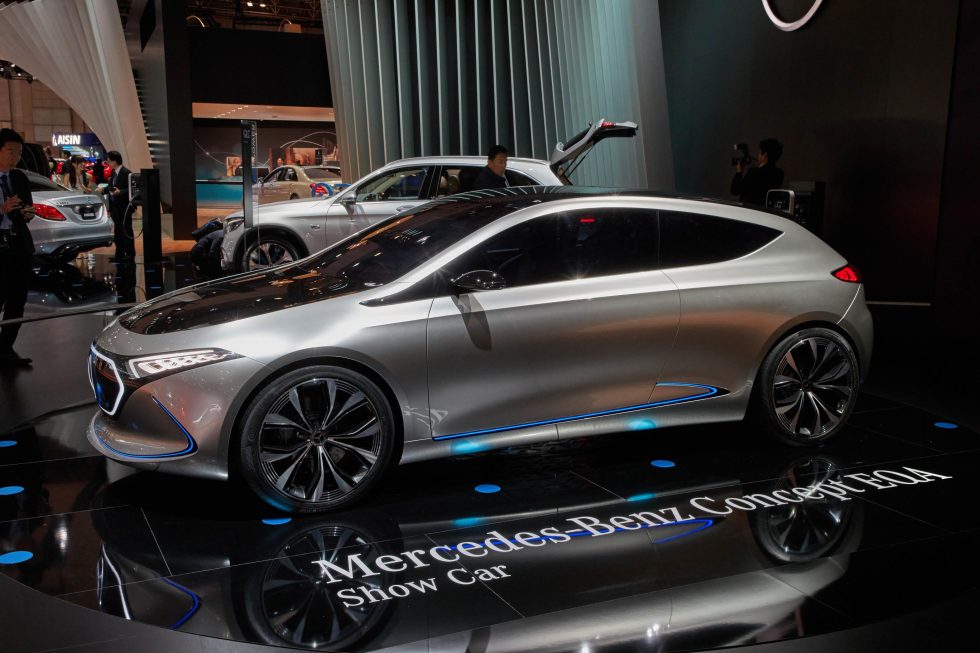
Mercedes-Benz EQ S Electric Sedan

Mercedes-Benz EQ S Electric Sedan
Mercedes officials have revealed that rather than giving the C-Class a pure electric powertrain, that role will be attributed to the new EQ model expected to go on sale by 2022. It’s going to be a similar story with the S-Class as instead of losing its combustion engine, a large sedan of just about the same size will boast an all-electric setup to become a top-tier member of the EQ lineup.
Getting back to the C-Class, the recently revealed mid-cycle refresh has further electrified the model as now there’s also a plug-in hybrid version with a diesel engine, too. Known as the C300de, it joins the familiar C300e equipped with a gasoline engine, and both will cover approximately 31 miles (50 kilometers) running solely on electric juice based on the outgoing NEDC cycle. The extended EV range was achieved by increasing the capacity of the lithium-ion battery pack from the previous 6.4 kWh to 13.5 kWh.
The two partially electrified C-Class models benefit from the company’s third-gen hybrid system able to automatically adapt by using data from the navigation system as well as the information coming from the radar sensor and the camera.
But if you would rather have a Mercedes without a combustion engine, the aforementioned EQ C will go on sale at the beginning of 2019. It will be followed by a smaller electric hatchback previewed by the EQ A concept last year at the Frankfurt Motor Show.
Electric initiative at Mercedes-Benz Cars
By 2022, Daimler will electrify the entire portfolio of Mercedes-Benz
In 2017, Mercedes-Benz Cars set important strategic course for electromobility:
- Electric hubs for the production of electric vehicles and batteries are currently being built around the globe.
- By 2022, Daimler will electrify the entire portfolio of Mercedes-Benz, offering customers at least one electrified alternative in all Mercedes-model series. The company is planning to offer more than 50 electrified vehicle variants. To that, Mercedes-Benz will be continuously supporting the development of plug-in hybrids and the introduction of 48-volt-systems. More than ten models of the over 50 electrified vehicles will be fully electric cars – in all segments, from smart to large SUVs.
- Over the next few years, Mercedes-Benz Cars will be investing ten billion euros in the expansion of its electrical fleet and an additional one billion euros in a global battery production network within the worldwide production network. That way a global battery network is created, which currently comprises five battery factories on three continents.
- While the start of production of the fortwo Coupé and Cabriolet at the smart plant in Hambach in 2017 already represent the start of the fourth generation of electric vehicles of the brand, the first electric vehicle of the new product and technology brand EQ will roll off the production line at the Mercedes-Benz plant in Bremen. Production of the EQC, an all-electric SUV, will start in 2019.
- Shortly afterwards, the EQC will also roll off the production line at BBAC, Daimler’s joint venture with BAIC. Further locations for EQ models are the
- Mercedes-Benz plants in Rastatt, Sindelfingen and Tuscaloosa (USA), where the model range is extended to include electric vehicles of the compact, upper and luxury class as well as the SUV segment.
Markus Schäfer, Member of the Divisional Board of Mercedes-Benz Cars, Production and Supply Chain: “Our electric vehicles will be built in six plants on three continents. We address every market segment: from the smart fortwo seater, to the large SUV. The battery is the key component of e-mobility. As batteries are the heart of our electric vehicles we put a great emphasis on building them in our own factories. With our global battery network we are in an excellent position: As we are close to our vehicle plants we can ensure the optimal supply of production. In case of a short-term high demand in another part of the world our battery factories are also well prepared for export. The electric initiative of Mercedes-Benz Cars is right on track. Our global production network is ready for e-mobility. We are electrifying the future”.
In 2018, Daimler will complete the second battery factory in Kamenz and intensify preparations for the EQC at the Mercedes-Benz plant in Bremen. In 2019, the EQC will be the first series vehicle of the product and technology brand EQ to roll off the production line at Bremen and at BBAC in Beijing.

At a glance: Electric initiative at Mercedes-Benz Cars
At a glance: Electric initiative at Mercedes-Benz Cars
Daimler Invests in ChargePoint to Promote Breakthrough in Electric Mobility
Daimler AG has become the lead investor in American charging solutions provider ChargePoint Inc.
Daimler AG has become the lead investor in American charging solutions provider ChargePoint Inc. latest round of financing and will receive a seat on the company’s Board of Directors. ChargePoint is the world’s leading provider in electric mobility charging solutions and is the market leader in North America. Thanks to the increasing electrification of drive systems, ChargePoint is on a course for growth with its product portfolio. Expansion of the business to the European market is already being planned. With its strategic participation in ChargePoint, Daimler is making another significant step forward as part of its corporate strategy known as “CASE” – in particular with regard to its new product brand EQ, under which the company is planning to bundle its know-how in the field of intelligent electric mobility in future Mercedes-Benz products. The cooperation lays the groundwork for a comprehensive, customer-focused offer.

Daimler steigt bei ChargePoint ein
Daimler invests in ChargePoint
Daimler AG is investing heavily in electric mobility. As part of this, investments are being made far beyond just vehicle development. As part of the electric mobility offensive from Mercedes-Benz Cars, in the coming years the company is investing around €10 billion in the expansion of its product portfolio comprised under the EQ brand. Another key focus is on the expansion of the electric mobility ecosystem with products, services and innovations. The range extends from intelligent charging services for the home as well as tailor-made services right through to home energy storage units, which work for example in conjunction with photovoltaics installed on house rooftops. Whether at home, at work or out on the road: intelligently networked charging solutions form an integral part, as customer acceptance in the area of electric mobility is closely associated with the availability of a comprehensive infrastructure.
Axel Harries, head of CASE at Daimler AG and as such head of the electric mobility think-tank, is all set to take up the seat on the Board of Directors at ChargePoint. In his opinion, collaboration with ChargePoint is an important building block: “While pursuing the systematic expansion of our CASE ecosystem based on our new product brand EQ, we also remain open and ready for partnerships and cooperation at the highest level. ChargePoint is a company of experts in the field of electric mobility charging solutions with a great deal of know-how in both hardware and software. Together we will be able to significantly expand the product portfolio in the area of intelligent charging solutions and provide the customer with an all-embracing premium offer for electric mobility.”
Currently offering more than 33,000 charging spots at more than 7,000 sites around North America, ChargePoint is the world’s leading provider in the sector for electric mobility charging solutions and is the market leader in North America. With the increasing electrification of the drive system, demand for the company’s innovative charging solutions is increasing steadily, setting it on a course of steady growth. The international expansion of the business segment to the European market in particular is now on the agenda. “The automobile industry is at an inflection point, with more vehicles coming onto the market offering highly advanced electric powertrains than any other time in the world’s history,” said Pasquale Romano, CEO of ChargePoint. “ The significant investment by our lead investor Daimler and others not only underscores a collective commitment to e-mobility around the world, but will lay the groundwork for Europe’s most comprehensive charging network ever.”
Both the development and production of innovative infrastructure solutions for electric vehicles are among the company’s core competencies – from conventional AC charging through to ultra-fast charging via DC at up to 400 kW. ChargePoint offers solutions for every niche of the electric vehicle charging ecosystem, including commercial businesses, the retail trade, public institutions, fleet customers and individual drivers. Technologically, in Europe the company relies on the standardised Combined Charging System (CCS), with which it provides maximum compatibility for future electric vehicle models of all brands. All of the products from ChargePoint are networked via software and can be deployed for various customers in a variety of locations. In addition to charging stations, the US market leader also provides its customers with tailor-made cloud-based solutions – starting with user-specific energy management systems and well-proven payment services, as well as through to mobile apps boasting innovative features previously unavailable in the European market. Through remote monitoring and hotline support, ChargePoint ensures maximum availability of the charging stations around the clock, seven days a week – a decisive purchasing factor in particular for fleet operators of passenger cars, commercial vehicles or buses.
Daimler and ChargePoint are systematically pursuing the same goal: to promote the breakthrough of electric mobility through the targeted expansion of infrastructure and services. The collaboration between the two companies is the ideal supplement to the existing successful alliances and joint ventures of Daimler AG aimed at expanding an ecosystem for electric mobility. The companies will be embarking on their collaboration shortly.
Mercedes-Benz wants to double-down on its EV efforts to “overtake Audi and BMW”
But the pressure is building, and Daimler’s CEO, Dieter Zetsche, said he plans to move the company more towards EV development
Tesla Motors is really making an impact on the luxury car market by being the only reliable source for all-electric luxury cars. This obviously has the current mass market luxury automakers pretty ruffled and is the reason why companies like BMW, Audi, and Mercedes are moving more towards electrification and alternative powertrains.

Mercedes-Benz wants to double-down on its EV efforts to “overtake Audi and BMW”
Mercedes however seems to be lagging behind the competition, relying more on the traditional internal combustion engine to keep the reliable and dependable cars going into hands of demanding customers.
But the pressure is building, and Daimler’s CEO, Dieter Zetsche, said he plans to move the company more towards EV development.
“We are adjusting our planning in this field. It is very important to get the right timing. As a tendency, and as a trend, we have become more bullish in that regard,” Zetsche told AutomotiveNews Europe.
So far, Mercedes-Benz supposedly has some big things to reveal for their plan at the Paris Motor Show in October, with speculation suggesting the display of a new EV concept, promising a driving range of up to 500 kilmoeters, or 310 miles. The concept is also on the roster for production, meaning it could be spotted in showrooms as early as 2020.
Mercedes so far has shifted nearly $7.2 billion in R&D towards electric vehicles in 2015, a figure that’s up from $6.3 billion in 2014.
Source: egmCarTech
Zero-Emmission Driving is a Reality
Daimler is once again setting a new milestone on the road to zero-emission driving
Daimler is once again setting a new milestone on the road to zero-emission driving: In the future managers will drive electrified company cars. Furthermore, Daimler is this year set to invest a further 30 million euros into extending the company’s own charging infrastructure across many of its sites. This will also benefit employees, who have access to a growing range of vehicles with alternative drive systems.

Mercedes-Benz and smart on e-mission in Montafon
It represents a further commitment from Daimler to an electric future for mobility: “We are continuing on the path of zero-emission driving with consistency”, states Ola Källenius, member of the Board of Management of Daimler AG responsible for Mercedes-Benz Cars Sales and Marketing, about the importance of the current initiative. “This is why we are making electric mobility an integral part of the everyday lives of our top management to set an example and to provide a clear role model.”
The agreement applies to the company’s senior levels of management and focuses on plug-in hybrids. Daimler AG believes that the technology offered by these vehicles provides a key to zero-emission driving and is therefore expanding its product portfolio with plug-in hybrid drive systems. The models already presented and mostly already introduced to the market are the S 500 e in Saloon, the C 350 e in Saloon, Estate and extended-wheelbase versions, the GLE 500 e 4MATIC, the GLC 350 e 4MATIC and the new E 350 e Saloon.
In a pilot project in the wider Stuttgart region, managers across different levels are driving the purely battery-electric-powered B 250 e already since April 2015. One of these is Harald Kröger, responsible for E-Drive development of the company: “I can only commend to my colleagues to experience themselves over a longer period the viability of our battery-electric vehicles in everyday use. I never cease to be amazed by their completely silent electric “cruising” ability and yet at the same time by the impressively sporty nature of the electric drive system, which immediately places its full torque at disposal of any engine speed.” It goes with the territory as Director of Development for E-Drive that Harald Kröger is an electric mobility enthusiast. He had previously driven the smart fortwo electric drive for company business, subsequently switching to one of the company’s first plug-in hybrid models. With the battery-electric B-Class he continues his series of electrified company cars. “I am delighted that our eMobility initiative will give managers the opportunity to experience this drive system”, reinforces Kröger.

Mercedes-Benz and smart on e-mission in Montafon
30 million euros for charging infrastructure
The vast majority of electric-car drivers put their vehicle on charge whenever they leave it for a longer period: mostly overnight or while they’re at work. This brings benefits in terms of both convenience and time, with no need to drive out of one’s way to find a filling station, as might otherwise be necessary. Daimler identified this trend very early on – in the wider Stuttgart area alone, the company has already built 556 charging points for managers and employees. Already therefore Daimler is a pioneer in this field and is now taking things a step further: “In order to enable the convenience of using our electric and plug-in hybrid vehicles, we have now decided to extend the charging infrastructure at our company locations even further. This work will already be undertaken over the next few months”, emphasises Ola Källenius. All in all, the company will be making an immediate investment of 30 million euros into extending charging facilities.
Interesting offers for employees
All Daimler AG’s staff are able to take advantage of the steadily growing range of eMobility vehicles. Both partially and fully electric vehicles are available at attractive terms through the employee car scheme. This offer includes the smart fortwo electric drive and the B 250 e as well as the GLE 500 e and the C 350 e. The research project “charge@work” that was launched in October 2013 offers employees the use of electric vehicles for both business and private use and has been developed alongside the company’s charging infrastructure. Since that date, they have been able to hire a smart fortwo electric drive from the car pools at the company’s Möhringen, Untertürkheim and Sindelfingen sites – for a weekend, a week or a whole month, as they prefer. The idea has been enthusiastically received and taken up by employees: The disctance that has been covered with zero emission in the first year and a half alone is equivalent of 40 round-the-world trips.
Mercedes-Benz Electric – More electricity. Less fuel.
The campaign shows how Mercedes-Benz brings innovative hybrid technology from the race track to the street so everyone can experience it
Mercedes-Benz is using an exceptional campaign to show the benefits of its Plug-In Hybrid technology. Both the C 350 e and the MERCEDES AMG PETRONAS Team’s current F1 car embody the headline ‘Success has two sides. More electricity. Less fuel. ‘Both the racing car and the series model are the product of ground-breaking, new technologies. The campaign shows how Mercedes-Benz brings innovative hybrid technology from the race track to the street so everyone can experience it.

Mercedes-Benz
The international campaign consists of six print motifs and a TV commercial. In the print motifs, the C 350 e presents itself far away from the city on forgotten streets which run through a prohibited area. The streets are rough and dusty – the perfect testing ground for hybrid technology. Here, the benefits of the C 350 e come to the fore: efficient, dynamic and comfortable. Extreme perspectives bring the benefits to the fore in the motifs. The print campaign will run until September 30th, 2015.
The C 350 e, the second Plug-In Hybrid model that Mercedes-Benz is introducing after the S-Class, convinces with its exceptional dynamism and efficiency. The vehicle allows up to 31 kilometres of electric and thus locally emission-free driving. Its four-cylinder petrol engine, in conjunction with a powerful electric motor, gives it a total system output of 205 kW (279 hp) with a system torque of 600 Nm. The new C 350 e thus delivers the performance of a sports car while offering a certified consumption of just 2.1 litres of fuel per 100 kilometres in both its saloon and estate variants.
Powerful with Nico Rosberg and Lewis Hamilton
The TV commercial shows a dynamic drive from the driver’s perspective through tight corners and long straights. A second vehicle keeps appearing. The viewer sees an exciting neck-and-neck race. At the end of the drive, we see both cars stopped in front of a parking garage. A voice-over says ‘The two best driver’s in the world…’. One of the drivers sticks his arm out and up in an attempt to pull the ticket. We recognize Lewis Hamilton. He’s sitting in his F1 car in front of the barrier. Nico Rosberg is beside him at the second barrier in the C 350 e. He clearly has the advantage and confidently takes out the ticket, puts on his winner’s smile and disappears into the dark parking garage. But Hamilton doesn’t give up. He quickly closes his visor, accelerates and drives underneath the barrier. The voice-over adds ‘…and one winner: hybrid technology by Mercedes-Benz.’
Mercedes-Benz Slated to Offer a Variety of Electric Option
Daimler announces they’ll be releasing a new plug-in-hybrid Mercedes about every four months as we lurch toward 2017
Daimler must’ve gone long on stock in Glade, as they’ve announced that they’ll be releasing a new plug-in-hybrid Mercedes about every four months as we lurch toward 2017. The S500 plug-in, out this spring, will be the first, followed by the C350e that comes this fall—the lowercase-e suffix set to replace Benz’ all-caps “PLUG-IN HYBRID” appellation.

Mercedes-Benz C350e
A plug-in GLE—the GLEe!—is up next, and the GLK replacement, the GLC, also will go the plug-in route. Those two will pair the technology with 4MATIC, whereas the S- and the C-class are rear-wheel drive. Given that there’s a plug-in S and a plug-in C, it does stand to reason that the E-class also will get the treatment.
Mercedes has said there will be 10 in all, but the remaining count gets murkier. Mercedes has talked about a V-class plug-in van. Might it be called the “Metrise”? If would if it were sold here, but we’re told the plug-in variant likely stays in Europe. So, too the wagon versions of the C and the E—damn. The GLE Coupe could follow the regular GLE down electric avenue, but our market is likely to get that car only in muscular, hi-po variants. The tenth model could be the B-class, which already exists as a full electric, or its CLA or GLA sibling.
Clearly, though, the American market won’t see everything that Stuttgart cooks up. For us, the plug-in count won’t reach a perfect 10—more like a fine five.
Via: Car and Driver
Mercedes & BYD Reveal the Denza Electric Vehicle
Shenzhen BYD Daimler New Technology Co., Ltd. (BDNT) officially unveiled its DENZA all-electric vehicle at Auto China 2014, in Beijing
Shenzhen BYD Daimler New Technology Co., Ltd. (BDNT) officially unveiled its DENZA all-electric vehicle at Auto China 2014, in Beijing. The world premiere of the serial production model is the culmination of cooperative efforts at the 50:50 R&D technology joint venture established by Daimler and BYD back in 2010 – the first Sino-German joint venture dedicated to an all-electric vehicle in China. Combining Daimler’s renowned tradition and engineering expertise as a worldwide leader in safety technology and quality excellence with BYD’s leading battery technology, DENZA is styled as an honest and modern urban vehicle concept that fits both private and fleet customers.

Daimler-BYD Joint Venture’s New All-Electric Vehicle DENZA unveiled at Auto China; from right: Prof. Thomas Weber, Member of the Board of Management of Daimler AG responsible for Research and Development, Wang Chuanfu, Chairman of BYD Co., Ltd., Hubertus Troska, Member of the Board of Management of Daimler AG with responsibility for China, Lian Yubo, CEO of Shenzhen BYD Daimler New Technology Co., Ltd., Arno Röhringer, COO of Shenzhen BYD Daimler New Technology Co., Ltd., Stella Li, Senior
“Daimler is constantly moving forward with emission-free mobility; and with our DENZA we are also on the right track in China, which is destined to become the world’s most important market for electric vehicles”, said Hubertus Troska, Member of the Board of Management of Daimler AG with responsibility for China, and Chairman and CEO of Daimler Greater China. “With DENZA we deliver the safest, most reliable, and most convenient electric vehicle to our Chinese customers – designed, engineered, and produced in China, for China, once again proving our full commitment to the country.”
- DENZA production model world premiere at Auto China in Beijing.
- DENZA combines Daimler’s renowned tradition and engineering expertise as a worldwide leader in safety technology and quality excellence with BYD’s leading battery technology.
- Hubertus Troska: “We deliver the safest, most reliable, and most convenient electric vehicle to our Chinese customers – designed, engineered, and produced for China, in China”.
- Thomas Weber: “The first complete vehicle that Daimler has developed together with BYD outside of Germany and undoubtedly one key pillar of our electric vehicle strategy for China”.
- Market launch in September 2014, starting at RMB 369,000 and entitled to central and local subsidies totalling in a price reduction for the customer of up to almost RMB 120,000.
Safety – At the highest level, by an intelligent package concept
DENZA has been designed around its lithium iron phosphate battery which is framed by a lightweight aluminium case with extrusion profiles. Designed to absorb large amounts of energy, it is located at the safest place in the car – underneath the body. The layout also ensures that all powertrain components are separated from the passenger compartment. Additionally, DENZA’s intelligent Power Flow Management System constantly monitors the energy flow between the battery and powertrain to guarantee that, in the event of an accident, the battery is disconnected automatically and, if needed, quickly discharges to levels below critical values.
As a forerunner in electric vehicle safety, BDNT worked closely with China’s official safety certification body, CATARTC, to jointly develop an electric vehicle safety standard for China. By also considering real life accident data, DENZA has gone even further than these legal requirements to ensure that its customers enjoy the highest level of safety.
“DENZA is the first complete vehicle that Daimler has developed together with BYD outside of Germany and it is undoubtedly one key pillar of Daimler’s electric vehicle strategy in China”, noted Prof. Thomas Weber, Member of the Board of Management of Daimler AG responsible for Research and Development. “No compromises have been made to design and develop, in China, an all-electric car that raises the bar in its segment. We assure our Chinese customers the highest standards of safety, paired with maximum convenience, outstanding reliability and unique driving fun as part of a superior overall concept.”
Reliability – By an intensive testing program and high production standards
The DENZA has been put through 18 months of intensive testing that saw various cars drive over 1.2 million kilometres across all of China under extreme and various weather and road conditions – be it hot, cold, dusty or icy. This testing program, which looked at overall quality and endurance, was complemented by additional component testing and crash test programs. In total, BDNT crashed more than 20 cars, including high-speed, low-speed and rollover-scenarios. DENZA also became the first electric vehicle to be tested according to C-NCAP consumer ratings at C-NCAP facilities, obtaining the highest possible rating of 5 stars.
It goes without saying that the quality of the production is secured at a modern, independent production line in Shenzhen, following Daimler’s proven production philosophy and quality control methods.
Convenience – By a benchmark driving range and more
With a driving range of up to 300 kilometres, the DENZA offers the ease and convenience of emission free mobility for day-to-day use – in urban areas, and beyond. Charging the battery is highly flexible, as it can be done at any household power outlet, public charging facilities or special wall boxes. The latter of which can be installed at homes or in offices at the request of DENZA customers, guaranteeing fast charging, ranging from seven hours to less than an hour. With the DENZA app, available for both Android and iOS phones, wall box customers can even remotely check on their charging status and vehicle location using their smartphones and, if needed, get connected right away to a dealership or customer service centre.
DENZA clearly aims to change mobility, but not the mobility behaviours of its customers. That is why, thanks to its luxury class level wheelbase, it can comfortably accommodate up to 5 passengers, with ample legroom and an inviting 460 litre trunk volume. The roominess of the interior is complemented by a clean, functional design and high craftsmanship.
Power – By a strong electric drive train and battery
DENZA’s package is convincing, and so is its heart, the electric powertrain and battery technology. The vehicle is powered by an 86 kW (peak) all-electric engine that provides a maximum speed of up to 150 km/h and impressive peak torque, at 290 Nm. Together with its big 47.5 kWh battery capacity, and a convenient suspension, customers can rest assured that they can enjoy both maximum driving fun and comfort with a range of up to 300 km. In light of the fact that the average daily driving distance in China is 50 to 80 kilometres a day, the typical customer will only have to recharge DENZA twice a week. This bi-weekly pit stop will be met with joy as driving 100 km with a DENZA cost less than 20 RMB (2,35 EUR). All this classifies the DENZA as the perfect vehicle for day-to-day use – in urban areas, and beyond.
Wang Chuanfu, Chairman of BYD Company Limited, stated: “With our DENZA, I see my vision come true as we make big steps towards sustainable development in and for China. Backed by a supportive government and the win-win alliance between BYD and Daimler, and its Chinese heart, DENZA offers a convincing package to our Chinese customers, pointing the way and contributing strongly to the development of the electric vehicle market in China.”
Top Customer Experience – outstanding Sales and Service
DENZA teamed up with strong partners to offer the best sales and service experience to customers. Dedicated sales and service outlets from three of China’s leading automobile dealership groups will distribute the vehicle, initially in Beijing (Pangda Group), Shanghai (Lei Shing Hong Group), and Shenzhen (Zhongsheng Group). Phase 2 market cities will include Guangzhou, Hangzhou, and Tianjin.
DENZA’s customer commitment is further supported by 11 service centers, a 24-hours all-year customer service hotline, and a strategic partnership with global leading technology group ABB, with whom DENZA aims to establish the world’s largest charging infrastructure in China by 2020. ABB will provide a variety of flexible fast charging solutions for DENZA customers, per request and as a one-stop-solution as it is fully integrated in DENZA’s sales and aftersales process.
Ready to Market – Starting September 2014
BDNT’s first DENZA car will hit the market in September 2014. Starting at RMB 369,000 (about EUR 43,400], DENZA offers its customers two more convincing arguments: exemption from standard license plate lottery in Beijing, or even free license plates in Shanghai and Shenzhen; and central and local subsidies totalling up to almost RMB 120,000 (about EUR 14,100) that can be deducted from the vehicle price right away.
The DENZA will be available in two distinctive, well equipped lines: the “Lifestyle” version comes amongst others with nicely designed 18″ light alloy wheels, genuine leather seats and an 8″ multimedia touchscreen. The “Executive” version features on top also a powerful Harman-Kardon-Soundsystem, innovative Xenon Lights with an adaptive front lighting system, and an easy-to-use onboard Navigation system. Additionally, various exterior and interior color and trim combinations that provide customers a high level of individualization and, together with the modern and welcoming interior design and high craftsmanship, a feeling like home.
Electric vehicle DENZA on Track for Chinese Market
The DENZA represents a significant step in sustainable transportation for the Chinese automotive market
The Chinese joint venture between Daimler and BYD, also known as Shenzhen BYD Daimler New Technology Co., Ltd., along with ABB, one of the world’s leading power and automation technology companies, have agreed on the supply of fast chargers for BDNT’s battery electric DENZA. The home wall-mounted fast chargers will be sold through DENZA dealerships along with the vehicle and significantly reduces charging time. Furthermore, the DENZA vehicle will also be rechargeable at a conventional wall socket and offers its customers optimal flexibility.
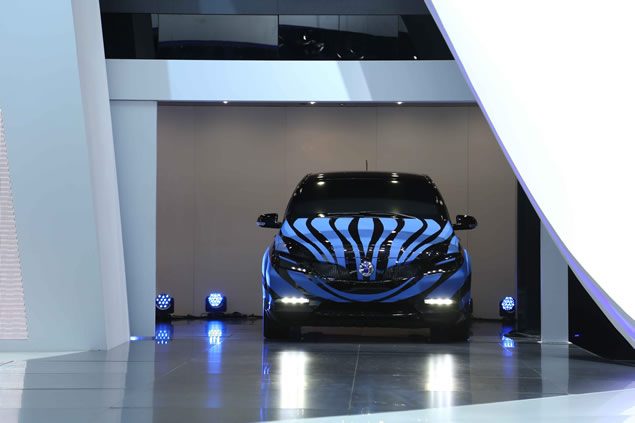
DENZA
The chargers are designed for user convenience and safety: An innovative mobile app allows remote monitoring and control of charging sessions, with the option of charging status change notifications.
“The DENZA represents a significant step in sustainable transportation for the Chinese automotive market. It was vital, that we have the right infrastructure partner to support this innovative concept,” says Arno Röhringer, COO of BDNT. “ABB is the ideal technology partner for us, as they have proven themselves worldwide including China with chargers and – equally important – the service to install it.”
The Chinese government has introduced a fast charging standard to encourage technical innovation and stimulate market acceptance of electric vehicles. This standard will give Chinese consumers the opportunities to conveniently charge their vehicles at home or in public. Public fast charging is expected to be rolled out in China in the near future.
The battery-electric DENZA vehicle will see its world premiere at the Auto China trade fair in Beijing in April 2014. Market introduction is slated for this year as announced earlier. In Beijing, the first DENZA dealership will open its doors mid of this year. Further dealerships are built up simultaneously in Shanghai and Shenzhen.The official goal of the joint venture: DENZA will be the safest and most reliable electric vehicle – designed and engineered in China, for China
Mercedes SLS AMG Coupe Electric Drive Sets Green Hell Record
The Mercedes SLS AMG Coupé Electric Drive circled the Nürburgring Nordschleife in a record time of 7:56.234 minutes
The Mercedes-Benz SLS AMG Coupé Electric Drive circled the Nürburgring Nordschleife (“north loop”) in a record time of 7:56.234 minutes. Therefore, the electric AMG super sports car is at the same time the first electrically-powered series production vehicle, which masters the legendary race track in under eight minutes. The record time of the SLS AMG Coupé Electric Drive was notarially certified. Two weeks after the first overall win for the Mercedes-Benz SLS AMG GT3 in the 24 Hours Nürburgring, a further member of the SLS AMG family impressively demonstrates its potential on the most difficult race track worldwide.
“Mercedes-AMG impressively shows the potential of the SLS AMG Coupé Electric Drive with the new record on the Nürburgring Nordschleife. Mercedes-AMG is the first vehicle manufacturer which makes it possible to circle the Nordschleife in under eight minutes with an electrically-powered series production vehicle. This record run is another proof for our constant innovative vigour,” according to Ola Källenius, Chairman of Mercedes-AMG GmbH.
“For the first time, an electrically-powered series production vehicle circles the Nürburgring Nordscheife in under eight minutes. The record for the SLS AMG Coupé Electric Drive in 7:56.234 minutes on the Nordschleife shows the special position of our innovative and unique drive solution. With the extremely efficient battery technology deriving from Formula 1, four electric motors positioned close to the wheels, the individual wheel torques “AMG Torque Dynamics,” the SLS eSound and our ambitious “AMG Lightweight Performance” design strategy, the SLS AMG Coupé Electric Drive generates a breathtaking sensation unlike any other model out on the road,” according to Tobias Moers, Head of Overall Vehicle Development and member of the Board of Management of Mercedes-AMG GmbH.
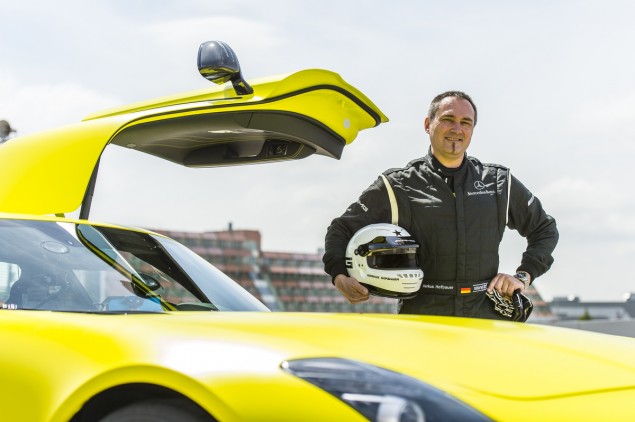
The SLS AMG Coupé Electric Drive, with which Mercedes-AMG set up the record on the 20.832 kilometres long traditional race track in the Eifel, corresponds to the series version, which celebrates its launch in June 2013. The currently strongest AMG high-performance car has four electrical motors with a total output of 552 kW (751 hp) and maximum torque of 1000 Nm (738 lb-ft).
The gullwing car is therefore advancing to become the strongest and fastest electrically-powered series production vehicle in the world. The SLS AMG Coupé Electric Drive accelerates from zero to 100 km/h in a mere 3.9 seconds and can reach a top speed of 250 km/h (electronically limited).
A new dimension of driving performance – the AMG brand pledge is fulfilled to remarkable effect by the outstanding performance dynamics, which come courtesy of AMG Torque Dynamics and are made possible by the wheelselective all-wheel drive. The most “electrifying” gullwing model ever has been developed in-house by Mercedes-AMG GmbH. The extremely powerful highvoltage battery for the SLS AMG Coupé Electric Drive is the result of the collaboration between Mercedes-AMG and Mercedes AMG High Performance Powertrains in Brixworth in the UK and is setting the pace in energy density, power density and efficiency. Here, the British Formula 1 experts were able to draw on their extensive experience with KERS hybrid concepts.

The car’s agile response to movements of the accelerator pedal and the linear power output are a source of pure delight: unlike with a combustion engine, the build-up of torque is instantaneous with electric motors – maximum torque is effectively available from standstill. The spontaneous torque build-up and immense power delivery without any interruption in traction on the one hand are combined with completely vibration-free motor running characteristics on the other.
An overview of the most important data:
| SLS AMG Coupé Electric Drive | |
| Max. output | 552 kW (751 hp) |
| Torque | 1000 Nm (738 lb-ft) |
| 0-100 km/h | 3.9 s |
| Top speed | 250 km/h* |
| Range | 250 km (according to NEDC) |
| Battery energy content | 60 kWh |
| Battery voltage | 400 volts |
| CO2 emissions | 0 g/km |
| *Electronically limited | |
*Electronically limited
All-wheel drive with AMG Torque Dynamics offers new-found freedom
Four motors, four wheels – the intelligent and permanent all-wheel drive of the SLS AMG Coupé Electric Drive guarantees driving dynamics of the highest calibre, while at the same time providing the best possible active safety. Optimum traction of the four driven wheels is therefore ensured, whatever the weather conditions. According to the developers, the term “AMG Torque Dynamics” refers to individual control of the electric motors, something which enables completely new levels of freedom to be achieved. The AMG Torque Dynamics feature is permanently active and allows for selective distribution of power to each individual wheel. The intelligent distribution of drive torque has a beneficial effect on driving dynamics, handling, driving safety and ride comfort. Each individual wheel can be both electrically driven and electrically braked in accordance with the specific driving situation, thus helping to
- optimise the vehicle’s cornering properties,
- reduce the tendency to oversteer/understeer,
- increase the yaw damping of the basic vehicle,
- reduce the steering effort and steering angle required,
- increase traction,
- and minimise ESP® and ASR intervention.
The AMG Torque Dynamics feature boasts a high degree of variability and individuality by offering three different driving modes:
- Comfort (C): comfortable, forgiving driving characteristics
- Sport (S): sporty, balanced driving characteristics
- Sport plus (S+): sporty, very agile driving characteristics

2014 SLS AMG Coupe Electric Drive Production Car
Manufaktur hand finishing at company headquarters in Affalterbach
Mercedes-AMG has installed a dedicated Manufaktur hand-finishing section for electric vehicles at its headquarters in Affalterbach for final assembly of the SLS AMG Coupé Electric Drive. The electrically powered gullwing model is assembled and readied for operation at a total of seven different stations. The entire logistics process is based in Affalterbach, too.
Production of parts such as the exterior and interior initially takes place at the Mercedes-Benz production facility in Sindelfingen. In Affalterbach, highly trained workers take charge of assembling the axles, electric motors, transmissions and cooling system components. Particular care is taken with the installation of all high-voltage components, such as the liquid-cooled lithium-ion battery, the accompanying cables, inverter and control units, and the onboard charger. Needless to say, the utmost standards of safety are applied during all work on high-voltage components. The operational check and extensive final inspection at the end ensure that the manufacturing and product quality offered by the SLS AMG Coupé Electric Drive is of the very highest order.
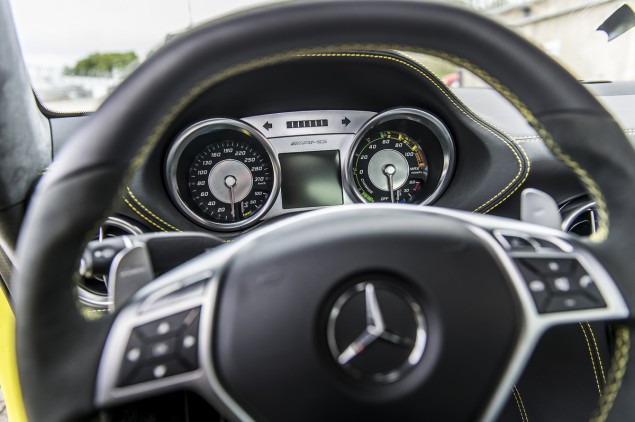
The Mercedes-Benz SLS AMG Coupé Electric Drive celebrates its sales launch in June 2013. The purchase price for Germany (incl. 19% VAT):
- SLS AMG Coupé Electric Drive: 416,500 euros (USD $549,780 as of 2:00 pm Eastern on Thursday, June 6, 2013)
The SLS AMG Electric Drive is currently not planned for sales and distribution in the United States.
2014 Mercedes B-Class Electric Drive Coming to America
The 2014 B-Class Electric Drive will launch in the U.S. first early next year but will be available for pre-orders this fall
One of the most common complaints we receive is that Mercedes doesn’t bring their fuel efficient models to the U.S., but that is all about to change with their electric car lineup, including the all-new 2014 Mercedes-Benz B-Class Electric Drive. Making its world debut at the New York International Auto Show last week, the Electric Drive offers a stylish design, luxury interior and a high-torque electric motor for completely emission-free driving. With a range of 115 miles, the 2014 B-Class Electric Drive is easily going to be the best choice for city driving families, carpools and commutes.
The 2014 B-Class Electric Drive will launch in the U.S. first early next year but will be available for pre-orders this fall. What else does Mercedes-Benz have for Electric, check out the new smart fortwo electric drive and the SLS AMG E-Cell.
If you don’t have time to read the full press release, check out the quick reference guide below and then head straight to the photo gallery to get a good look at what to expect from the all new emission free model.

Quick Reference Guide: 2014 B-Class Electric Drive:
Customer Availability:
- B-Class Electric Drive – Early 2014
Performance:
- 2014 B-Class Electric Drive
(134 hp/100 kW, 228 lb.-ft.)
Standard Feature Highlights:
- 28 kWh lithium-ion battery
- Charging time range for 60 miles: 2 hours
- 0-60 in less than 10 seconds
- COLLISION PREVENTION ASSIST w/ Adaptive Brake Assist
- Audio 20 with 5.8″ color screen
- MP3-capable CD player and USB connection
- Becker MAP PILOT
- LED daytime running lamp
Optional Feature Highlights:
- COMAND Online with internet access, navigation and voice control
- Blind Spot Assist
- Lane Keeping Assist
- Active Parking Assist

Powerful and lively drive system
The new Mercedes-Benz B-Class Electric Drive is based on the conventionally powered B-Class, which has become a bestseller in many countries since its market debut in 2011. As a particularly versatile vehicle concept, the B-Class also allows environmentally friendly driving at the Mercedes level – with its innovative electric drive. In the USA, the vehicle will only be introduced with battery electric drive.
Quiet and locally emission-free drive power is provided by an electric motor with more than 134 hp (100 kW). Typically for an electric drive, the maximum torque of 228 lb.-ft. is available right from the first tap on the accelerator pedal – this roughly corresponds to the torque delivery of a modern gasoline engine with a displacement of 3.0 liters. This results in decidedly powerful acceleration from a standing start. For the standard sprint from 0 to 60 mph (100 km/h), the electric-powered B-Class requires less than ten seconds. This guarantees superior driving performance and highly dynamic, exhilarating driving pleasure in any situation.
The powerful lithium-ion battery is accommodated in the “Energy Space” in the vehicle’s underfloor – both space-saving and safe. Thanks to this intelligent packaging, the five-seater retains the familiar, generous interior and luggage space of the B-Class.
Emission-free even over longer distances
The maximum speed is electronically limited to 100 mph (160 km/h) – in the interests of operating range. The range is around 115 miles (200 kilometers), according to the respective driving cycle. This means that in addition to emission-free urban driving and short-range trips, longer journeys can also be undertaken without any problems, such as the distances covered on a daily basis by commuters. The battery of the B-Class Electric Drive can be recharged at any standard domestic power outlet. In the USA, the charging time for a range of about 60 miles (100 kilometers) is less than 2 hours at 240 V/40 A.
While the car is on the move, the electric drive itself contributes to a favorable energy balance by converting kinetic energy into electric current on the overrun and during braking, and feeds this energy into the battery (recuperation).
Dynamic Mercedes-Benz design
Refined sportiness together with visual appeal – the new B-Class Electric Drive is another example of the self-assured and dynamic Mercedes design, with powerful, tense lines and finely styled details. The front and rear sets the tone for the vehicle’s width, with a wide, prominent front grille, headlamps extending into the vehicle sides, a wide rear window, two-piece tail lamps and a large tailgate with a low loading sill. The side sill panels and striking bumpers with bar-shaped LED daytime running lamps exude dynamic. The charging socket is inconspicuously installed behind the charging flap.
Sporty interior with premium details
The interior underscores the high comfort standards of Mercedes-Benz. Highquality materials and finely structured surfaces, premium details, and precise finishing, emphasize the fact that electric driving is defined at a very high level according to the philosophy of Mercedes-Benz. The three large, round air vents in the center with their distinctively designed cross-form nozzles are sporty features that contribute to the emotional design language of the interior. Above the air vents is the display screen for the telematics system which appears to be free-floating – a modern, eye-catching feature of the cockpit.
When it comes to information and communication systems, the B-Class Electric Drive offers convenience and outstanding functionality that is signature luxury typical of Mercedes-Benz. Standard onboard features include the Audio 20 with a 14.7 cm color screen, a twin tuner, an MP3-capable CD player and a USB connection. Navigation is provided by the Becker® MAP PILOT. The multimedia system COMAND Online with internet access, navigation and voice control is available as an optional extra.
Functions specific to electric vehicles have been added to the instrumentation of the B-Class Electric Drive. A power display in the dial instrument has been added on the right. Its pointer rises in a clockwise direction from the green to the red area when power is being consumed, and drops below the zero line when the vehicle is feeding recuperative energy back into the battery.
Full connectivity
Its modern technology ensures that the B-Class Electric Drive is not only sustainable (locally emission-free) and agile (because of its high torque and acceleration), but also fully networked. Remote check-up and remote configuration of the vehicle is conveniently possible via the Vehicle Homepage. The driver can easily access his vehicle through the internet, using a PC or smartphone. In this way, it is possible to check the current charge status of the lithium-ion battery or to verify the vehicle’s current range on a map. The planned route can also be displayed, immediately showing whether and where the vehicle can be recharged along the way. The range of services for connectivity is rounded off with a pre-entry climate control option offering individually timed pre-heating or cooling. This advance air conditioning makes the B-Class Electric Drive the unrivalled benchmark in its segment.
Big on safety
Mercedes-Benz applies its familiar, high safety standards to the B-Class Electric Drive. Thanks to the innovative “Energy Space”, the battery is safely accommodated under the floor for crash protection. In addition, Mercedes-Benz already equips this innovative electric car with the radar-based accident warning system COLLISION PREVENTION ASSIST with adaptive Brake Assist as standard. This assistance system gives the driver a visual and acoustic warning of recognized obstacles, prepares him for braking action and assists him with the braking process as the situation requires. In this way it significantly reduces the danger of a rear-end collision. Additionally, more modern driver assistance systems are available – among them Blind Spot Assist, Lane Keeping Assist and Active Park Assist.
Electric driving made by Mercedes-Benz
Locally emission-free electric vehicles such as the new B-Class Electric Drive are a major part of the Mercedes-Benz strategy for sustainable mobility. The Stuttgart-based premium manufacturer is reasserting its claim to leadership in this sector with electric cars which are fully suitable for everyday use. These include the B-Class F-CELL, and the SLS AMG Coupé Electric Drive (TBD for USA). The smart fortwo electric drive which launched last year in Europe received a positive response from customers. Since the middle of last year, much more than 1,000 vehicles have been produced and delivered. The all-new smart fortwo electric drive will be available in U.S. stores beginning May 1, 2013. The new B-Class Electric Drive will be available in the USA from early 2014 and then the European launch will follow.
Preliminary Technical Data
| Output | more than 134 hp (100 kW) |
| Torque | more than 228 lb.-ft. |
| Range | 115 miles [US City], 200 km [NEFZ] |
| Charging time for a range of 60 miles [US City] (100 km [NEFZ]) |
USA: 2 hours 40 A/240 V (ECE: 1.5 hours 400V) |
| Acceleration 0-60 mph | under 10 s |
| Top speed | 100 mph (160 km/h), electronically limited |
Mercedes-Benz B-Class Electric Drive Live in New York
The Mercedes-Benz B-Class is the future in electric driving, celebrating its premiere at the 2013 New York International Auto Show
The future of electric driving celebrated its world premiere this morning at the 2013 New York International Auto Show: the Mercedes-Benz B-Class Electric Drive makes its debut with a dynamic design, high-quality interior and a high-torque electric motor for local emission-free driving. This makes for lively and effortless driving pleasure over a range of around 115 miles. In addition, the B-Class Electric Drive is digitally networked meaning it can be conveniently checked and configured via the internet. As a true Mercedes it also sets high standards in terms of comfort, quality and safety. Bearing the Mercedes star as an unmistakable trademark, the B-Class Electric Drive will be launched first in the USA at the beginning of 2014, where it will be the first luxury battery electric car from Mercedes-Benz in the market.
The new B-Class Electric Drive surprises with a particularly dynamic driving experience, delivering decidedly powerful acceleration while gliding along the road practically silently. The driver and passengers in this new electric Mercedes will enjoy the familiar comfort of a well designed, high-quality interior offering a generous amount of space. The B-Class Electric Drive thus combines dynamism and driving pleasure with zero local emissions – in short, electric driving at the premium level.
According to Dr. Joachim Schmidt, member of the Mercedes-Benz Cars Board of Management responsible for Sales and Marketing: “The B-Class Electric Drive meets the wishes of many customers for emission-free driving without foregoing the hallmark attributes of a Mercedes-Benz, namely safety, comfort and, of course, not to forget exhilarating driving pleasure.”
The new Mercedes B-Class Electric Drive will be availabe in the U.S. early next year but pre-orders will likely make it sold out for quite a while so place your order early if you want one.

Powerful and lively drive system
The new Mercedes-Benz B-Class Electric Drive is based on the conventionally powered B-Class, which has become a bestseller in many countries since its market debut in 2011. As a particularly versatile vehicle concept, the B-Class also allows environmentally friendly motoring at the Mercedes level thanks to its innovative electric drive. In the USA, the vehicle is being introduced onto the market exclusively as the electric variant.
Quiet and local emission-free drive power is provided by an electric motor generating more than 100 kW. Typically for an electric drive, the maximum torque of 310 Nm is available right from the first tap on the accelerator pedal – this roughly corresponds to the torque delivery of a modern petrol engine with a displacement of 3.0 litres. This results in decidedly powerful acceleration from a standing start. For the standard sprint from 0 to 60 mph (100 km/h), the electric-powered B-Class requires considerably less than ten seconds. This guarantees superior driving performance and highly dynamic, exhilarating driving pleasure in any situation.
A powerful lithium-ion battery feeds energy to the electric drive and is accommodated in the so-called “Energy Space” in the vehicle’s underfloor – a solution which is both space-saving and safe. Thanks to this intelligent packaging, the five-seater retains the familiar, generous interior space and luggage space of the B-Class.

Emission-free even over longer distances
The maximum speed is electronically limited to 100 mph (160 km/h) in the interests of operating range. Depending on the respective driving cycle, the range is around 115 miles (200 km). This means that in addition to emission-free driving in urban traffic and on short-range trips, longer journeys can also be undertaken without any problems – such as the distances covered on a daily basis by commuters going to work, for example. The B-Class Electric Drive can be recharged at any standard household power socket. In the USA, the charging time for a range of about 60 miles (100 km) is less than 2 hours at 240 V/40 A.
While the car is on the move, the electric drive itself contributes to a favourable energy balance through recuperation, by converting kinetic energy into electric current in deceleration mode and during braking and feeding this energy into the battery.

Dynamic Mercedes-Benz design
Refined sportiness together with aesthetic visual appeal – the B-Class Electric Drive is another example of the self-assured and dynamic Mercedes design, with powerful, tense lines and finely styled details. Both the front and rear set the tone for the vehicle’s width, which comes courtesy of the wide, prominent grille and headlamps extending into the vehicle sides, as well as the wide rear window, two-piece rear lamp cluster and the large tailgate with low boot sill. The side sill panels and striking bumpers with bar-shaped LED daytime driving lights exude dynamism. The charging socket is inconspicuously installed behind the charging flap.

Sporty interior with premium details
The interior underscores the high comfort standards of Mercedes-Benz. High-quality materials and finely structured surfaces, premium details, and precise finishing all highlight the fact that electric driving is defined at a very high level according to the philosophy of Mercedes-Benz.
The three large, round air vents in the centre with their distinctively designed cross-form nozzles are sporty features that contribute to the emotional design idiom of the interior. Above the air vents is the display screen for the telematics system which appears to be free-floating – a modern, eye-catching feature of the cockpit.
When it comes to information and communication systems, the electric B-Class offers levels of convenience and functionality that were previously reserved for higher classes of vehicles. Standard onboard features include the Audio 20 with a 14.7 cm colour screen, a twin tuner, an MP3-capable CD player and a USB connection. Navigation is provided for by the Becker® MAP PILOT. The multimedia system COMAND Online with internet access, navigation and LINGUATRONIC voice control is also available as an optional extra.
Functions specific to electric vehicles have been added to the instrumentation of the B-Class Electric Drive. The power display in the dial instrument on the right is immediately obvious. When power is being consumed, its pointer rises in a clockwise direction from the green to the red area, and drops back below the zero line when the vehicle is feeding recuperative energy back into the battery.

Fully networked: connected services
Its cutting-edge technology ensures that the B-Class Electric Drive is not only sustainable (because it offers local emission-free driving) and agile (because of its high torque and acceleration), but also fully networked. Remote checking and remote configuration of the vehicle are conveniently possible via the Vehicle Homepage, for example. The driver can easily access his vehicle via the internet, using a PC or smartphone. In this way, it is possible to check the current charge status of the lithium-ion battery or to verify the vehicle’s current range on a map. The planned route can also be displayed, immediately showing where the vehicle can be recharged along the way, if necessary. The range of connected services is rounded off with a pre-entry climate control option offering individually timed pre-heating or cooling. This pre-entry climate control system makes the B-Class Electric Drive unique in its segment.
Big on safety
Mercedes-Benz applies its familiar, high safety standards to the B-Class Electric Drive. Thanks to the innovative “Energy Space”, the battery is safely accommodated in the underfloor of the vehicle for crash protection. In addition, Mercedes-Benz has already equipped this innovative electric car with the radar-based collision warning system COLLISION PREVENTION ASSIST with adaptive Brake Assist as standard. This assistance system gives the driver a visual and acoustic warning of recognized obstacles, prepares him for braking action and assists him with the braking process as the situation requires. In this way it significantly reduces the danger of a rear-end collision. Additional, more up-to-date driver assistance systems are also available – among them Blind Spot Assist, Lane Keeping Assist and Active Parking Assist.
Electric motoring made by Mercedes-Benz
Local emission-free electric vehicles such as the new B-Class Electric Drive are a major part of the Mercedes-Benz strategy for sustainable mobility. The Stuttgart-based premium manufacturer is reasserting its claim to leadership in this sector with electric vehicles which are fully suitable for everyday use. These include the A-Class E-CELL, the B-Class F-CELL, the Vito E-CELL van, and the SLS AMG Coupé Electric Drive. The smart fortwo electric drive – of which well over 1000 units have been produced and delivered since the middle of last year – has enjoyed an extremely positive response from our customers, too. The new B-Class Electric Drive will be available initially in the USA from the beginning of 2014, and will be launched in European markets subsequently.
Technical data*
| Output | More than 100 kW |
| Torque | More than 310 Nm |
| Range | 115 miles [US City], 200 km [NEDC] |
| Charging time for a range of 60 miles [US City] (100 km [NEDC]) |
USA: 2 h at 240 V/40 A (ECE: 1.5 h at 400 V) |
| Acceleration 0-60 mph (0-100 km/h) |
Under 10 s |
| Top speed | 100 mph (160 km/h), electronically limited |
Mercedes-Benz SLS AMG Now Available in Seven Variants
The Mercedes-Benz SLS AMG Coupé Black Series and SLS AMG Coupé Electric Drive will market launch in June 2013
Ask someone to name a Mercedes AMG model and chances are the first model that will pop into their head is the SLS AMG, and for good reason. It is a car that is in a league of it’s own, as much a sculpture as it is a race car, it epitomizes the luxury Mercedes is known for and the performance AMG is known for.
The Mercedes SLS AMG previously came in five different variants, but apparently that wasn’t enough, because now Mercedes has added two additional variants to the SLS AMG lineup – and we’re glad they did.The SLS AMG Coupé Black Series and the SLS AMG Coupé Electric Drive. This means that the SLS AMG now comes in a total of seven different variants, model diversity unmatched by competitors. No matter which SLS AMG you choose, a Coupé, Roadster, GT, Black Series variant, electrically powered gullwing model or thoroughbred GT3 racing version – the Mercedes-Benz SLS AMG is simply the best
We’ll be taking a more in-depth look at both the SLS AMG Coupé Black Series and the SLS AMG Coupé Electric Drive throughout the day but read on below for a quick overview.
First off, the questions we get the most. When can I buy it and how much does it cost?
Thankfully, for those eager to purchase one of the new SLS AMG Coupes, you won’t have to wait long. The Mercedes-Benz SLS AMG Coupé Black Series and SLS AMG Coupé Electric Drive will have their market launch in June 2013. The prices in Germany (incl. 19% VAT) will be:
- SLS AMG Coupé Black Series: €249,900
- SLS AMG Coupé Electric Drive: €416,500
The SLS AMG Coupé was the first car to be developed in-house by Mercedes-AMG and was first unveiled at the 2009 IAA International Motor Show in Frankfurt/Main. The gullwing model was followed a couple years later in 2011 by the SLS AMG Roadster as well as the SLS AMG GT3 customer sport racing car. The racing version of the gullwing car proved to the world the performance abilities of AMG during the 2012 motorsport season when the SLS AMG GT3 Race Car racked up nine championship titles and 43 race victories.
2012 marked the premiere of the SLS AMG GT, which is available in Coupé and Roadster versions, followed later by the Mercedes-Benz SLS AMG Coupé Black Series and the SLS AMG Coupé Electric Drive. This means that the model range has now grown to seven variants in all. Not only does Mercedes-AMG boast the widest model range in the super sports car segment, its diversity is also unprecedented and covers all manner of customer requirements and preferences. The power outputs of the road-going models range from 420 kW (571 hp) up to 552 kW (751 hp).
Production in Sindelfingen and Affalterbach
The specific assembly area for the SLS AMG is located in the largest Mercedes-Benz production plant in Sindelfingen. The AMG 6.3-litre V8 engine comes directly from the AMG engine workshop in Affalterbach, where it is hand-assembled according to the traditional “one man, one engine” philosophy.
The SLS AMG Coupé Electric Drive is being built in an exclusive production run directly at Mercedes-AMG company headquarters in Affalterbach, where a team of highly qualified specialists assemble the purely electrically powered super sports car by hand in a newly installed Manufaktur hand-finishing section.
An overview of all SLS AMG models
| Model | Engine/ cylinders | Displace-ment | Output | Max. torque | Acceleration 0-100 km/h | Top speed |
| SLS AMG Coupé | V8 | 6208 cc | 420 kW (571 hp) at 6800 rpm | 650 Nm at 4750 rpm | 3.8 s | 317 km/h* |
| SLS AMG Roadster | V8 | 6208 cc | 420 kW (571 hp) at 6800 rpm | 650 Nm at 4750 rpm | 3.8 s | 317 km/h* |
| SLS AMG Coupé GT | V8 | 6208 cc | 435 kW (591 hp) at 6800 rpm | 650 Nm at 4750 rpm | 3.7 s | 320 km/h* |
| SLS AMG Roadster GT | V8 | 6208 cc | 435 kW (591 hp) at 6800 rpm | 650 Nm at 4750 rpm | 3.7 s | 320 km/h* |
| SLS AMG Coupé Black Series | V8 | 6208 cc | 464 kW (631 hp) at 7400 rpm | 635 Nm at 5500 rpm | 3.6 s | 315 km/h |
| SLS AMG Coupé Electric Drive | 4 electric motors | – | 552 kW (751 hp) | 1000 Nm | 3.9 s | 250 km/h* |
| SLS AMG GT3 | V8 | 6208 cc | approx. 367 kW (500 hp)** | n/a | *** | *** |
* electronically limited; ** depending on Balance of Performance; *** depending on transmission ratio
40 major accolades for the Mercedes-Benz SLS AMG
The SLS AMG has succeeded in winning numerous comparison tests against a host of international competitors conducted by the world’s motoring press – both as the gullwing model and the Roadster. Since its world premiere at the IAA International Motor Show in Frankfurt in 2009 and the presentation of the SLS AMG Roadster in May 2011, the super sports car from Mercedes-AMG has picked up over 40 awards – including such major accolades as the “German Design Award”, the “Red Dot Design Award”, the “Golden Steering Wheel 2009”, the “iF product design award”, “Classic of the Future”, “Sports Car of the Year”, “Best Performance Car” and “Legends on Wheels”.
Mercedes SLS AMG Coupé Electric Drive TRON Video
Mercedes-Benz AMG released the latest Tron inspired video of the SLS AMG Coupé Electric Drive
Mercedes AMG released the latest Tron inspired video of the SLS AMG Coupé Electric Drive, perfect inspiration for those having trouble working through this rather dreary Friday. Once you’ve watched the video, skip down to the photo gallery for a complete overview of the car from every angle.
First show at the Paris Motor Show, Mercedes presented the public with the all-electric SLS setting the stage to become the fastest production electric supercar in the world.
When designing the Mercedes SLS AMG Coupé Electric Drive, Mercedes AMG took a few styling tips from the F1 racing world. In addition to the body and drivetrain that uses F1 technology, AMG designers also adopted the racing rule of beginning with the the drive engineering and working their way out. In this case, the electric drivetrain is the focus of the SLS AMG.Acting as the car’s spine, the battery is located within a carbon-fiber monocoque, around that is the aluminum spaceframe body.. Keeping the center of gravity low, the battery compartment is near to the ground and spread along the length of the car to keep the weight evenly distributed.
Press Release
The key data at a glance:
- SLS AMG Coupé Electric Drive
- Max. output 552 kW
- Torque 1000 Nm
- 0 – 100 km/h 3.9 s
- Range 250 km (according to NEDC combined)
- Battery energy content 60 kWh
- Battery voltage 400 volts
The locally emission-free super sports car featurs advanced technology from the world of Formula 1 and is the most exclusive and dynamic way in which to drive an electric car. The most powerful AMG high-performance vehicle of all time, the SLS AMG Coupe Electic Drive has four electric motors producing a total output of 552 kW and a maximum torque of 1000 Nm, resulting in a 0-62 mph sprint in 3.9 seconds. The cost for the SLS AMG Coupe and its one of a kind electric drive, 416,500 Euros ($538,326 based on 9/28/12), with gas prices hitting nearly $5.00 a gallon in California this week, the savings will pile up very quickly.

Mercedes SLS AMG Coupe Electric Drive
A new dimension of driving performance – a convincing synonym for the AMG brand promise are the outstanding driving dynamics which come courtesy of AMG Torque Dynamics as well as torque distribution to individual wheels, which is made possible by means of wheel-selective all-wheel drive. The most “electrifying” gullwing model ever has been developed in-house by Mercedes-AMG GmbH. The high-voltage battery for the SLS AMG Coupé Electric Drive is the result of cooperation between Mercedes-AMG and Mercedes AMG High Performance Powertrains in Brixworth (GB). This is an area in which the British Formula 1 experts were able to contribute their extensive know-how with KERS hybrid concepts.
“The SLS AMG Coupé Electric Drive is setting new standards for cars with electric drives. As the most powerful gullwing model ever, it is also representative of the enduring innovational strength of Mercedes-AMG. Our vision of the most dynamic electric vehicle has become a reality. With the help of our colleagues at Mercedes AMG High Performance Powertrains in Brixworth, we are bringing exciting advanced technology from the world of Formula 1 to the road”, according to Ola Källenius, Chairman of the Board of Management of Mercedes-AMG GmbH.
Pioneering, visionary, electrifying: the powerful and locally emission-free super sports car with electric drive also embodies the development competence of Mercedes-AMG GmbH. With this innovative and unique drive solution, AMG – as the performance brand of Mercedes-Benz – is demonstrating its technological leadership in this segment. The SLS AMG Coupé Electric Drive is aimed at technology-minded super sports car fans who are open to new ideas and enthusiastic about ambitious high-tech solutions for the future of motoring.

Mercedes SLS AMG Coupe Electric Drive
Enormous thrust thanks to 1000 Nm of torque
The pioneering drive package in the SLS AMG Coupé Electric Drive is impressive and guarantees a completely innovative and electrifying driving experience: enormous thrust comes courtesy of four synchronous electric motors providing a combined maximum output of 552 kW and maximum torque of 1000 Nm. The very special gullwing model accelerates from zero to 100 km/h in 3.9 seconds, and can reach a top speed of 250 km/h (electronically limited). The agile response to accelerator pedal input and the linear power output provide pure excitement: unlike with a combustion engine, the build-up of torque is instantaneous with electric motors – maximum torque is effectively available from a standstill. The spontaneous build-up of torque and the forceful power delivery without any interruption of tractive power are combined with completely vibration-free engine running characteristics.
The four compact permanent-magnet synchronous electric motors, each weighing 45 kg, achieve a maximum individual speed of 13,000 rpm and in each case drive the 4 wheels selectively via a axially-arranged transmission design. This enables the unique distribution of torque to individual wheels, which would normally only be possible with wheel hub motors which have the disadvantage of generating considerable unsprung masses.

Mercedes SLS AMG Coupe Electric Drive
Typical AMG: the sound of the 21st century
Powerful, voluminous, dynamic, emotional and authentic: the characteristic sound of the SLS AMG Coupé Electric Drive embodies the sound of the 21st century. After an elaborate series of tests as well as numerous test drives, the AMG experts have created a sound which captures the exceptional dynamism of this unique super sports car with electric drive. Starting with a characteristic start-up sound, which rings out on pressing the “Power” button on the AMG DRIVE UNIT, the occupants can experience a tailor-made driving sound for each driving situation: incredibly dynamic when accelerating, subdued when cruising and as equally characteristic during recuperation. The sound is not only dependent on road speed, engine speed and load conditions, but also reflects the driving situation and the vehicle’s operating state with a suitable driving noise. Perfect feedback for the driver is guaranteed thanks to a combination of the composed sound, the use of the vehicle’s existing inherent noises and the elimination of background noise – this is referred to by the experts as “sound cleaning”. The impressive sound comes courtesy of the standard sound system with eleven loudspeakers.
Advanced Formula 1 technology: high-voltage lithium-ion battery
Battery efficiency, performance and weight: in all three areas Mercedes-AMG is setting new standards. The high-voltage battery in the SLS AMG Coupé Electric Drive boasts an energy content of 60 kWh, an electric load potential of 600 kW and weighs 548 kg – all of which are absolute best values in the automotive sector. The liquid-cooled lithium-ion high-voltage battery features a modular design and a maximum voltage of 400 V.
Advanced technology and know-how from the world of Formula 1 have been called on during both the development and production stages: the battery is the first result of the cooperation between Mercedes-AMG GmbH in Affalterbach and Mercedes AMG High Performance Powertrains Ltd. Headquartered in Brixworth in England, the company has been working closely with Mercedes-AMG for a number of years. F1 engine experts have benefited from its extensive expertise with the KERS hybrid concept, which made its debut in the 2009 Formula 1 season. At the Hungarian Grand Prix in 2009, Lewis Hamilton achieved the first historic victory for a Formula 1 vehicle featuring KERS hybrid technology in the form of the Mercedes-Benz KER System. Mercedes AMG High Performance Powertrains supplies the Formula 1 teams MERCEDES AMG PETRONAS, Vodafone McLaren Mercedes and Sahara Force India with Mercedes V8 engines and the KERS.
The high-voltage battery consists of 12 modules each comprising 72 lithium-ion cells. This optimised arrangement of a total of 864 cells has benefits not only in terms of best use of the installation space, but also in terms of performance. One technical feature is the intelligent parallel circuit of the individual battery modules – this helps to maximise the safety, reliability and service life of the battery. As in Formula 1, the battery is charged by means of targeted recuperation during deceleration whilst the car is being driven.
High-performance control as well as effective cooling of all components
A high-performance electronic control system converts the direct current from the high-voltage battery into the three-phase alternating current which is required for the synchronous motors and regulates the energy flow for all operating conditions. Two low-temperature cooling circuits ensure that the four electric motors and the power electronics are maintained at an even operating temperature. A separate low-temperature circuit is responsible for cooling the high-voltage lithium-ion battery. In low external temperatures, the battery is quickly brought up to optimum operating temperature with the aid of an electric heating element. In extremely high external temperatures, the cooling circuit for the battery can be additionally boosted with the aid of the air conditioning. This also helps to preserve the overall service life of the battery system.
Quick charge function via special wall box
Ideally the SLS AMG Coupé Electric Drive is charged with the aid of a so-called wall box. Installed in a home garage, this technology provides a 22 kW quick-charge function, which is the same as the charging performance available at a public charging station. A high-voltage power cable is used to connect the vehicle to the wall box, and enables charging to take place in around three hours. Without the wall box, charging takes around 20 hours. The wall box is provided as an optional extra from Mercedes-AMG in cooperation with SPX and KEBA, two suppliers of innovative electric charging infrastructures for the automotive industry.
Eight-stage design for maximum safety
To ensure maximum safety, the SLS AMG Coupé Electric Drive makes use of an eight-stage safety design. This comprises the following features:
1. all high-voltage cables are colour-coded in orange to prevent confusion
2. comprehensive contact protection for the entire high-voltage system
3. the lithium-ion battery is liquid-cooled and accommodated in a high-strength aluminium housing within the carbon-fibre zero-intrusion cell
4. conductive separation of the high-voltage and low-voltage networks within the vehicle and integration of an interlock switch
5. active and passive discharging of the high-voltage system when the ignition is switched to “off”
6. in the event of an accident, the high-voltage system is switched off within fractions of a second
7. continuous monitoring of the high-voltage system for short circuits with potential compensation and insulation monitors
8. redundant monitoring function for the all-wheel drive system with torque control for individual wheels, via several control units using a variety of software
By using this design, Mercedes-AMG ensures maximum safety during production of the vehicle and also during maintenance and repair work. Of course the SLS AMG Coupé Electric Drive also meets all of the statutory and internal Mercedes crash test requirements.
All-wheel drive with AMG Torque Dynamics enables new levels of freedom
Four motors, four wheels – the intelligent and permanent all-wheel drive of the SLS AMG Coupé Electric Drive guarantees driving dynamics at the highest level, while at the same time providing the best possible active safety. Optimum traction of the four driven wheels is therefore ensured, whatever the weather conditions. According to the developers, the term “Torque Dynamics” refers to individual control of the electric motors, something which enables completely new levels of freedom to be achieved. The AMG Torque Dynamics feature is permanently active and allows for selective distribution of forces for each individual wheel. The intelligent distribution of drive torque greatly benefits driving dynamics, handling, driving safety and ride comfort. Each individual wheel can be both electrically driven and electrically braked, depending on the driving conditions, thus helping to:
- optimise the vehicle’s cornering properties
- reduce the tendency to oversteer/understeer
- increase the yaw damping of the basic vehicle
- reduce the steering effort and steering angle required
- increase traction
- and minimise ESP® and ASR intervention
The AMG Torque Dynamics feature boasts a great deal of variability and individuality by offering three different transmission modes:
Comfort (C): comfortable, forgiving driving characteristics
Sport (S): sporty, balanced driving characteristics
Sport plus (S+): sporty, agile driving characteristics
AMG Torque Dynamics enables optimum use of the adhesion potential between the tyres and the road surface in all driving conditions. The technology allows maximum levels of freedom and as such optimum use of the critical limits of the vehicle’s driving dynamics. Outstanding handling safety is always assured thanks to the two-stage Electronic Stability Program ESP®.
“AMG Lightweight Performance” design strategy
The trailblazing body shell structure of the SLS AMG Coupé Electric Drive is part of the ambitious “AMG Lightweight Performance” design strategy. The battery is located within a carbon-fibre monocoque which forms an integral part of the gullwing model and acts as its “spine”. The monocoque housing is firmly bolted and bonded to the aluminium spaceframe body. The fibre composite materials have their roots in the world of Formula 1, among other areas. The advantages of CFRP (carbon-fibre reinforced plastic) were exploited by the Mercedes-AMG engineers in the design of the monocoque. These include their high strength, which makes it possible to create extremely rigid structures in terms of torsion and bending, excellent crash performance and low weight. Carbon-fibre components are up to 50 percent lighter than comparable steel ones, yet retain the same level of stability. Compared with aluminium, the weight saving is still around 30 percent, while the material is considerably thinner. The weight advantages achieved through the carbon-fibre battery monocoque are reflected in the agility of the SLS AMG Coupé Electric Drive and, in conjunction with the wheel-selective four-wheel drive system, ensure true driving enjoyment. The carbon-fibre battery monocoque is, in addition, conceived as a “zero intrusion cell” in order to meet the very highest expectations in terms of crash safety. It protects the battery modules inside the vehicle from deformation or damage in the event of a crash.
The basis for CFRP construction is provided by fine carbon fibres, ten times thinner than a human hair. A length of this innovative fibre reaching from here to the moon would weigh a mere 25 grams. Between 1000 and 24,000 of these fibres are used to form individual strands. Machines then weave and sew them into fibre mats several layers thick, which can be moulded into three-dimensional shapes. When injected with liquid synthetic resin, this hardens to give the desired structure its final shape and stability.
Optimum weight distribution and low centre of gravity
The purely electric drive system was factored into the equation as early as the concept phase when the super sports car was being developed. It is ideally packaged for the integration of the high-performance, zero-emission technology: by way of example, the four electric motors and the two transmissions can be positioned as close to the four wheels as possible and very low down in the vehicle. The same applies to the modular high-voltage battery. Advantages of this solution include the vehicle’s low centre of gravity and balanced weight distribution – ideal conditions for optimum handling, which the electrically-powered gullwing model shares with its petrol-driven sister model.
New front axle design with pushrod damper struts
The additional front-wheel drive called for a newly designed front axle: unlike the series production vehicle with AMG V8 engine, which has a double wishbone axle, the SLS AMG Coupé Electric Drive features an independent multi-link suspension with pushrod damper struts. This is because the vertically-arranged damper struts had to make way for the additional drive shafts. As is usual in a wide variety of racing vehicles, horizontal damper struts are now used, which are operated via separate push rods and transfer levers. Thanks to this sophisticated front-axle design, which has already been tried and tested in the world of motorsport, the agility and driving dynamics of the SLS AMG Coupé Electric Drive attain the same high levels as the V8 variant. Another distinguishing feature is the speed-sensitive power steering with rack-and-pinion steering gear: the power assistance is implemented electrohydraulically rather than just hydraulically.
AMG ceramic composite brakes for perfect deceleration
The SLS AMG Coupé Electric Drive is slowed with the aid of AMG high-performance ceramic composite brakes, which boast direct brake response, a precise actuation point and outstanding fade resistance, even in extreme operating conditions. The over-sized discs – measuring 402 x 39 mm at the front and 360 x 32 mm at the rear – are made of carbon fibre-strengthened ceramic, feature an integral design all round and are connected to an aluminium bowl in a radially floating arrangement.
The ceramic brake discs are 40 percent lighter in weight than the conventional, grey cast iron brake discs. The reduction in unsprung masses not only improves handling dynamics and agility, but also ride comfort and tyre grip. The lower rotating masses at the front axle also ensure a more direct steering response – which is particularly noticeable when taking motorway bends at high speed.
Exclusive, high-quality design and appointments
Visually, the multi-award-winning design of the SLS AMG is combined with a number of specific features which are exclusive to the Electric Drive variant. The front apron has a striking carbon-look CFRP front splitter which generates downforce on the front axle. The radiator grille and adjacent air intakes adorn special areas painted in the vehicle colour and with bionic honeycomb-shaped openings. They are not only a visual highlight but, thanks to their aerodynamically optimised design, also improve air flow over the cooling modules mounted behind them. Darkened headlamps also impart a sense of independence to the front section. Viewed from the side, the “Electric Drive” lettering stands out on the vehicle side, as do the AMG 5-twin-spoke light-alloy wheels with their specific paint design. The SLS AMG Electric Drive comes as standard with 265/35 R 19 tyres on the front and 295/30 R 20 tyres on the rear. The overall look is rounded off to dynamic effect by the new diffuser-look rear apron, and the darkened rear lamps. One feature reserved exclusively for the SLS AMG Coupé Electric Drive is the “AMG electricbeam magno” matt paint finish. A choice of five other colours is available at no extra cost.
When the exterior colour AMG electricbeam magno is chosen, the high-quality, sporty interior makes use of this body colour for the contrasting stitching – the stitching co-ordinates perfectly with designo black Exclusive leather appointments. AMG sports seats and numerous carbon-fibre trim elements in the interior underscore the exclusive and dynamic character of what is currently the fastest electric car. Behind the new AMG Performance steering wheel there is a newly designed AMG instrument cluster: instead of a rev counter, there is a power display providing information on the power requirements, recuperation status, transmission modes and battery charge.
AMG Performance Media as standard
The AMG DRIVE UNIT comprises the electronic rotary switch for selecting the three transmission modes of “C” (Controlled Efficiency), “S” (Sport) and “S+” (Sport plus), which the driver can use to specify different performance levels from the electric motors, which in turn also changes the top speed and accelerator pedal response. Behind the buttons for “power” and “ESP On/Off”, there are also buttons for AMG Torque Dynamics and AMG Setup.
In addition to carbon-fibre exterior mirrors, AMG carbon-fibre engine compartment cover, COMAND APS, Media Interface, Blind Spot Assist and reversing camera, the standard equipment also includes the AMG Performance Media system. Besides full high-speed mobile internet access, the system provides information on engine performance, lateral and longitudinal acceleration, tyre pressure, vehicle setup and lap times, as well displaying a variety of additional information such as:
- vehicle energy flow
- battery charge status
- burrent range
- AMG Torque Dynamics
- temperatures of the battery and motors
- energy consumption kWh/100 km
The Mercedes-Benz SLS AMG Coupé Electric Drive will be celebrating its market launch in 2013. The price in Germany (incl. 19% VAT) will be:
SLS AMG Coupé Electric Drive: 416,500 euros
Mercedes-Benz SLS AMG Coupe Electric Drive at 2012 Paris Motor Show – Video Update
The 2013 SLS AMG Coupe Electric Drive can take you from 0-62 mph in 3.9 seconds for $538,000
A huge surprise at the 2012 Paris Motor Show was the SLS AMG Coupé Electric Drive, proving that Mercedes-AMG is entering a new era. The locally emission-free super sports car featurs advanced technology from the world of Formula 1 and is the most exclusive and dynamic way in which to drive an electric car. The most powerful AMG high-performance vehicle of all time, the SLS AMG Coupe Electic Drive has four electric motors producing a total output of 552 kW and a maximum torque of 1000 Nm, resulting in a 0-62 mph sprint in 3.9 seconds. The cost for the SLS AMG Coupe and its one of a kind electric drive, 416,500 Euros ($538,326 based on 9/28/12), with gas prices hitting nearly $5.00 a gallon in California this week, the savings will pile up very quickly.
A new dimension of driving performance – a convincing synonym for the AMG brand promise are the outstanding driving dynamics which come courtesy of AMG Torque Dynamics as well as torque distribution to individual wheels, which is made possible by means of wheel-selective all-wheel drive. The most “electrifying” gullwing model ever has been developed in-house by Mercedes-AMG GmbH. The high-voltage battery for the SLS AMG Coupé Electric Drive is the result of cooperation between Mercedes-AMG and Mercedes AMG High Performance Powertrains in Brixworth (GB). This is an area in which the British Formula 1 experts were able to contribute their extensive know-how with KERS hybrid concepts.
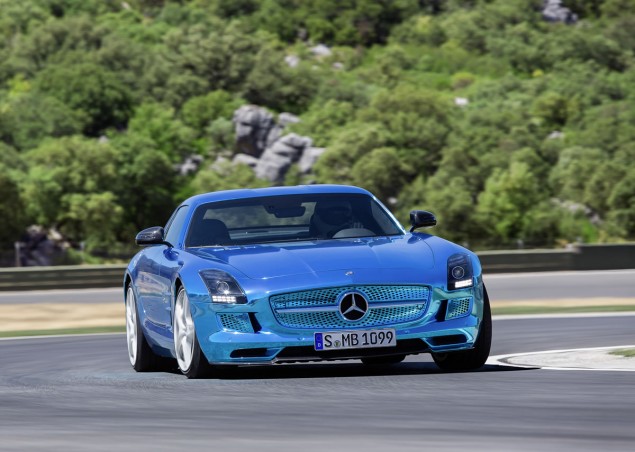
“The SLS AMG Coupé Electric Drive is setting new standards for cars with electric drives. As the most powerful gullwing model ever, it is also representative of the enduring innovational strength of Mercedes-AMG. Our vision of the most dynamic electric vehicle has become a reality. With the help of our colleagues at Mercedes AMG High Performance Powertrains in Brixworth, we are bringing exciting advanced technology from the world of Formula 1 to the road”, according to Ola Källenius, Chairman of the Board of Management of Mercedes-AMG GmbH.
Pioneering, visionary, electrifying: the powerful and locally emission-free super sports car with electric drive also embodies the development competence of Mercedes-AMG GmbH. With this innovative and unique drive solution, AMG – as the performance brand of Mercedes-Benz – is demonstrating its technological leadership in this segment. The SLS AMG Coupé Electric Drive is aimed at technology-minded super sports car fans who are open to new ideas and enthusiastic about ambitious high-tech solutions for the future of motoring.
Enormous thrust thanks to 1000 Nm of torque
The pioneering drive package in the SLS AMG Coupé Electric Drive is impressive and guarantees a completely innovative and electrifying driving experience: enormous thrust comes courtesy of four synchronous electric motors providing a combined maximum output of 552 kW and maximum torque of 1000 Nm. The very special gullwing model accelerates from zero to 100 km/h in 3.9 seconds, and can reach a top speed of 250 km/h (electronically limited). The agile response to accelerator pedal input and the linear power output provide pure excitement: unlike with a combustion engine, the build-up of torque is instantaneous with electric motors – maximum torque is effectively available from a standstill. The spontaneous build-up of torque and the forceful power delivery without any interruption of tractive power are combined with completely vibration-free engine running characteristics.
The four compact permanent-magnet synchronous electric motors, each weighing 45 kg, achieve a maximum individual speed of 13,000 rpm and in each case drive the 4 wheels selectively via a axially-arranged transmission design. This enables the unique distribution of torque to individual wheels, which would normally only be possible with wheel hub motors which have the disadvantage of generating considerable unsprung masses.
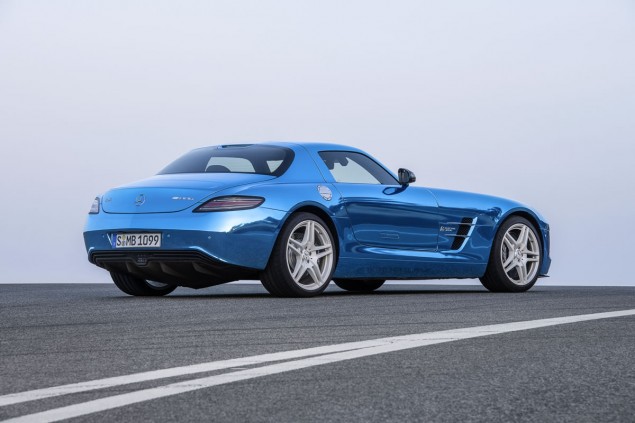
The key data at a glance:
| SLS AMG Coupé Electric Drive | |
| Max. output | 552 kW |
| Torque | 1000 Nm |
| 0 – 100 km/h | 3.9 s |
| Range | 250 km (according to NEDC combined) |
| Battery energy content | 60 kWh |
| Battery voltage | 400 volts |
Typical AMG: the sound of the 21st century
Powerful, voluminous, dynamic, emotional and authentic: the characteristic sound of the SLS AMG Coupé Electric Drive embodies the sound of the 21st century. After an elaborate series of tests as well as numerous test drives, the AMG experts have created a sound which captures the exceptional dynamism of this unique super sports car with electric drive. Starting with a characteristic start-up sound, which rings out on pressing the “Power” button on the AMG DRIVE UNIT, the occupants can experience a tailor-made driving sound for each driving situation: incredibly dynamic when accelerating, subdued when cruising and as equally characteristic during recuperation. The sound is not only dependent on road speed, engine speed and load conditions, but also reflects the driving situation and the vehicle’s operating state with a suitable driving noise. Perfect feedback for the driver is guaranteed thanks to a combination of the composed sound, the use of the vehicle’s existing inherent noises and the elimination of background noise – this is referred to by the experts as “sound cleaning”. The impressive sound comes courtesy of the standard sound system with eleven loudspeakers.
Advanced Formula 1 technology: high-voltage lithium-ion battery
Battery efficiency, performance and weight: in all three areas Mercedes-AMG is setting new standards. The high-voltage battery in the SLS AMG Coupé Electric Drive boasts an energy content of 60 kWh, an electric load potential of 600 kW and weighs 548 kg – all of which are absolute best values in the automotive sector. The liquid-cooled lithium-ion high-voltage battery features a modular design and a maximum voltage of 400 V.
Advanced technology and know-how from the world of Formula 1 have been called on during both the development and production stages: the battery is the first result of the cooperation between Mercedes-AMG GmbH in Affalterbach and Mercedes AMG High Performance Powertrains Ltd. Headquartered in Brixworth in England, the company has been working closely with Mercedes-AMG for a number of years. F1 engine experts have benefited from its extensive expertise with the KERS hybrid concept, which made its debut in the 2009 Formula 1 season. At the Hungarian Grand Prix in 2009, Lewis Hamilton achieved the first historic victory for a Formula 1 vehicle featuring KERS hybrid technology in the form of the Mercedes-Benz KER System. Mercedes AMG High Performance Powertrains supplies the Formula 1 teams MERCEDES AMG PETRONAS, Vodafone McLaren Mercedes and Sahara Force India with Mercedes V8 engines and the KERS.
The high-voltage battery consists of 12 modules each comprising 72 lithium-ion cells. This optimised arrangement of a total of 864 cells has benefits not only in terms of best use of the installation space, but also in terms of performance. One technical feature is the intelligent parallel circuit of the individual battery modules – this helps to maximise the safety, reliability and service life of the battery. As in Formula 1, the battery is charged by means of targeted recuperation during deceleration whilst the car is being driven.
High-performance control as well as effective cooling of all components
A high-performance electronic control system converts the direct current from the high-voltage battery into the three-phase alternating current which is required for the synchronous motors and regulates the energy flow for all operating conditions. Two low-temperature cooling circuits ensure that the four electric motors and the power electronics are maintained at an even operating temperature. A separate low-temperature circuit is responsible for cooling the high-voltage lithium-ion battery. In low external temperatures, the battery is quickly brought up to optimum operating temperature with the aid of an electric heating element. In extremely high external temperatures, the cooling circuit for the battery can be additionally boosted with the aid of the air conditioning. This also helps to preserve the overall service life of the battery system.
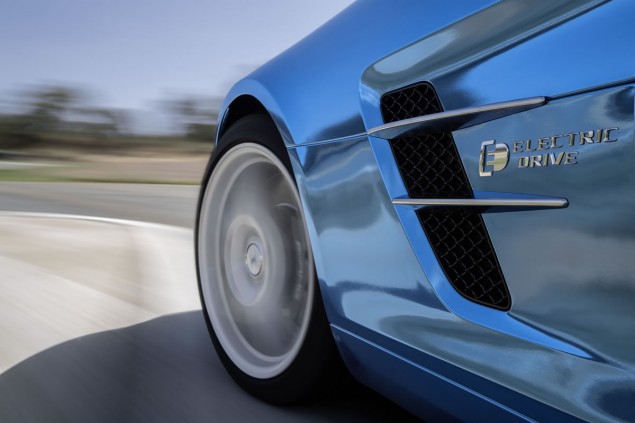
Quick charge function via special wall box
Ideally the SLS AMG Coupé Electric Drive is charged with the aid of a so-called wall box. Installed in a home garage, this technology provides a 22 kW quick-charge function, which is the same as the charging performance available at a public charging station. A high-voltage power cable is used to connect the vehicle to the wall box, and enables charging to take place in around three hours. Without the wall box, charging takes around 20 hours. The wall box is provided as an optional extra from Mercedes-AMG in cooperation with SPX and KEBA, two suppliers of innovative electric charging infrastructures for the automotive industry.
Eight-stage design for maximum safety
To ensure maximum safety, the SLS AMG Coupé Electric Drive makes use of an eight-stage safety design. This comprises the following features:
1. all high-voltage cables are colour-coded in orange to prevent confusion
2. comprehensive contact protection for the entire high-voltage system
3. the lithium-ion battery is liquid-cooled and accommodated in a high-strength aluminium housing within the carbon-fibre zero-intrusion cell
4. conductive separation of the high-voltage and low-voltage networks within the vehicle and integration of an interlock switch
5. active and passive discharging of the high-voltage system when the ignition is switched to “off”
6. in the event of an accident, the high-voltage system is switched off within fractions of a second
7. continuous monitoring of the high-voltage system for short circuits with potential compensation and insulation monitors
8. redundant monitoring function for the all-wheel drive system with torque control for individual wheels, via several control units using a variety of software
By using this design, Mercedes-AMG ensures maximum safety during production of the vehicle and also during maintenance and repair work. Of course the SLS AMG Coupé Electric Drive also meets all of the statutory and internal Mercedes crash test requirements.
All-wheel drive with AMG Torque Dynamics enables new levels of freedom
Four motors, four wheels – the intelligent and permanent all-wheel drive of the SLS AMG Coupé Electric Drive guarantees driving dynamics at the highest level, while at the same time providing the best possible active safety. Optimum traction of the four driven wheels is therefore ensured, whatever the weather conditions. According to the developers, the term “Torque Dynamics” refers to individual control of the electric motors, something which enables completely new levels of freedom to be achieved. The AMG Torque Dynamics feature is permanently active and allows for selective distribution of forces for each individual wheel. The intelligent distribution of drive torque greatly benefits driving dynamics, handling, driving safety and ride comfort. Each individual wheel can be both electrically driven and electrically braked, depending on the driving conditions, thus helping to:
- optimise the vehicle’s cornering properties
- reduce the tendency to oversteer/understeer
- increase the yaw damping of the basic vehicle
- reduce the steering effort and steering angle required
- increase traction
- and minimise ESP® and ASR intervention
The AMG Torque Dynamics feature boasts a great deal of variability and individuality by offering three different transmission modes:
- Comfort (C): comfortable, forgiving driving characteristics
- Sport (S): sporty, balanced driving characteristics
- Sport plus (S+): sporty, agile driving characteristics
AMG Torque Dynamics enables optimum use of the adhesion potential between the tyres and the road surface in all driving conditions. The technology allows maximum levels of freedom and as such optimum use of the critical limits of the vehicle’s driving dynamics. Outstanding handling safety is always assured thanks to the two-stage Electronic Stability Program ESP®.
“AMG Lightweight Performance” design strategy
The trailblazing body shell structure of the SLS AMG Coupé Electric Drive is part of the ambitious “AMG Lightweight Performance” design strategy. The battery is located within a carbon-fibre monocoque which forms an integral part of the gullwing model and acts as its “spine”. The monocoque housing is firmly bolted and bonded to the aluminium spaceframe body. The fibre composite materials have their roots in the world of Formula 1, among other areas. The advantages of CFRP (carbon-fibre reinforced plastic) were exploited by the Mercedes-AMG engineers in the design of the monocoque. These include their high strength, which makes it possible to create extremely rigid structures in terms of torsion and bending, excellent crash performance and low weight. Carbon-fibre components are up to 50 percent lighter than comparable steel ones, yet retain the same level of stability. Compared with aluminium, the weight saving is still around 30 percent, while the material is considerably thinner. The weight advantages achieved through the carbon-fibre battery monocoque are reflected in the agility of the SLS AMG Coupé Electric Drive and, in conjunction with the wheel-selective four-wheel drive system, ensure true driving enjoyment. The carbon-fibre battery monocoque is, in addition, conceived as a “zero intrusion cell” in order to meet the very highest expectations in terms of crash safety. It protects the battery modules inside the vehicle from deformation or damage in the event of a crash.
The basis for CFRP construction is provided by fine carbon fibres, ten times thinner than a human hair. A length of this innovative fibre reaching from here to the moon would weigh a mere 25 grams. Between 1000 and 24,000 of these fibres are used to form individual strands. Machines then weave and sew them into fibre mats several layers thick, which can be moulded into three-dimensional shapes. When injected with liquid synthetic resin, this hardens to give the desired structure its final shape and stability.
Optimum weight distribution and low centre of gravity
The purely electric drive system was factored into the equation as early as the concept phase when the super sports car was being developed. It is ideally packaged for the integration of the high-performance, zero-emission technology: by way of example, the four electric motors and the two transmissions can be positioned as close to the four wheels as possible and very low down in the vehicle. The same applies to the modular high-voltage battery. Advantages of this solution include the vehicle’s low centre of gravity and balanced weight distribution – ideal conditions for optimum handling, which the electrically-powered gullwing model shares with its petrol-driven sister model.
New front axle design with pushrod damper struts
The additional front-wheel drive called for a newly designed front axle: unlike the series production vehicle with AMG V8 engine, which has a double wishbone axle, the SLS AMG Coupé Electric Drive features an independent multi-link suspension with pushrod damper struts. This is because the vertically-arranged damper struts had to make way for the additional drive shafts. As is usual in a wide variety of racing vehicles, horizontal damper struts are now used, which are operated via separate push rods and transfer levers. Thanks to this sophisticated front-axle design, which has already been tried and tested in the world of motorsport, the agility and driving dynamics of the SLS AMG Coupé Electric Drive attain the same high levels as the V8 variant. Another distinguishing feature is the speed-sensitive power steering with rack-and-pinion steering gear: the power assistance is implemented electrohydraulically rather than just hydraulically.
AMG ceramic composite brakes for perfect deceleration
The SLS AMG Coupé Electric Drive is slowed with the aid of AMG high-performance ceramic composite brakes, which boast direct brake response, a precise actuation point and outstanding fade resistance, even in extreme operating conditions. The over-sized discs – measuring 402 x 39 mm at the front and 360 x 32 mm at the rear – are made of carbon fibre-strengthened ceramic, feature an integral design all round and are connected to an aluminium bowl in a radially floating arrangement.
The ceramic brake discs are 40 percent lighter in weight than the conventional, grey cast iron brake discs. The reduction in unsprung masses not only improves handling dynamics and agility, but also ride comfort and tyre grip. The lower rotating masses at the front axle also ensure a more direct steering response – which is particularly noticeable when taking motorway bends at high speed.
Exclusive, high-quality design and appointments
Visually, the multi-award-winning design of the SLS AMG is combined with a number of specific features which are exclusive to the Electric Drive variant. The front apron has a striking carbon-look CFRP front splitter which generates downforce on the front axle. The radiator grille and adjacent air intakes adorn special areas painted in the vehicle colour and with bionic honeycomb-shaped openings. They are not only a visual highlight but, thanks to their aerodynamically optimised design, also improve air flow over the cooling modules mounted behind them. Darkened headlamps also impart a sense of independence to the front section. Viewed from the side, the “Electric Drive” lettering stands out on the vehicle side, as do the AMG 5-twin-spoke light-alloy wheels with their specific paint design. The SLS AMG Electric Drive comes as standard with 265/35 R 19 tyres on the front and 295/30 R 20 tyres on the rear. The overall look is rounded off to dynamic effect by the new diffuser-look rear apron, and the darkened rear lamps. One feature reserved exclusively for the SLS AMG Coupé Electric Drive is the “AMG electricbeam magno” matt paint finish. A choice of five other colours is available at no extra cost.
When the exterior colour AMG electricbeam magno is chosen, the high-quality, sporty interior makes use of this body colour for the contrasting stitching – the stitching co-ordinates perfectly with designo black Exclusive leather appointments. AMG sports seats and numerous carbon-fibre trim elements in the interior underscore the exclusive and dynamic character of what is currently the fastest electric car. Behind the new AMG Performance steering wheel there is a newly designed AMG instrument cluster: instead of a rev counter, there is a power display providing information on the power requirements, recuperation status, transmission modes and battery charge.
AMG Performance Media as standard
The AMG DRIVE UNIT comprises the electronic rotary switch for selecting the three transmission modes of “C” (Controlled Efficiency), “S” (Sport) and “S+” (Sport plus), which the driver can use to specify different performance levels from the electric motors, which in turn also changes the top speed and accelerator pedal response. Behind the buttons for “power” and “ESP On/Off”, there are also buttons for AMG Torque Dynamics and AMG Setup.
In addition to carbon-fibre exterior mirrors, AMG carbon-fibre engine compartment cover, COMAND APS, Media Interface, Blind Spot Assist and reversing camera, the standard equipment also includes the AMG Performance Media system. Besides full high-speed mobile internet access, the system provides information on engine performance, lateral and longitudinal acceleration, tyre pressure, vehicle setup and lap times, as well displaying a variety of additional information such as:
- vehicle energy flow
- battery charge status
- burrent range
- AMG Torque Dynamics
- temperatures of the battery and motors
- energy consumption kWh/100 km
The Mercedes-Benz SLS AMG Coupé Electric Drive will be celebrating its market launch in 2013. The price in Germany (incl. 19% VAT) will be:
SLS AMG Coupé Electric Drive: 416,500 euros
Mercedes B-Class Electric Drive Concept Revealed Ahead of Paris
This concept vehicle is one of the first models to incorporate the term "Electric Drive" into its model designation
At next week’s Paris Motor Show, Mercedes will be unveiling their newest addition to Mercedes-Benz family of electric vehicles. A battery-powered electric variant of the B-Class. This concept vehicle is one of the first models to incorporate the term “Electric Drive” into its model designation. In future, “Electric Drive” lettering will adorn the boot lids of all battery-powered electric passenger cars from Mercedes-Benz, Mercedes-AMG and smart.
Similarly to the successful B-Class models with combustion engines, the battery-powered Concept B-Class Electric Drive also combines a comfortable and enjoyable driving experience with full suitability for everyday and family use. The so-called Energy Space in the floor of the vehicle in front of the rear axle ensures that the concept vehicle offers the same generous and variable space inside as the current series production models. The Energy Space provides a safe and space-saving means of accommodating the powerful lithium-ion battery which also has a positive effect on the vehicle’s centre of gravity.
The Concept B-Class Electric Drive is equipped with a 100 kW electric motor whose powerful 310 Newton meters of torque provide for attractive driving dynamics over a range of 200 kilometres. The battery can be charged at any standard domestic 230 V power outlet or alternatively – with rapid charging function – at a 400 V high-voltage terminal.

Mercedes-Benz B-Class Electric Drive
In the B-Class, Mercedes-Benz has at its disposal an extremely versatile car which is suitable for the most diverse types of drive – from combustion engines through battery-powered drives to the fuel cell. Thanks to Energy Space, the B-Class is the ultimate all-rounder and the Mercedes trailblazer for alternative drives in the compact premium automobile segment. The particularly family-friendly electric car from Mercedes-Benz is almost ready for series production, with the market launch already planned for 2014.

Mercedes-Benz B-Class Electric Drive
The Paris Motor Show will also feature the world premieres of the production versions of the Mercedes-Benz SLS AMG Coupé Electric Drive and the smart BRABUS electric drive. These new electric cars in three different vehicle categories from Mercedes-Benz, Mercedes-AMG and smart demonstrate once again Daimler’s rigorous pursuit of its drive strategy focusing on the ultimate objective of zero-emission driving. Along with optimised combustion engines and hybridisation tailored to prevailing needs, the focus is on battery-powered electric drives and the fuel cell.