smart and Brabus Partnership History
10 years of smart-BRABUS stands for more than 50,000 customised vehicles and lots of delighted smart customers
Sporty smarts are called BRABUS – and have been for ten years already. In 2002 smart and the tuning specialist BRABUS founded a joint company. As early as 2003 the first premium models developed by the joint venture smart-BRABUS GmbH –the smart fortwo BRABUS coupé and cabrio – were introduced on the market. Now the companies are celebrating their anniversary with the unique and exclusively equipped “10th anniversary” special model.
smart boss Dr Annette Winkler says: “10 years of smart-BRABUS stands for more than 50,000 customised vehicles and lots of delighted customers. The fact that we already produced more than 10,000 smarts together last year shows that we still have lots of potential for further growth and high profitability with this creative and efficient team.” Bodo Buschmann, CEO of the BRABUS Group, adds: “The cooperation with smart has developed extremely well in the past ten years. This means that BRABUS is not only a synonym for fast, but also highly exclusive sports cars. And we still have lots of ideas how smart and BRABUS can continue to grow together.”
Since the launch of the first smart fortwo BRABUS more than 50,000 customers worldwide have opted for a smart model customised by the joint venture. The customisation programme “smart BRABUS tailor made” that was launched two years ago and has now become established throughout Europe is also very successful. In 2012 it will also be extended to customers in the USA and China. According to the current forecast, more than 1000 customers will choose the smart-BRABUS tailor made offering this year. tailor made underlines one of the great strengths of smart-BRABUS – individualisation of the vehicle interior and exterior. In Germany, for example, prices start at €2999 incl. VAT for an exterior colour of the customer’s choice or exclusive leather appointments in the interior.
Here is an overview of the most important models from smart BRABUS:
| June 2002 | smart BRABUS 1st edition |
| May 2003 | smart fortwo BRABUS (production model) |
| June 2003 | smart fortwo BRABUS “edition starblue”, |
| July 2003 | smart roadster BRABUS V6 biturbo |
| October 2003 | smart roadster BRABUS “edition bluewave” |
| April 2004 | smart roadster BRABUS |
| November 2004 | BRABUS Ultimate 101 |
| March 2005 | smart forfour BRABUS |
| March 2007 | smart fortwo BRABUS (second model generation) |
| October 2007 | BRABUS Ultimate 112 |
| May 2008 | smart fortwo BRABUS “Edition 10” |
| March 2009 | Study: smart fortwo BRABUS electric drive |
| May 2009 | smart fortwo BRABUS USA version |
| March 2010 | Customisation programme smart BRABUS tailor made |
| March 2011 | BRABUS Ultimate Style |
| September 2011 | smart BRABUS tailor made by WeSC |
| March 2012 | smart fortwo BRABUS/Xclusive facelift, |
| BRABUS Ultimate 120, | |
| smart BRABUS electric drive, | |
| smart BRABUS ebike (study) | |
| July 2012 | smart BRABUS 10th anniversary |
Ten years of smart BRABUS: customisation – a success story
Flexible small-scale manufacturer for discerning customers
smart BRABUS GmbH is a joint venture between smart and BRABUS and stands for premium automotive enhancement. In the past ten years more than 50,000 customers have opted for products that were developed or produced in cooperation with the engineers from BRABUS. 2011 was the most successful year to date with more than 10,000 smart fortwos customised by BRABUS.
Today smart offers two model lines in cooperation with BRABUS: the smart BRABUS and the smart BRABUS Xclusive. The smart BRABUS engineers and designers place a particular focus on two areas. Firstly, enhancing the performance. The 75 kW (102 hp) turbo engine accelerates the coupé and cabrio from 0 to 100 km/h in 8.9 seconds. The sporty transmission configuration, suspension components developed specially for smart and a number of aerodynamic elements also ensure all-round sporty driving dynamics. The second focus is on enhancing the appearance of the whole vehicle with exclusive design elements in high-quality materials such as leather, brushed aluminium and bright stainless steel.
Sporty: the smart BRABUS
As well as a 75 kW (102 hp) turbo engine with sporty transmission configuration, the smart BRABUS has “Monoblock VII” alloy wheels with front tyres: 175/50 R 16; rear tyres: 225/35 R 17, a sports suspension lowering the vehicle by 10 mm, front fog lamps, a sports exhaust with rear apron in black, BRABUS logo at the front, rear and in the mirror triangle, and a panoramic roof (coupé; incl. sunblind). The tridion safety cell comes in black, or is alternatively available in silver or white. Among other things the interior is upgraded by BRABUS dashboard instruments (cockpit clock & rev counter), a gear knob in leather/aluminium, an aluminium hand brake lever and sports pedals in stainless steel with rubber nubs. There is also a 3-spoke leather sports steering wheel with steering wheel gearshift, air conditioning with automatic temperature control (incl. dust and pollen filter) and electric windows. The fabric upholstery comes in design black and the interior contrast components in pearl black. Fabric elements on the instrument panel, door trim and knee pad, colour-coordinated with the upholstery, round off the stylish look of the smart BRABUS.
Uncompromising: smart BRABUS Xclusive
Fine materials, exclusive styling and plenty of power: from the dynamic exterior to the high-quality interior equipment, the smart fortwo BRABUS Xclusive leaves virtually nothing to be desired. In addition to the equipment of the smart BRABUS, the Xclusive also has a front spoiler and side skirts in the bodypanel colour and headlamps with titanium-coloured surrounds. In the interior the BRABUS Xclusive features heated leather seats, silver stitching and the BRABUS logo embossed in the headrests. The air conditioning has automatic temperature control (incl. dust and pollen filter). The contrast components come in aluminium look, and the instrument panel and door trim in leather optic.
Anything is possible: smart BRABUS tailor made
With the almost unlimited options available from smart BRABUS tailor made smart buyers can contribute creative ideas to the design of their two-seater and give their vehicle their own personal touch. smart’s customisation programme meets the needs of all those customers who want to drive a smart fortwo tailored to their own ideas in line with the principle “anything is possible”. For example, customers can choose the exterior colour, types of leather and cabrio soft top colour from a wide range. There are barely any limits. The following are available:
- Exterior finishes in thousands of different colours
- Leather in 30 basic colours and exclusive design variants
- Six cabrio soft top colours
The whole smart-BRABUS range of accessories
To help smart customers to find their own style, a number of attractive tailor-made packages are available. The tailor-made models are made-to-measure in the truest sense of the word. This means that they are individually customised at the factory with masterly craftsmanship using top quality materials and parts tested by the manufacturer – with a full manufacturer’s guarantee.
Dynamic and powerful acceleration: the smart BRABUS electric drive
Zero local emissions but maximum driving fun: the smart BRABUS electric drive proves that cutting-edge urban mobility can be combined with lively agility and a sporty look. The electric motor is based on the state-of-the-art drive technology of the new smart fortwo electric drive and has an output of 60 kW. It delivers maximum torque of 135 Nm which means that the smart BRABUS electric drive almost always wins when pulling away at the traffic lights. The new BRABUS sports suspension makes a decisive contribution to driving fun by bringing the vehicle approximately ten millimetres closer to the asphalt. The sporty character is accompanied by a special BRABUS sound to match, generated by a sound module. The smart BRABUS electric drive comes with a BRABUS sports steering wheel with steering wheel gearshift as a standard feature. Recuperation can be regulated with the help of the shift paddles.

The smart BRABUS electric drive has a dynamic look that also signals environmental friendliness: the tridion safety cell and mirror covers are painted in electric green whilst black dominates on all other body parts – even the front grille. Dark BRABUS headlamps, BRABUS “Monoblock VII” alloy wheels measuring 16″ at the front and 17″ at the rear, and BRABUS Xclusive aerodynamic body styling parts (a front spoiler and a special rear apron insert with double reflectors) round off the sporty look.
In the interior, accent trim parts and contrast components also come in electric green. Numerous BRABUS Xclusive components, including the instrument panel and interior door trim in leather look, leather seats, stainless steel sports pedals with rubber nubs, BRABUS hand brake lever and BRABUS dashboard instruments (cockpit clock and rev counter) lend the interior a dynamic and exclusive look.
The smart BRABUS electric drive will be available from smart centers in 12 countries from the end of this year.
Max. speed up to 45 km/h: the smart BRABUS ebike
The smart BRABUS ebike has the features typical of BRABUS – more style, more power and more exclusiveness. It has a dynamic look with the frame and fork in matt black and components such as quick release skewers, pedals and brake callipers in anodised green providing a striking contrast. Saddle and grips come in green leather. A four-piston brake system is fitted on the front wheel. The matt black four-spoke wheels are made of carbon. Further components that distinguish the smart BRABUS ebike from the smart ebike are Sport Contact tyres, weight-optimised cranks and pedals and the carbon seatpost.
With 500 watts the electric motor is twice as powerful as that of the smart ebike. At the same time BRABUS has managed to reduce the weight of the ebike by more than ten percent. This makes for particularly agile performance: the two-wheeler, which requires a license plate, has a top speed of 45 km/h. The rider decides how much assistance to their muscle power they would like from the electric motor using the throttle grip. There is a choice of four power levels with the fourth and highest level providing maximum pushing power.
The production version of the smart BRABUS ebike is expected to be available from dealers from the end of 2012.
Milestones in the cooperation between smart and BRABUS
March 2002: the 50:50 joint venture between smart and BRABUS is founded. BRABUS founder Bodo Buschmann is the Managing Director of smart BRABUS GmbH. The smart BRABUS 1st edition is presented at the Geneva Motor Show – initially as a study.
June 2002: the first jointly produced model, the smart BRABUS 1st edition, goes on sale as a coupé and a cabrio. It is characterised by a 52 kW (70 hp) uprated engine, a sporty body kit and exclusive interior appointments with leather and carbon. It is produced in a limited edition of 500 vehicles.
May 2003: the smart city coupé BRABUS and smart cabrio BRABUS, soon to be renamed smart fortwo BRABUS, are launched in 2003 and now represent the top of the model range. They meet the highest customer demands as regards exclusiveness, individuality, innovation and dynamics. Both top versions are fitted with a powerful 55 kW (75 hp) engine enabling a top speed of 150 km/h.
July 2003:with the smart roadster-coupé Brabus V6 biturbo, in cooperation with smart and Mercedes-Benz (engine development) BRABUS shows what is possible. Two standard production engines, each with capacity of 698 cc, three cylinders and their turbochargers are connected with a newly constructed crankcase and installed at the rear of the coupé. The über-smart has power output of 125 kW (170 hp) and sprints from 0 to 100 km/h in less than six seconds. Ten prototypes are built.
March 2004: world premiere of the BRABUS versions of the smart roadster and coupé at the Geneva Motor Show. Both variants are enhanced in terms of power and equipment. They now have an output of 74 kW (101 hp) and reach top speeds of 190 (roadster) and 195 km/h (roadster-coupé) respectively. The standard equipment of the agile two-seaters includes sports suspension and 17-inch alloy rims, softouch automatic transmission, black leather heated sports seats and a 3-spoke leather sports steering wheel with steering wheel gearshift.
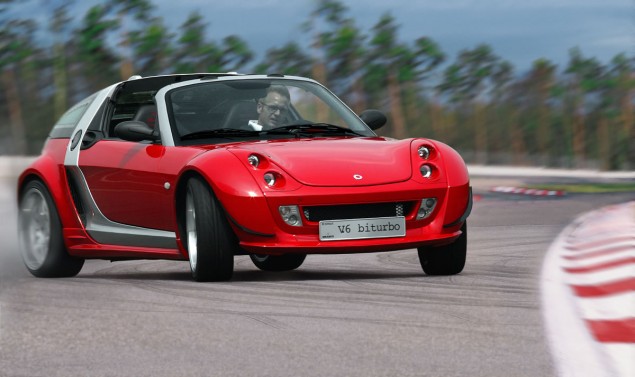
27 April 2004: the new Bottrop headquarters of the company smart-BRABUS GmbH, founded in March 2002, are officially inaugurated with a ceremony. The state-of-the-art technology and competence centre of the joint venture between smart and the tuning specialist BRABUS has an area of almost 9,000 square metres. In addition to ultramodern vehicle workplaces, this building built with an investment of €16 million accommodates a development department with computer-controlled test benches and the administrative headquarters of the joint venture. With the decision to set up the headquarters here, smart-BRABUS GmbH created 120 new jobs in Bottrop.
November 2004: the limited special model “BRABUS ULTIMATE 101” based on the smart fortwo with a production volume of 101 vehicles is presented. It costs €39,900 and, in addition to a special finish in racing red or a colour of the customer’s choice that also includes the safety cell, it has a 74 kW (101 hp) uprated engine. It accelerates from 0 to 100 km/h in 11.9 s and has an electronically regulated top speed of 160 km/h. The suspension and tyres are adapted to this speed.
March 2005: world premiere at the Geneva Motor Show for the new smart forfour BRABUS. A maximum speed of 221 km/h, acceleration from 0 to 100 km/h in 6.9 seconds and even more driving pleasure mark the four-seater BRABUS as a premium vehicle for connoisseurs and enthusiasts. Leather in the interior creates a premium class atmosphere, which is underlined by leather-covered headrests and velour floor mats sporting BRABUS lettering.
March 2007: sportiness in an exclusive guise: the BRABUS models of the new smart fortwo as a coupé or a cabrio are premiered in Geneva with the market launch following in the autumn. With a reengineered 72 kW (98 hp) three-cylinder turbo engine the smart fortwo BRABUS and the smart fortwo BRABUS Xclusive have 30 percent more power than their predecessors, yet still boast low fuel consumption of only 5.2 l/100 km. The sporty two-door car accelerates from 0 to 100 km/h in 9.9 seconds and reaches a top speed of 155 km/h. What’s more, the two BRABUS variants boast an extremely low power-to-weight ratio: at just 7.8 kg/hp this is 24 percent lower than that of the previous BRABUS variant.
The smart fortwo BRABUS Xclusive lives up to its name with additional equipment details such as H7 projection headlamps with titanium-coloured surrounds, a front spoiler with enlarged air inlets, striking side skirts and a special rear apron. All body styling parts are painted in the car’s exterior colour. The seats are upholstered with fine leather, heated, and feature head/thorax side airbags as standard. The leather-effect instrument panel boasts aluminium-look trims.
October 2007: the BRABUS ULTIMATE 112 based on the new smart fortwo cabrio or coupé offers a symbiosis of extravagant equipment, sporty performance and agile handling that is unique for a city sports car. The body comes in a flaming pearl metallic orange special finish or in a colour of the customer’s choice, the interior features exclusive black BRABUS leather upholstery with orange seams or a colour chosen by the customer. In addition to the special finish, the muscular body kit with front spoiler, side skirts and BRABUS WIDESTAR wheel arches at the front and rear catch the eye. As the name of the exclusive special model indicates, this model packs a powerful punch with 82.4 kW (112 hp). Needing just 3.9 seconds to reach 60 km/h and with an electronically limited top speed of 170 km/h this is one fast mover. The ULTIMATE 112 rolls on gleaming black painted Monoblock VI twin-spoke wheels measuring 7Jx18 with 205/35 R 18 tyres at the front, and 8.5Jx18 wheels with 235/30 R 18 tyres at the rear.
May 2008: to mark the tenth anniversary of the smart fortwo a new special model for German customers is introduced on the market. From September the smart fortwo edition 10 is produced in a limited edition of just 500 vehicles. The smart fortwo edition 10 is available as a coupé or a cabrio. The exterior stands out with bodypanels, mirror covers and front grille in the colour dark brown metallic in conjunction with a silver tridion safety cell. The exclusive two-tone leather interior in sand beige/chocolate with contrasting stitching harmonises with this and enhances the seats, the 2-spoke steering wheel, the door inside panels, door pockets, instrument panel, knee pad and the hand brake lever trim. Accent trim parts and contrast components painted in the exterior colour are further eye-catching highlights. The gear knob, hand brake lever and velour floor mats in an “edition 10” design, special stitching in the seat backrest and the “edition 10” label in the mirror triangle and on the tailgate round off the exclusive appearance of the limited special model.
March 2010: smart-BRABUS tailor made is launched. From now on smart increasingly fulfils unusual customer wishes.
September 2011: smart and the street fashion brand WeSC team up and present the fruits of their “golden” cooperation at the International Motor Show in Frankfurt: the “smart BRABUS tailor made by WeSC” and the “headphones for the smart by WeSC”. The smart fortwo cabrio is completely painted in shades of gold, some of which are matt and some shiny, all specially created by the tuning specialist BRABUS for the Swedish label. The deep black rims and leather seats with horizontal stitching in the interior bear the clear hallmark of the street style experts. In return smart designed the 32-ohm headphones from WeSC and based the design on the look of the car with perforated black ear cushions and shiny gold accents. See photo below.
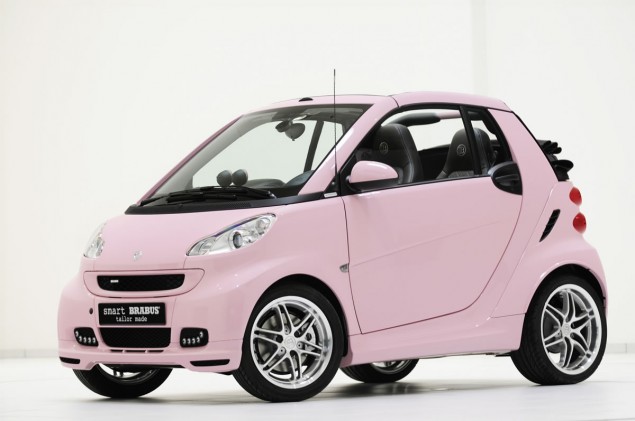
March 2012: with the smart fortwo BRABUS electric drive a near-series show car from smart BRABUS with electric drive and a state-of-the-art lithium-ion battery celebrates its world premiere at the Geneva Motor Show. Here, ecology and a feast for the senses go hand in hand. The light and airy design of the smart fortwo BRABUS electric drive coupled with fine natural materials demonstrate harmony with the environment and at the same time elevate the pleasure of owning and driving this vehicle to an even higher level. The sports suspension with BRABUS “Monoblock VII” alloy wheels in a five twin-spoke design and matt white exterior and interior trims convey a sporty and functional impression. The smart fortwo BRABUS electric drive is additionally equipped with a BRABUS sound generator which generates a sound specially developed for the smart fortwo electric drive via the power output.
March 2012: BRABUS Ultimate 120 – the ultimate city sports car. As the name indicates, this open two-seater is a super-smart with power output of 88.3 kW (120 hp) and a top speed of 170 km/h. It is built in a limited edition of just 120 numbered vehicles. The new BRABUS Monoblock F “Platinum Edition” forged wheels with the dimensions 7Jx18 on the front axle are fitted with 205/35 R 18 high-performance tyres. At the rear the wheels measure 8.5Jx18 with 235/30 R 18 tyres. The height-adjustable BRABUS coil-over sports suspension, which combines direct, safe and sporty handling with a high level of ride comfort, is specially configured for the ultra-flat tyres and the wider track. A high-performance braking system from BRABUS with perforated discs and 4-piston fixed-calliper brakes on the front axle painted in the body colour offers enormous deceleration and maximum fatigue strength. Needing just 8.9 seconds to sprint to 100 km/h and with an electrically limited top speed of 170 km/h the cabrio also sets a benchmark in its class in this discipline. This impressive performance also has the sound to match thanks to a BRABUS stainless steel sports exhaust system with two chrome-plated tail pipes.
The ULTIMATE 120 also features exquisite highlights in the cockpit: the whole interior is covered with particularly soft and breathable BRABUS mastic leather in black with red contrasting stitching matching the outer skin, or in a colour of the customer’s choice. To guarantee optimal side support during fast cornering the city sports car is equipped with Recaro Sportster seats. These are not only covered with the finest BRABUS leather – their seat backrest shells are painted in the colour of the outer skin.
AMG Retro Collection Helps Celebrate 45 Year Anniversary
Commemorate AMG's 45th Anniversary in 1970's style with the AMG Retro Edition Collection from Mercedes-Benz Accessories
On June 1, 1967, Mercedes-Benz engineers Hans-Werner Aufrecht and Erhard Melcher teamed up to found AMG Motorenbau und Entwicklungsgesellschaft mbH (AMG Engine Production and Development, Ltd.). In 1971 the company became famous overnight with a second place finish at the the 24-hour race in Spa-Francorchamps with the 300 SEL 6.8 red touring car with the start number 35.
Both of these events are commemorated with 1970’s style in the AMG Retro Edition from Mercedes-Benz Accessories GmbH, which you can see in the photo gallery below and which are now available from Mercedes’ partners and the online shop.
These historic dates are featured on the classic white polo shirt made from 100% cotton. Discreet red highlighting on the collar, inner button placket and on the neck band, and a red stripe on the sleeve cuffs also commemorate the first AMG racing car, as do the badges on the sleeves showing the date 1971 and the number 35. The first AMG logo is printed in silver in 3D on the left-hand side of the chest, with the words “Founded 1967” on the back of the neck. Even the buttons bear the AMG logo. The men’s polo shirt is available in sizes S to XXL. To go with the polo shirt there is a cap showing the early version of the AMG logo, the badges “1971” and “35”, and the words “Founded 1967”.
A fine leather collection is available made from vintage-look cognac-coloured calfskin, and the items in this collection are sure to become the user’s everyday style accessories. The collection includes a weekend travel bag (dimensions: 47 x 30 x 25 cm) with sturdy handles, dark-brown cotton lining and base feet, a wallet and a belt. All of these items feature the same exceptional high-quality leather workmanship, with inserts made from perforated leather, the early version of the AMG logo embossed on the outside and the words “Founded 1967” stamped on the inside. To go with the leather collection there is also a key ring.
A tasteful pin in the form of the AMG heritage logo commemorates the anniversary of the company’s establishment. It is made of matt silver-coloured rhodium-plated brass with a patina effect. Completing the AMG Retro Edition is a coffee mug with original racing features from the AMG 300 SEL 6.8 and a set of 2 classic espresso cups with the early version of the AMG logo, both of which come in special gift boxes.
AMG Performance 50 Strategy – Hints at 8 New Models
The A45 AMG is representative of the future strategy entitled "AMG Performance 50", leading up to the 50th anniversary
As part of the anniversary marking “45 years of AMG”, Mercedes-AMG is providing an exclusive glimpse of the highlights of the A 45 AMG. With the powerful new top-of-the-range A-Class model, the performance brand from Mercedes-Benz is marking the start of a new era. For the first time in the 45-year history of the company, AMG will offer an exciting high-performance vehicle in the compact class. The A 45 AMG is representative of the ambitious future strategy entitled “AMG Performance 50”, leading up to the 50th anniversary of Mercedes-AMG GmbH. Based on a unique model offensive comprising additional high-performance compact cars as well as a number of AMG cars in higher classes featuring highly efficient drive systems, the company from Affalterbach is giving out clear signals for dynamic growth. And the offensive is all set to get under way this summer with new models including the SLS AMG GT and the GL 63 AMG.
The AMG 2.0-litre four-cylinder turbo engine specially developed for the A 45 AMG is expected to set new standards in its displacement class: with maximum torque significantly above 400 Nm and low consumption levels, AMG is aiming to take the leading position among the competition. “Our goal is to build the most dynamic, most powerful and at the same time most efficient four-cylinder series production compact car. Together with other future high-performance compact cars, the new A 45 AMG will embody exclusive dynamism and the “AMG Performance 50″ growth strategy. With this passionate commitment to what for us is a new vehicle segment, Mercedes-AMG plans to make a significant contribution to the growth of Mercedes-Benz Cars”, according to Ola Källenius, Chairman of the Board of Management of Mercedes-AMG GmbH.
Perfect power transmission is ensured in the A 45 AMG thanks to the AMG SPEEDSHIFT DCT 7-speed sports transmission with dual clutch technology and performance-oriented all-wheel drive. The ideal basis for high cornering speeds and exciting, agile handling also comes courtesy of the AMG sports suspension with independently developed front and rear axles, electromechanical AMG speed-sensitive sports steering, AMG high-performance braking system and 3-stage ESP® with “SPORT Handling” mode.
Driving performance for the new generation – world premiere in the first quarter of 2013
With the new A 45 AMG – the top-of-the-range Mercedes-Benz A-Class model – Mercedes-AMG is addressing a new target group: falling within an age range from 30 up to around 45, the target group is younger than the classic AMG customer. Professionally successful and independent, these customers are looking for a compact, dynamic and individual vehicle. They want to express their stylish, trend-oriented lifestyle with a car from a recognised performance brand. By being available at an attractive price, the A 45 AMG will appeal to prospective new customers and help to open up new markets.
The A 45 AMG will celebrate its world premiere in the first quarter of 2013. Further AMG high-performance compact cars with a variety of different characteristic features are already in the pipeline and will follow on the heels of the A 45 AMG. When it came to the development of the compact Mercedes-Benz vehicle architecture for front and all-wheel drive, Mercedes-AMG has been involved from the very beginning. The most dynamic versions of the A-Class, namely the A 250 Sport and the A 220 CDI Sport – both “engineered by AMG” – currently already feature a front axle developed by AMG as well as a correspondingly tuned suspension, AMG 5-spoke light-alloy wheels with 235/40 R 18 tyres all round, painted in high-gloss black and with a high-sheen finish, and also red-painted brake callipers. The “Sport” designation is always used to characterise the most dynamic model series versions in the Mercedes-Benz product range.
Even more future AMG models with all-wheel drive
All-wheel drive is set to play a bigger role at Mercedes-AMG in the future too – being offered not just for SUVs and off-road vehicles, but also for other AMG high-performance vehicles. Mercedes-AMG currently has four all-wheel-drive models in its range: the ML 63 AMG, the G 63 AMG, the G 65 AMG and the GL 63 AMG. To mark the start of the new era, in 2013 the new A 45 AMG will be launched with a performance-oriented all-wheel drive system as standard.
Consistent growth strategy: “AMG Performance 50”
AMG is enjoying strong demand for its vehicles, particularly in its three largest markets where the performance brand has witnessed extremely dynamic growth in the past year. Sales have increased by seven percent in the USA, 15 percent in Germany and almost 50 percent in China.
This growth is continuing in 2012. In the first quarter of the year AMG recorded growth of more than 30 percent, making it the best first quarter in the company’s history. As a result AMG is looking to continue its consistent growth beyond 2012 and to make a significant contribution to the sales achieved by Mercedes-Benz Cars. Based on the ambitious future strategy entitled “AMG Performance 50”, in the coming years AMG will be launching further unique high-performance models. According to Ola Källenius: “We have decided to expand our model range from its current level of 22 vehicles to around 30 vehicles in the future. We are looking to increase our global sales, which today stand at around 20,000 vehicles, to more than 30,000 vehicles by the time of our 50th anniversary, and thereby assert our leading position in this exclusive segment.” In addition to the new performance compact car, the SLS AMG GT and the GL 63 AMG, in the future the S-Class segment will play an even greater role at AMG. The current offering comprising the S 63 AMG and S 65 AMG, as well as the CL 63 AMG and CL 65 AMG, will be extended further over the coming years.
To meet the increasing demand, AMG is also expanding its production capacity accordingly. As a result, the new AMG 2.0-litre four-cylinder turbo engine will be produced at the Mercedes-Benz MDC Power engine production plant in Kölleda. This is where four-cylinder engines for the A- and B-Class are normally produced, and a specific assembly line is being set up for the new AMG engine. Of course the 2.0-litre four-cylinder turbo engines will also be produced in line with the traditional AMG philosophy of “one man, one engine”. A characteristic feature of this production principle is the AMG engine badge bearing the signature of the responsible engineer.
Around 350 AMG Performance Centers by the 50th anniversary of Mercedes-AMG GmbH
The “AMG Performance 50” growth strategy also includes opening up new dynamic markets. AMG see significant potential for increasing demand in countries such as China, Russia, Korea and Brazil. Playing a central role as part of this strategy are the AMG Performance Centers: some 270 Centers have been opened in 24 countries around the globe since 2008, and there are plans to increase this number to around 350 Performance Centers by 2017. A current example for the regional growth strategy is China: the new AMG Performance Center Beijing Sanlitun opened on 22 April 2012 is situated in an exclusive prime location in the luxury Sanlitun Village North shopping mall, and reflects the pioneering role played by AMG when it comes to design and technology in a modern setting. Unlike previously, the new store in Beijing is not integrated into a Mercedes-Benz dealership as part of a “shop-in-shop” system. Instead, it is based on a so-called standalone concept, and focuses exclusively on the products and features of the AMG performance brand.
Expansion of the excellent service quality enjoyed by all AMG customers
An important part of the “AMG Performance 50” dynamic growth strategy is the expansion of the excellent service quality enjoyed by all AMG customers. With immediate effect, more intensive customer care will allow for vehicles to be collected direct from the AMG headquarters – where AMG customers can learn all about the spirit of Affalterbach in the AMG theme area. In a new, 360-square-metre delivery hall, AMG customers can now take receipt of their new high-performance vehicle direct from AMG.
After being welcomed by a personal customer service attendant in the AMG Private Lounge, which was opened in 2011, the programme comprises an exclusive tour of the plant. This also includes a visit to the AMG Performance Studio, where individual and one-off AMG vehicles are developed and produced in limited numbers. This is followed by a tour of the AMG engine production facility: here AMG customers have the unique opportunity to meet the engineers who have produced the engine of their high-performance vehicle by hand in accordance with the traditional philosophy “one man, one engine”.
“AMG Performance 50” helps to reduce fleet consumption
Another goal of “AMG Performance 50” is the consistent reduction of fleet consumption. According to Ola Källenius: “By the 50th anniversary of AMG, we want to achieve CO2 emissions of around 200 grams per kilometre for the entire AMG model range. Our new AMG compact cars will of course help us to achieve this ambitious plan, but we are also aiming for a significant reduction in fuel consumption for other model series too. Many AMG models are currently already the “best in class” when it comes to consumption, emissions, maximum performance and torque. Our success is based on state-of-the-art technology.”
Acting as a role model in this area is the SLK 55 AMG. The eight-cylinder roadster incorporates Formula 1 technology for the road. It uses the world’s most fuel-efficient V8 engine which features the newly developed AMG Cylinder Management cylinder shut-off system. Adapted from the world of Formula 1, this technology enables the SLK 55 AMG to achieve a fuel consumption level which at 8.4 litres is 30% lower, and CO2 emissions of 195 grams per kilometre (NEDC combined). The technology is used in a similar way in the approx. 750 hp Mercedes-Benz V8 engines found in Formula 1. As efficiency also plays a major role at the pinnacle of motor racing, four cylinders are disabled by shutting off the fuel injection when the driver has lower load demands.
The Mercedes-Benz SLS AMG E-CELL is further proof of the pioneering role played by Mercedes-AMG in the development of intelligent drive concepts. The drivetrain with high-voltage lithium-ion battery for the new SLS AMG E-CELL is produced in cooperation with experts from Mercedes AMG High Performance Powertrains in Brixworth in the UK. The SLS AMG E-CELL will celebrate its premiere this autumn at the Paris Motor Show. Mercedes-AMG will be launching a series production run of the first purely electric driven super sports car, and the first customers are expected to take delivery of this gullwing model with electric drive in 2013.
Both the SLS AMG E-CELL and the V8 engine with cylinder shut-off system in the SLK 55 AMG are examples of the goal to achieve a sustainable improvement in efficiency and a reduction in fleet consumption.
“AMG Lightweight Performance” design strategy
A further building block adopted from the world of motorsport is in the area of lightweight construction – less weight means better performance and lower fuel consumption. As part of its ambitious “AMG Lightweight Performance” lightweight construction strategy, Mercedes-AMG will continue to apply consistent measures to reduce vehicle weight. Through their experience with the SLR, the AMG Black Series vehicles and in motorsport, Mercedes-Benz and AMG have accumulated more than 10 years of expertise in working with carbon-fibre materials.
AMG currently makes the propshaft for the SLS AMG, for example, out of carbon fibre. In the SLS Roadster, the supporting structure for the draught-stop is made as standard as a carbon-fibre sandwich structure. This component, with extremely short cycle times in an industrially oriented manufacturing process, already demonstrates what will be possible in the future. Carbon-fibre is also used in the SLS AMG E-CELL: the carbon-fibre monocoque for the battery is an integral part of the body shell and connected to the aluminium spaceframe.
In the case of the SL 63 AMG and SL 65 AMG, for the first time the internal support for the boot lid is mass-produced from a lightweight carbon-fibre composite material. A completely new feature is the carbon-fibre rear panel with roll-over bar, available from the AMG Performance Studio as an exclusive optional extra for the C 63 AMG Coupé AMG Black Series. The high-strength, elegantly designed carbon-fibre component forms an integral part of the body and helps to reduce the vehicle weight by more than seven kilograms compared with a regular rear panel made of sheet steel.
Future strategy for all V12 engines lies with Mercedes-AMG
In the future, both the development responsibility as well as the production competence for all Mercedes-Benz-brand V12 engines will lie with Mercedes-AMG. Currently AMG produces the M 279 AMG 6.0-litre V12 biturbo engine motor for the S 65 AMG, CL 65 AMG, SL 65 AMG and G 65 AMG. In the future, all twelve-cylinder engines for upcoming Mercedes models will be developed in Affalterbach, and manufactured in the AMG production facility in accordance with the traditional philosophy “one man, one engine”.
AMG Sports package as a factor of success
A further component of the “AMG Performance 50” growth strategy is the consistent enhancement of the AMG Sports package. This dynamic optional extra is available for numerous Mercedes models and includes such attractive options as AMG bodystyling, AMG light-alloy wheels and the AMG sports suspension. The continually increasing demand for the AMG Sports package has induced Mercedes-AMG to enhance the range further. Currently around 25 percent of all Mercedes vehicles worldwide are delivered with the AMG Sports package – in 2011 alone more than 300,000 customers opted for a Mercedes-Benz with the AMG Sports package.
An attractive entry into the world of AMG is currently already afforded by the A 250 Sport and the A 220 CDI Sport, as well as the special variants of the C-Class, the C 250 Sport and C 250 CDI Sport, in whose development the performance specialists of AMG have been consistently involved. In addition to the visually enhanced AMG Sports package Plus, both models comprise a host of technical features developed exclusively by AMG to increase driving pleasure.
AMG Driving Academy on the road to success
The AMG Driving Academy also focuses on providing an intensive experience. The wide-ranging programme of events, which is being continually expanded, not only meets the most diverse requirements but also represents the very embodiment of pure excitement. Events on offer include enjoyment-oriented EMOTION tours, special winter driving training sessions in Swedish Lapland and exciting events on legendary racing circuits such as the North Loop of the Nürburgring, the Hockenheimring or Zandvoort. A particular highlight is the MASTERS programme, at which participants are able to drive the SLS AMG GT3, the racing version of the gullwing model. Participants who are resident in Germany also have the chance to acquire a national DMSB (German Motorsport Federation) driver’s licence.
All of the AMG Driving Academy’s events in Europe represent the perfect combination of driving pleasure and environmental awareness. The quantity of CO2 emissions of a Driving Academy event is determined on the basis of its so-called “carbon footprint” and this can be offset by involvement in climate protection projects. AMG Driving Academy training events now take place in Germany, France, Italy, the Netherlands, Austria, Sweden and Spain, as well as the USA, China and India. Based on increasing customer interest, Mercedes-AMG is currently working on expanding the programme to such markets as Australia, Japan, Russia and the United Arab Emirates. In addition, the AMG Driving Academy also offers tailor-made events for corporate customers as well as a variety of other different markets. Demand is constantly on the increase and reflects the impressive success story which the AMG Driving Academy has enjoyed. In 2011 more than 7000 participants attended an AMG Driving Academy event – and this trend is on the up.
Motorsport serves as a source of inspiration for the AMG engineers
AMG was founded in 1967 by Hans Werner Aufrecht and Erhard Melcher, and from the very outset has achieved numerous successes in the field of motorsport. Today, as in the past, a commitment to the race track continues to form the brand’s main source of inspiration. The former two-man company currently employs a workforce of more than 1000 at its plant in Affalterbach, and over the past 45 years has become the technological spearhead and a one hundred percent subsidiary of Daimler AG. The professionalism of Mercedes-Benz’s performance brand is defined by its pursuit of high performance, precision and efficiency. As the first vehicle developed independently by Mercedes-AMG, the SLS AMG super sports car unveiled in 2009 proves to impressive effect the competence and passion which exists at the company headquarters in Affalterbach. The AMG brand promise of “Driving Performance” stands for state-of-the-art technology and pure driving excitement.
With its roots seated firmly in motorsport, the AMG performance brand has been at home on the race track for decades – from its position as the most successful brand in the history of the DTM, through to its global commitment to customer motorsport at the highest level with the SLS AMG GT3. Having secured 26 victories and the FIA GT3 European championship, the SLS AMG GT3 was the most successful newcomer in the 2011 motorsports season. When it comes to Formula 1, AMG has been an official partner for 17 years, and has been helping to ensure that safety is maintained on the racing circuits by providing the Official F1™ Safety Car and the Official F1™ Medical Car since 1996. And since the start of 2012 the MERCEDES AMG PETRONAS Formula 1 team with Nico Rosberg and Michael Schumacher has also been lining up on the starting grid too.
Mercedes-Benz Unimog Celebrated 60 Years with Off-Road Concept
The design concept combines the past and future of the Unimog in an extremely avantgardist way
The Mercedes-Benz Special Trucks division, which include vehicles like the Unimog, Econic and Zetros, presented a futuristic design concept at the “60 Years Mercedes-Benz Unimog” ceremony on June 3, 2011 at the Daimler plant in Wörth. It has an impressive, dynamic and extremely expressive “face” corresponding to the future form language of Mercedes-Benz commercial vehicle design. The design concept combines the past and future of the Unimog in an extremely avantgardist way. “We have taken the Unimog-DNA with its unique concept features to 100 percent into consideration when creating this design concept,” says Bertrand Janssen from the Daimler department for commercial vehicle design. Furthermore, this design concept gives the observer sufficient room for thought to interpret its technical innovations. To cut a long story short, it is literally an unsually idea to make one think about the Universal-Motor-Gerät (Unimog) of the future. And Yaris Pürsün, Director of the Mercedes-Benz Plant at Wörth and Mercedes-Benz Special Trucks, is visibly enthusiastic about this new interpretation of the Unimog idea by the commercial vehicle designers and the project team responsible. “The result is a complete success. At Mercedes Benz Special Trucks we decided to construct a design concept because we are of the opinion that such a vehicle will act as a bridge between the progressive strength of self-renewal that has distinguished the Unimog programme for 60 years and the future design of the coming generations of products.”
The concept vehicle shows that even after 60 years – and including the 26 product ranges during this period – the Unimog is still able to renew itself. Just as its innovative power has left its mark on the Mercedes-Benz Unimog and driven it forward until the present day, the “Concept Design 60 Years Unimog” has shown impressively that a great deal of innovation is still possible in the engineering of future Unimog generations. This concept vehicle will no doubt surprise everyone who sees it, experts and enthusiasts, users and customers alike.
The design concept is based on the Unimog U 5000 chassis with its outstanding off-road capabilities. The traditional and well-known unique selling-point of the Unimog, its coil springs, are painted red in the concept vehicle, whereas Bertrand Janssen and his team have let its hulk of a bonnet with its typical Mercedes-Benz line and the mudguards shine out in a fresh green. When selecting the colours used, the designers in Bertrand Janssen’s team were inspired by an unusual amphibian, the poison dart frog: Just like the Unimog it is also extremely mobile both in water and on land. And furthermore in this point it is once more the link between past and future as green was the colour of the very first Unimog and numerous follow-up generations of the vehicle. The headlights are like stage lights, which focus the beam of light. The clearly visible, sweeping lines of the frame have been finished with high-grade trims cut from aluminium blocks. The four same-size wheels make a strong optical impression with their five star alu-rim design. Bertrand Janssen emphasises, ” On no account did we work in an atmosphere where our ideas were divorced from reality. Here we have a vehicle which is puristic, but still clearly true to concept – with the claim, that some of its details will turn up in coming product ranges in future. We continued to take up the most important Unimog features which have characterised the vehicle for the last 60 years and which will also characterise it in future – features such as portal axles, coil springs or the frame concept.” The design concept “60 Years Unimog” is not however a prototype for a new product range. But it becomes quite clear that the Mercedes-Benz Unimog will still continue to have an innovative character in future and will still possess a high degree of versatility in design and type of construction. It is after all a unique vehicle concept.
Michael Dietz, Head of Sales and Marketing Mercedes-Benz Special Trucks makes it clear. “During the last 60 years our Unimog has made a name for itself worldwide as an ambassador and image-carrier for the brand Mercedes-Benz. Whether working for numerous municipalities and contractors in Europe, under extreme conditions exploring for oil in the Taklamakan desert in China or for example as a motorhome “down under”, the design concept is a forward projection of these unique Unimog-DNA and is impressive proof of the innovative power of Mercedes-Benz Special Trucks.” Because of this, Yaris Pürsün pays the whole team a compliment. “Each of them brought his own competence to the project to the best of his ability. From the very beginning there was a unique spirt of cooperation. It has been a very emotional project which we all became very attached to.” And in one very important point the design concept for the jubilee year 2011 and the very first Mercedes-Benz Unimog of the product range 2010 which rolled off the band on June 3, 1951 at the Gaggenau plant have something very obvious in common: Both vehicles are open – really genuine cabrios.
Mercedes-Benz and LEGO Partner to Celebrate Unimog
The first do-it-yourself Unimog U400 will be on offer from LEGO beginning in August 2011
Anyone who always dreamed of owning his own Unimog now has the chance to put one in his garage: The first do-it-yourself Unimog U 400 (1:12,5) will be on offer from August on: The LEGO Group, the world’s third largest toy manufacturer, has created a model with 2048 elements – up to now the largest LEGO Technic model in the company’s history. The impressive vehicle which links a combination of electric drive and pneumatics has been produced in exlusive cooperation with Mercedes-Benz as a true adaptation of the original down to the smallest details. As the world ‘ s most versatile workhorse, the Unimog pushes snow away in winter, mows motorway embankments in summer or helps to construct new roads. The so-called ” Power Functions ” run the pump of a pneumatically operated crane with a gripper arm that can rotate almost 360 degrees. With its gripper and the front winch, the Unimog can move any load out of the way. In addition it also has a serviceable control system and an engine which is accurate in every detail right down to the pistons. The gear unit provides good ground clearance just like the portal axles in the orginal, an individual suspension deadens jolts and the four-wheel drive guarantees mobility off-road as well. For winter use, the crane and winch can be converted into a huge snow plough. The LEGO Technic Unimog U 400 will be available from toy retailers from August on as well as from Mercedes- Benz and it costs about 190 Euros.
Mercedes-Benz Unimog celebrates 60th Jubilee
This top LEGO model comes just at the right time for the two big jubilees that the Unimog is celebrating at the moment: 60 years ago, on 3 June 1951 to be exact, the first Mercedes-Benz Unimog was created in Gaggenau and in December 2010 the 10,000th Unimog from product range U 300/U 400/U 500 rolled off the band at the Mercedes-Benz plant in Wörth. A unique vehicle concept had been created with its outstanding off-road mobility due to its four-wheel drive and fast driving features on the road. Since then the Unimog has proved its worth not only for winter services, caring for green areas or for various work in horticulture and landscape gardening – they are also used for fighting forest fires and planting trees, digging ditches and drilling holes in the ground, as well as shunting on railway lines and disaster intervention over impassable country.
Altogether more than 380,000 units of the “Universal-Motor-Geräts (tool)” have rolled off the line. In the early days, the Unimog was produced in Gaggenau, but since 2002 it has been produced in Wörth. Daimler AG is celebrating this jubilee in 2011 with a whole variety of events.